Schiller Martin, Connelly James N, Glad Aslaug C, Mikouchi Takashi, Bizzarro Martin
Centre for Star and Planet Formation, University of Copenhagen, Øster Voldgade 5-7, DK-1350, Denmark.
Department of Earth & Planetary Science, University of Tokyo, Tokyo, Japan.
Earth Planet Sci Lett. 2015 Jun 15;420:45-54. doi: 10.1016/j.epsl.2015.03.028.
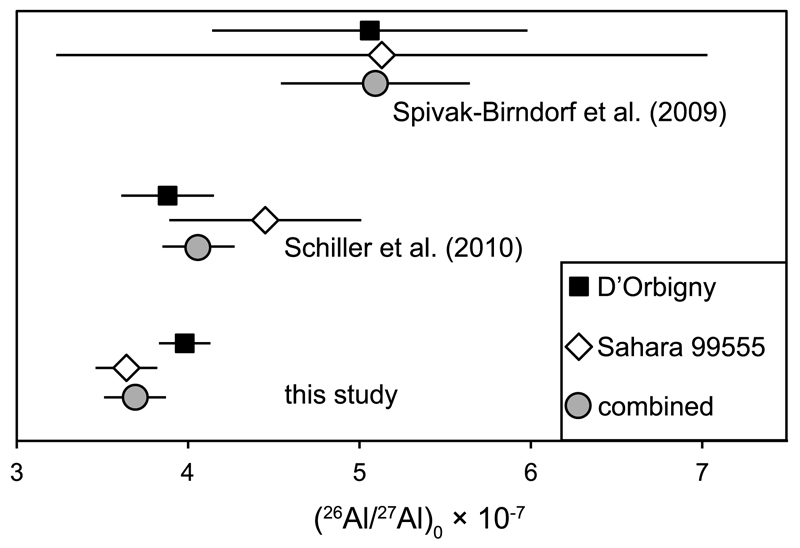
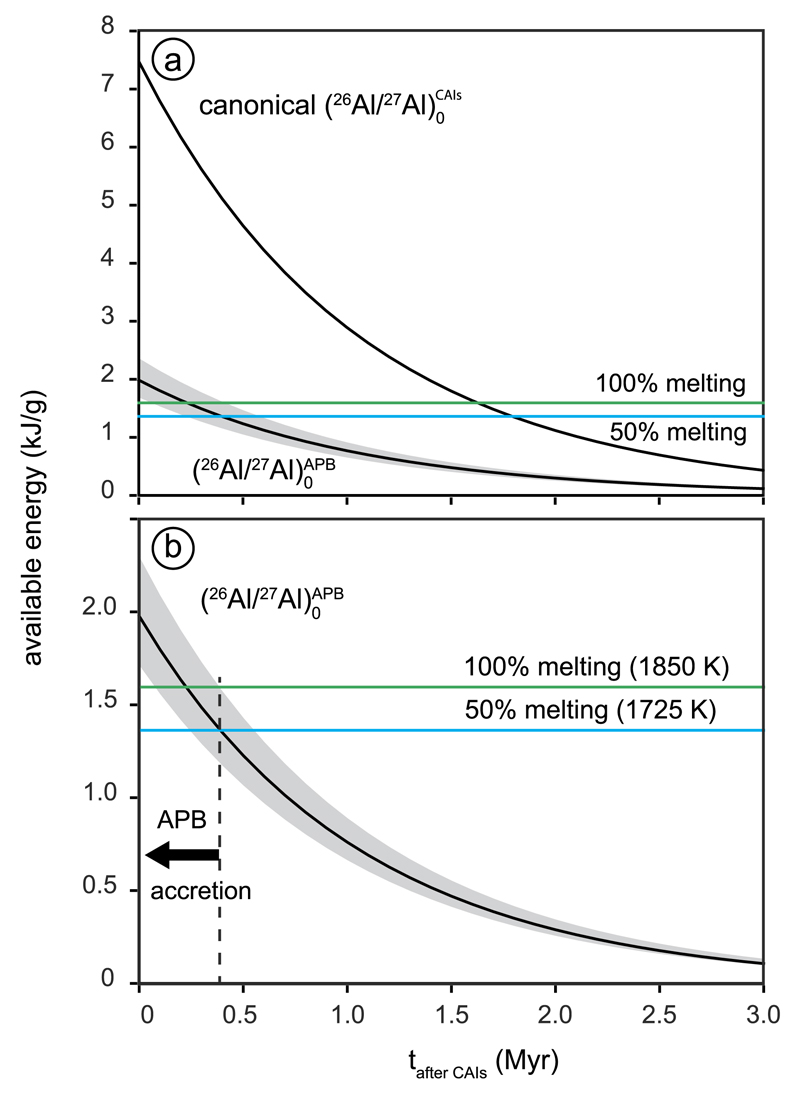
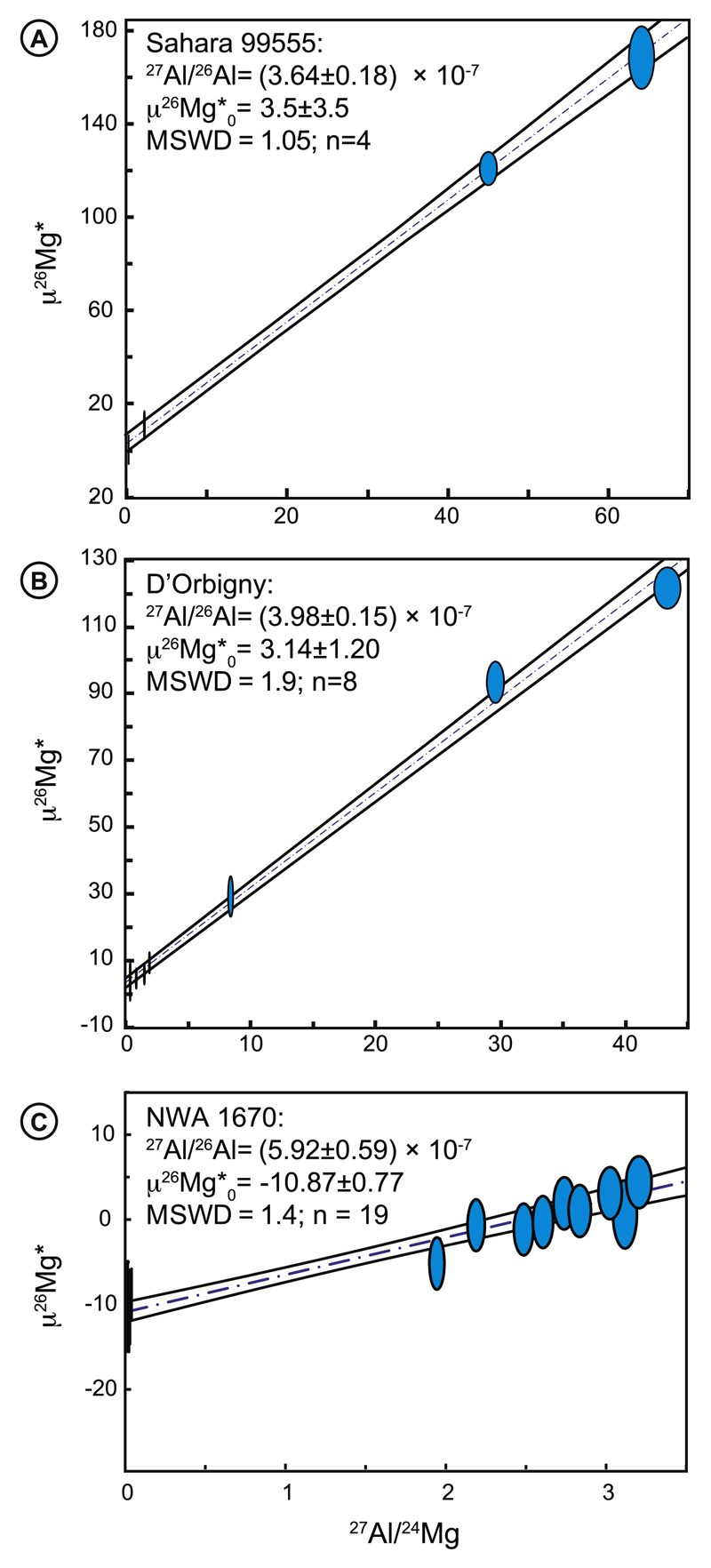
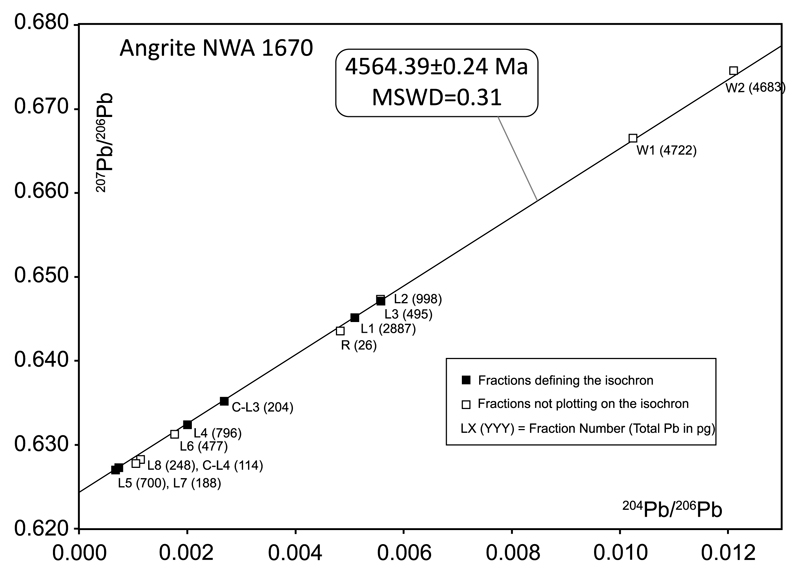
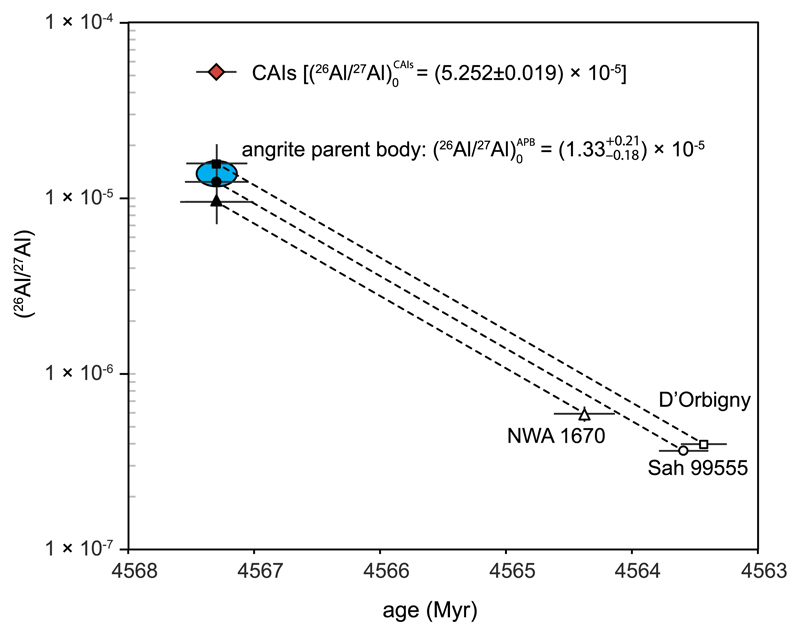
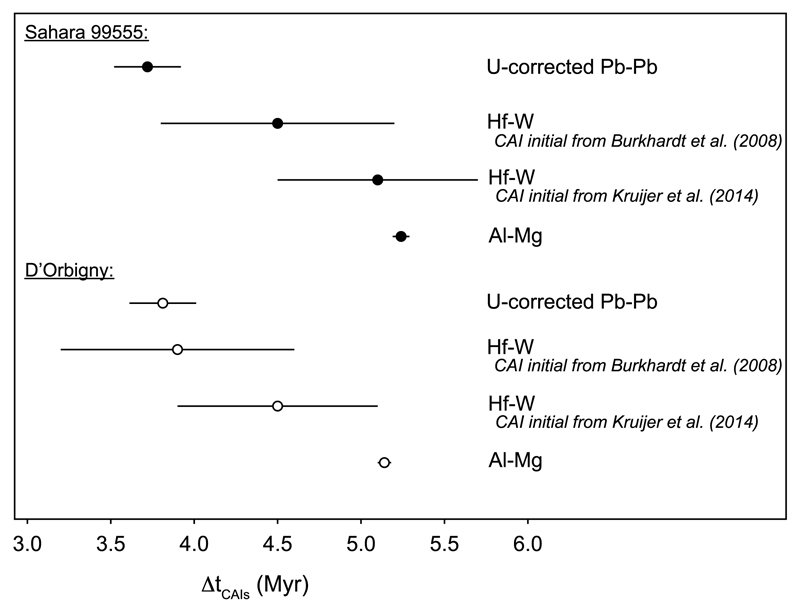
The mechanisms and timescales of accretion of 10-1000 km sized planetesimals, the building blocks of planets, are not yet well understood. With planetesimal melting predominantly driven by the decay of the short-lived radionuclide Al (Al→Mg; = 0.73 Ma), its initial abundance determines the permissible timeframe of planetesimal-scale melting and its subsequent cooling history. Currently, precise knowledge about the initial Al abundance [(Al/Al)] exists only for the oldest known solids, calcium aluminum-rich inclusions (CAIs) - the so-called canonical value. We have determined the Al/Al of three angrite meteorites, D'Orbigny, Sahara 99555 and NWA 1670, at their time of crystallization, which corresponds to (3.98 ± 0.15)×10, (3.64 ± 0.18)×10, and (5.92 ± 0.59)×10, respectively. Combined with a newly determined absolute U-corrected Pb-Pb age for NWA 1670 of 4564.39 ± 0.24 Ma and published U-corrected Pb-Pb ages for the other two angrites, this allows us to calculate an initial (Al/Al) of [Formula: see text] for the angrite parent body (APB) precursor material at the time of CAI formation, a value four times lower than the accepted canonical value of 5.25 × 10. Based on their similar Cr/Cr ratios, most inner solar system materials likely accreted from material containing a similar Al/Al ratio as the APB precursor at the time of CAI formation. To satisfy the abundant evidence for widespread planetesimal differentiation, the subcanonical Al budget requires that differentiated planetesimals, and hence protoplanets, accreted rapidly within 0.25 ± 0.15 Ma of the formation of canonical CAIs.
作为行星构成基石的10 - 1000千米大小的微行星的吸积机制和时间尺度尚未得到很好的理解。微行星的熔化主要由短寿命放射性核素铝(铝→镁;半衰期 = 0.73百万年)的衰变驱动,其初始丰度决定了微行星尺度熔化的允许时间范围及其随后的冷却历史。目前,关于初始铝丰度[(铝/铝)]的精确知识仅存在于已知最古老的固体——富钙铝包体(CAIs)中,即所谓的标准值。我们已经确定了三块钙长辉长无球粒陨石(奥伯尼陨石、撒哈拉99555陨石和NWA 1670陨石)结晶时的铝/铝比值,分别对应于(3.98 ± 0.15)×10、(3.64 ± 0.18)×10和(5.92 ± 0.59)×10。结合新测定的NWA 1670陨石经绝对铀校正后的铅 - 铅年龄为4564.39 ± 0.24百万年以及已发表的另外两块钙长辉长无球粒陨石经铀校正后的铅 - 铅年龄,这使我们能够计算出在CAIs形成时钙长辉长无球粒陨石母体(APB)前驱物质的初始(铝/铝)为[公式:见原文],该值比公认的标准值5.25 × 10低四倍。基于它们相似的铬/铬比值,大多数内太阳系物质可能是从在CAIs形成时含有与APB前驱体相似铝/铝比值的物质中吸积而来的。为了满足广泛存在的微行星分异的大量证据,低于标准值的铝储量要求分异后的微行星以及原行星在标准CAIs形成后的0.25 ± 0.15百万年内迅速吸积。