Dupont Christophe, Bradatan Elena, Soulaines Pascale, Nocerino Rita, Berni-Canani Roberto
Pediatric Gastroenterology, Hepatology and Nutrition Department, Necker Children's Hospital, 149, rue de Sèvres, 75015, Paris, France.
Department of Pediatrics, Regional Hospital, Namur, Belgium.
BMC Pediatr. 2016 Jul 18;16:96. doi: 10.1186/s12887-016-0637-3.
In case of cow's milk allergy (CMA), pediatric guidelines recommend for children the use of extensively hydrolyzed formulas (eHFs) as elimination diet. According to the American Academy of Pediatrics, the hypoallergenicity of each specific eHF should be tested in subjects with CMA.
A prospective, multicenter trial was performed to assess the tolerance/hypoallergenicity of a thickened casein-based eHF (eHCF, Allernova AR®, United Pharmaceuticals, France) in infants aged <12 months with CMA proven by a double-blind placebo-controlled food challenge. Its efficacy, measured through allergy symptoms monitoring and Cow's Milk-related Symptom Score (CoMiSS) calculation, and safety were evaluated during a 4-month feeding period. Growth z-scores were computed based on WHO anthropometric data.
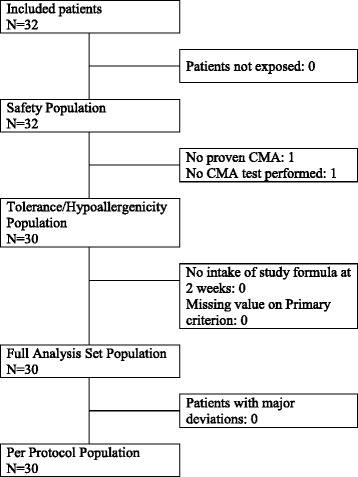
Thirty infants (mean age: 4.8 ± 3.0 months) with CMA proven by a DBPCFC tolerated the eHCF during the 4-month study. The CoMiSS, crying and regurgitation scores significantly decreased by 4.2 ± 4.0, 0.9 ±1.2 and 0.7 ± 1.1 respectively, after 14 days of feeding (p < 0.001). The Scoring Atopic Dermatitis index, of 33.2 ± 14.8 at inclusion in 9 patients, significantly decreased by 15.5 ± 6.7 and 21.1 ± 11.2, after 14 and 45 days of feeding, respectively (p < 0.001). The percentage of infants having normal stool consistency (soft or formed stools) significantly improved from 66.7 % (20/30) at inclusion to 90.0 % (27/30) after 14 days of feeding (p = 0.020). The growth z-scores, negative at study inclusion, significantly improved over the 4-month study. No adverse event was related to the eHCF.
The thickened eHCF was tolerated by more than 90 % of included allergic infants with 95 % confidence interval and can therefore be considered as hypoallergenic in accordance with current guidelines. The improvement of growth indices and absence of related adverse events confirmed its safety. Results of this trial back the use of the tested thickened eHCF as an efficient and safe alternative in children with CMA.
ClinicalTrials.gov, number NCT02351531 , registered on 27 January 2015.
对于牛奶蛋白过敏(CMA)患儿,儿科指南推荐使用深度水解配方奶粉(eHFs)作为饮食替代方案。根据美国儿科学会的建议,每种特定eHF的低过敏性应在CMA患者中进行测试。
开展一项前瞻性多中心试验,评估一种基于酪蛋白的增稠eHF(eHCF,Allernova AR®,联合制药公司,法国)在年龄小于12个月、经双盲安慰剂对照食物激发试验证实患有CMA的婴儿中的耐受性/低过敏性。在为期4个月的喂养期内,通过监测过敏症状和计算牛奶相关症状评分(CoMiSS)来评估其疗效,并评估安全性。根据世界卫生组织的人体测量数据计算生长z评分。
30名经双盲安慰剂对照食物激发试验证实患有CMA的婴儿(平均年龄:4.8±3.0个月)在为期4个月的研究中耐受了eHCF。喂养14天后,CoMiSS、哭闹和反流评分分别显著降低了4.2±4.0、0.9±1.2和0.7±1.1(p<0.001)。9名患者入组时特应性皮炎评分指数为33.2±14.8,喂养14天和45天后分别显著降低了15.5±6.7和21.1±11.2(p<0.001)。大便性状正常(软便或成形便)的婴儿比例从入组时的66.7%(20/30)显著提高到喂养14天后的90.0%(27/30)(p=0.020)。研究入组时为负的生长z评分在为期4个月的研究中显著改善。未发现与eHCF相关的不良事件。
超过90%的纳入研究的过敏婴儿耐受了增稠eHCF,95%置信区间内,因此根据现行指南可认为其具有低过敏性。生长指标的改善以及无相关不良事件证实了其安全性。本试验结果支持将受试增稠eHCF作为CMA患儿有效且安全的替代方案。
ClinicalTrials.gov,编号NCT02351531,于2015年1月27日注册。