Department of Neurosurgery, The Johns Hopkins University School of Medicine, Baltimore, Maryland, United States.
Division of Spine, Department of Orthopaedics, University of British Columbia and Vancouver General Hospital, Vancouver, British Columbia, Canada.
Global Spine J. 2016 Aug;6(5):482-96. doi: 10.1055/s-0035-1564807. Epub 2015 Oct 21.
Review of the literature.
Surgery and cement augmentation procedures are effective palliative treatment of symptomatic spinal metastases. Our objective is to systematically review the literature to describe the survival, prognostic factors, and clinical outcomes of surgery and cement augmentation procedures for breast cancer metastases to the spine.
We performed a literature review using PubMed to identify articles that reported outcomes and/or prognostic factors of the breast cancer patient population with spinal metastases treated with any surgical technique since 1990.
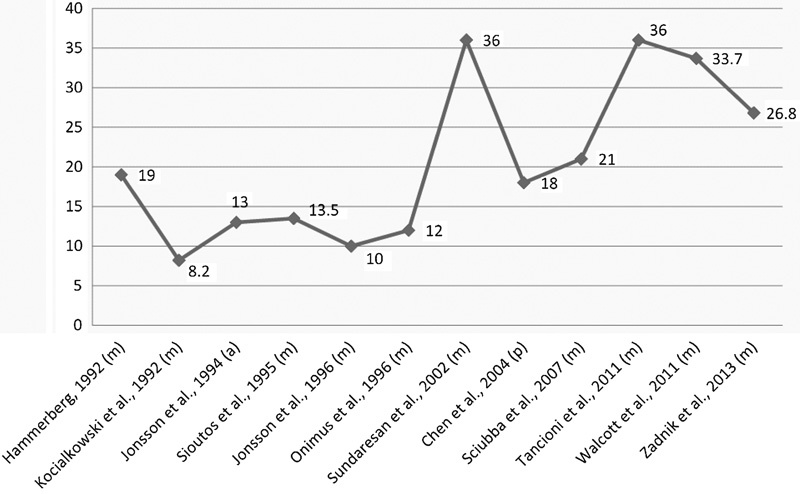
The median postoperative survival for metastatic breast cancer was 21.7 months (8.2 to 36 months), the mean rate of any pain improvement was 92.9% (76 to 100%), the mean rate of neurologic improvement was 63.8% (53 to 100%), the mean rate of neurologic decline was 4.1% (0 to 8%), and the local tumor control rate was 92.6% (89 to 100%). Kyphoplasty studies reported a high rate of pain control in selected patients. Negative prognostic variables included hormonal (estrogen and progesterone) and human epidermal growth factor receptor 2 (HER2) receptor refractory tumor status, high degree of axillary lymph node involvement, and short disease-free interval (DFI). All other clinical or prognostic parameters were of low or insufficient strength.
With respect to clinical outcomes, surgery consistently yielded neurologic improvements in patients presenting with a deficit with a minimal risk of worsening; however, negative prognostic factors associated with shorter survival following surgery include estrogen receptor/progesterone receptor negativity, HER2 negativity, and a short DFI.
文献回顾。
手术和骨水泥强化术是治疗症状性脊柱转移瘤的有效姑息性治疗方法。我们的目的是系统地回顾文献,描述手术和骨水泥强化术治疗乳腺癌脊柱转移的生存、预后因素和临床结果。
我们使用 PubMed 进行文献回顾,以确定自 1990 年以来报道过任何手术技术治疗乳腺癌脊柱转移患者的结局和/或预后因素的文章。
转移性乳腺癌的术后中位生存时间为 21.7 个月(8.2 至 36 个月),任何疼痛改善的平均率为 92.9%(76 至 100%),神经功能改善的平均率为 63.8%(53 至 100%),神经功能下降的平均率为 4.1%(0 至 8%),局部肿瘤控制率为 92.6%(89 至 100%)。经皮椎体后凸成形术研究报告称,在选定的患者中,疼痛控制率很高。负性预后因素包括激素(雌激素和孕激素)和人表皮生长因子受体 2(HER2)受体耐药肿瘤状态、腋窝淋巴结高程度受累和无病间隔(DFI)短。所有其他临床或预后参数的强度均较低或不足。
就临床结果而言,手术可使有神经功能缺损的患者获得神经功能改善,且风险极小;然而,与手术后生存时间较短相关的负性预后因素包括雌激素受体/孕激素受体阴性、HER2 阴性和 DFI 短。