Max Planck Institute for Demographic Research, Rostock, Germany.
Department of Occupational Therapy, The University of Texas Medical Branch, Galveston.
J Gerontol B Psychol Sci Soc Sci. 2018 Jun 14;73(5):913-922. doi: 10.1093/geronb/gbw082.
This article seeks to document the progression of disability in a developing country by implementing a model to examine how this process compares to a developed country.
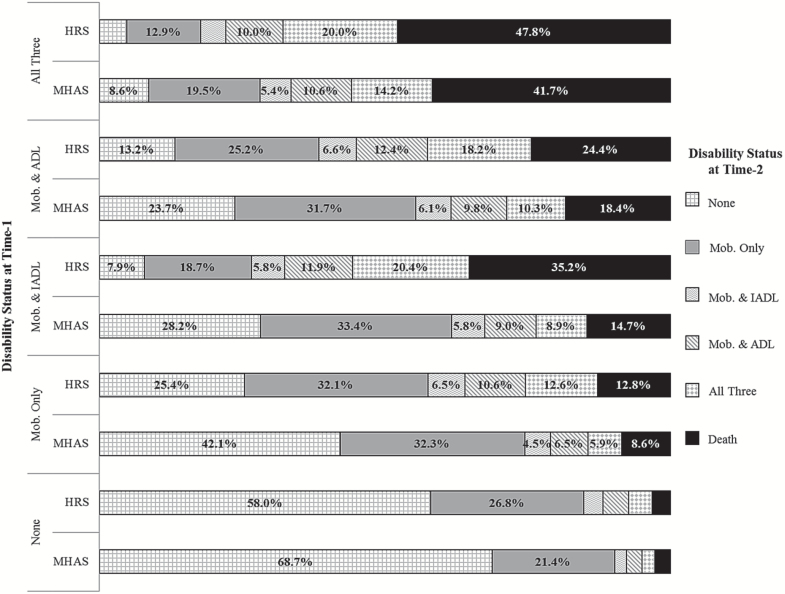
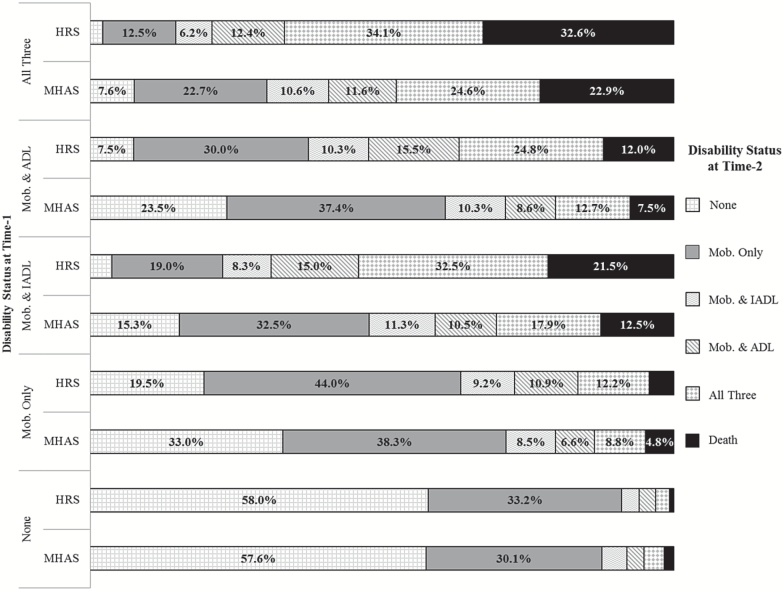
Data come from the Mexican Health and Aging Study (MHAS), including a baseline survey in 2001 and a follow-up in 2003, and from the U.S. Health and Retirement Study (HRS), using the 2000 and 2002 waves. An ordinal logistic regression approach is used to examine a progression of disability that considers (a) no disability, (b) mobility problems, (c) mobility plus limitations with instrumental activities of daily living, (d) mobility plus limitations with activities of daily living (ADLs), (e) limitations in all three areas and (f) death.
In both data sets, approximately 44% of the sample remained in the same level of disability at the 2-year follow-up. However, the progression of limitations with two disabilities differs by gender in the MHAS but is consistent for both men and women in the HRS.
Our model reflects the importance of ADLs in the disablement process in Mexico. We speculate that the difference in lifetime risk profiles and cultural context might be responsible for the divergence in the progression of disability by gender.
本文旨在通过构建一个模型来记录发展中国家的残疾进展情况,并将这一过程与发达国家进行比较。
数据来源于墨西哥健康与老龄化研究(MHAS),包括 2001 年的基线调查和 2003 年的随访,以及美国健康与退休研究(HRS),使用 2000 年和 2002 年的两个波次。采用有序逻辑回归方法来检验残疾的进展情况,该方法考虑了(a)无残疾、(b)行动不便、(c)行动不便且日常生活活动受限、(d)行动不便且日常生活活动受限、(e)所有三个方面受限以及(f)死亡。
在两个数据集,大约 44%的样本在 2 年随访时仍处于相同的残疾水平。然而,在 MHAS 中,两种残疾的限制进展因性别而异,而在 HRS 中,无论男性还是女性,这种进展都是一致的。
我们的模型反映了日常生活活动在墨西哥残疾发生过程中的重要性。我们推测,终生风险特征和文化背景的差异可能是导致残疾进展在性别上存在差异的原因。