Mari-Sanchis A, Gea A, Basterra-Gortari F J, Martinez-Gonzalez M A, Beunza J J, Bes-Rastrollo M
Department of Preventive Medicine and Public Health, University of Navarra, Pamplona, Spain.
Nutrition Unit-Department of Endocrinology and Nutrition, Hospital de Navarra, Pamplona, Spain.
PLoS One. 2016 Jul 20;11(7):e0157990. doi: 10.1371/journal.pone.0157990. eCollection 2016.
Meat consumption has been consistently associated with the risk of diabetes in different populations. The aim of our study was to investigate the incidence of type 2 diabetes according to baseline total meat consumption in a longitudinal assessment of a middle-aged Mediterranean population.
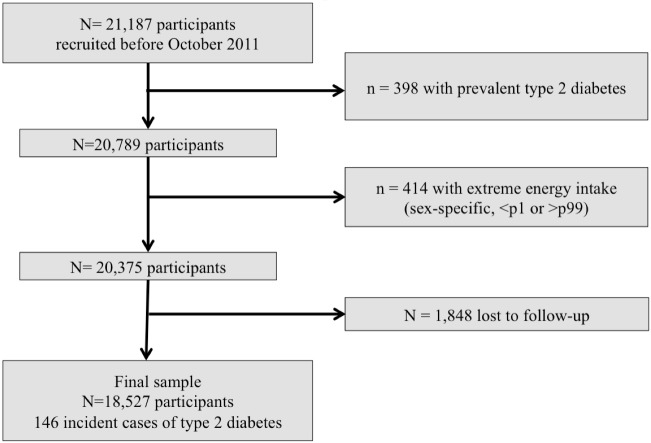
We followed 18,527 participants (mean age: 38 years, 61% women) in the SUN Project, an open-enrolment cohort of a highly educated population of middle-class Spanish graduate students. All participants were initially free of diabetes. Diet was assessed at baseline using a semi-quantitative food frequency questionnaire of 136-items previously validated. Incident diabetes was defined according to the American Diabetes Association's criteria.
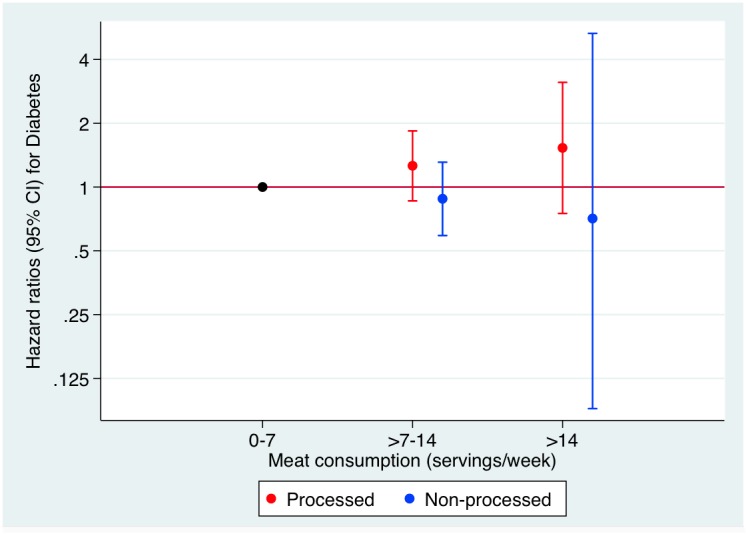
We identified 146 incident cases of diabetes after a maximum of 14 years of follow-up period (mean: 8.7 years). In the fully adjusted model, the consumption of ≥3 servings/day of all types of meat was significantly associated with a higher risk of diabetes (HR: 1.85; 95% CI: 1.03-3.31; p for trend = 0.031) in comparison with the reference category (<2 servings/day). When we separated processed from non-processed meat, we observed a non-significant higher risk associated with greater consumption of processed meat and a non-significant lower risk associated with non-processed meat consumption (p for trend = 0.123 and 0.487, respectively). No significant difference was found between the two types of meat (p = 0.594).
Our results suggest that meat consumption, especially processed meat, was associated with a higher risk of developing diabetes in our young Mediterranean cohort.
在不同人群中,肉类消费一直与糖尿病风险相关。我们研究的目的是在对中年地中海人群的纵向评估中,根据基线总肉类消费量调查2型糖尿病的发病率。
我们在SUN项目中跟踪了18527名参与者(平均年龄:38岁,61%为女性),该项目是一个针对西班牙中产阶级研究生的高学历人群的开放入组队列。所有参与者最初均无糖尿病。在基线时使用一份先前验证过的136项半定量食物频率问卷评估饮食情况。根据美国糖尿病协会的标准定义新发糖尿病。
在最长14年的随访期(平均:8.7年)后,我们确定了146例糖尿病新发病例。在完全调整模型中,与参考类别(<2份/天)相比,每天食用≥3份各类肉类与更高的糖尿病风险显著相关(风险比:1.85;95%置信区间:1.03 - 3.31;趋势p值 = 0.031)。当我们将加工肉类与未加工肉类分开时,我们观察到加工肉类消费量增加与非显著更高的风险相关,未加工肉类消费与非显著更低的风险相关(趋势p值分别为0.123和0.487)。两种肉类之间未发现显著差异(p = 0.594)。
我们的结果表明,在我们年轻的地中海队列中,肉类消费,尤其是加工肉类,与患糖尿病的较高风险相关。