Department of Epidemiology and Health Statistics, College of Public Health, Zhengzhou University, Zhengzhou 450000, China.
Department of Clinical Pharmacology, School of Pharmaceutical Science, Zhengzhou University, Zhengzhou 450000, China.
Nutrients. 2019 Nov 15;11(11):2783. doi: 10.3390/nu11112783.
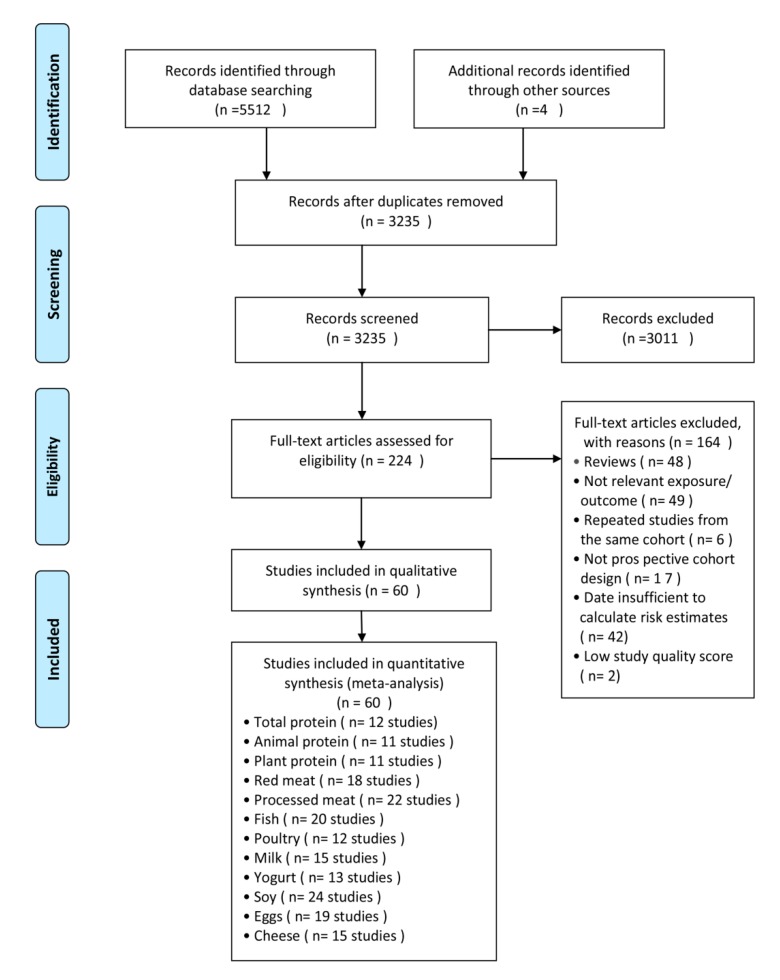
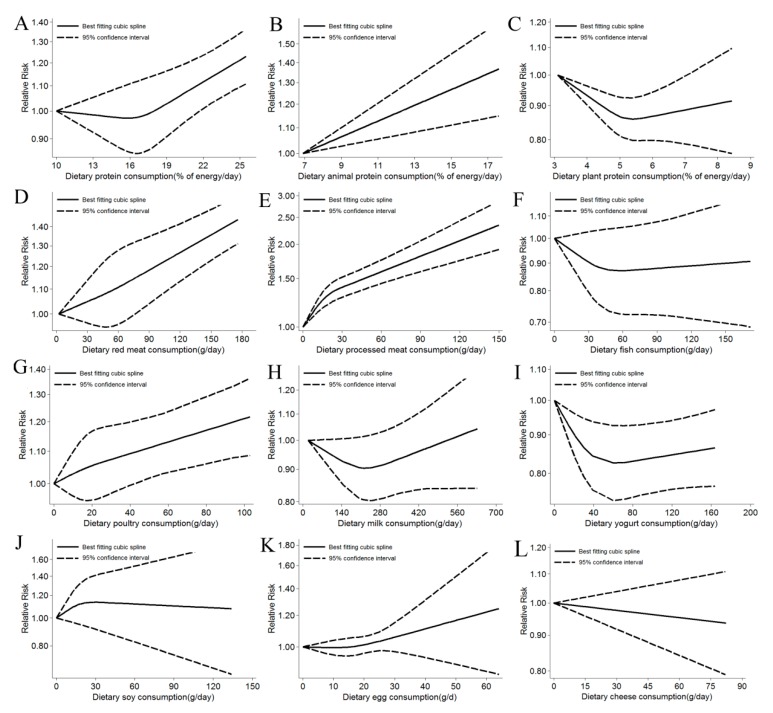
The relationship between dietary protein consumption and the risk of type 2 diabetes (T2D) has been inconsistent. The aim of this meta-analysis was to explore the relations between dietary protein consumption and the risk of T2D. We conducted systematic retrieval of prospective studies in PubMed, Embase, and Web of Science. Summary relative risks were compiled with a fixed effects model or a random effects model, and a restricted cubic spline regression model and generalized least squares analysis were used to evaluate the diet-T2D incidence relationship. T2D risk increased with increasing consumption of total protein and animal protein, red meat, processed meat, milk, and eggs, respectively, while plant protein and yogurt had an inverse relationship. A non-linear association with the risk for T2D was found for the consumption of plant protein, processed meat, milk, yogurt, and soy. This meta-analysis suggests that substitution of plant protein and yogurt for animal protein, especially red meat and processed meat, can reduce the risk for T2D.
膳食蛋白质摄入量与 2 型糖尿病(T2D)风险之间的关系一直存在争议。本荟萃分析旨在探讨膳食蛋白质摄入量与 T2D 风险之间的关系。我们在 PubMed、Embase 和 Web of Science 中进行了系统检索前瞻性研究。使用固定效应模型或随机效应模型汇总了汇总相对风险,并使用限制立方样条回归模型和广义最小二乘法分析评估了饮食-T2D 发病关系。总蛋白质和动物蛋白质、红肉、加工肉、牛奶和鸡蛋的摄入量与 T2D 风险呈正相关,而植物蛋白质和酸奶则呈负相关。植物蛋白质、加工肉、牛奶、酸奶和大豆的摄入量与 T2D 的风险呈非线性关联。本荟萃分析表明,用植物蛋白质和酸奶替代动物蛋白质,特别是红肉和加工肉,可降低 T2D 的风险。