Wu Wenrui, Guo Feifei, Ye Jianzhong, Li Yating, Shi Ding, Fang Daiqiong, Guo Jing, Li Lanjuan
State Key Laboratory for Diagnosis and Treatment of Infectious Diseases, The First Affiliated Hospital, School of Medicine, Zhejiang University, Hangzhou, China.
Collaborative Innovation Center for Diagnosis and Treatment of Infectious Diseases, Hangzhou, China.
Oncotarget. 2016 Aug 9;7(32):52095-52103. doi: 10.18632/oncotarget.10603.
Physical activity is associated with reduced risk of colorectal cancer. However, whether physical activity could impart cancer patients' survival benefits remains uncertain. The aim of this study is to systematically evaluate the relationship between physical activity and colorectal cancer mortality.
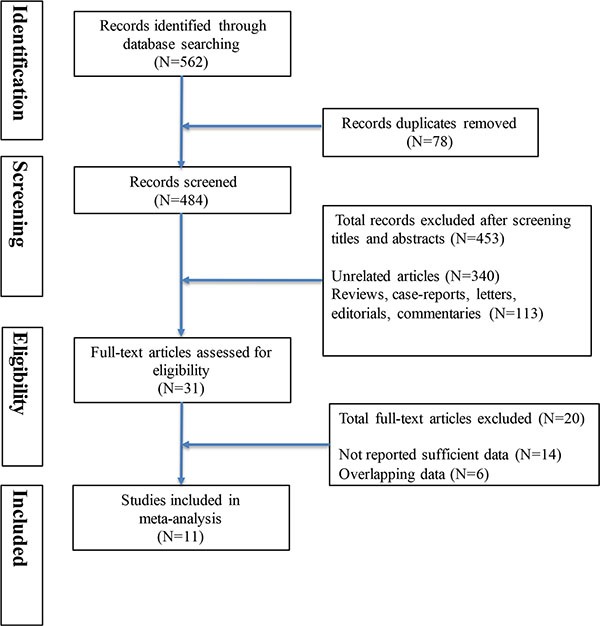
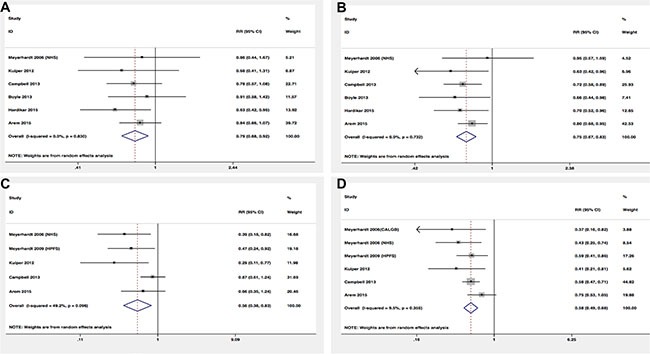
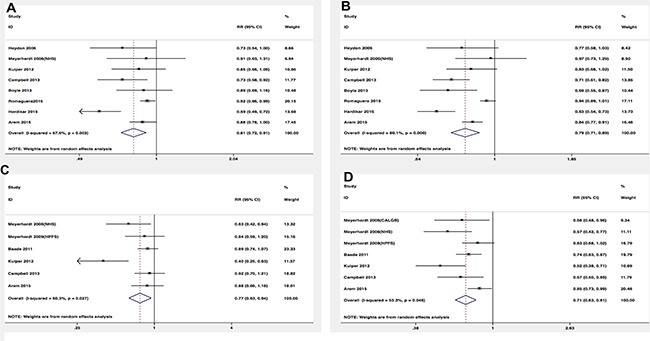
Our meta-analysis included 11 studies involving 17,295 patients with a follow-up period ranging from 3.8 to 11.9 years. Results indicated that physical activity was inversely associated with overall (RR = 0.81, 95% CI = 0.72-0.91) and colorectal cancer-specific mortality (RR = 0.79, 95% CI = 0.71-0.89) before the diagnosis of cancer, respectively. For physical activity after diagnosis, the pooled RRs of colorectal cancer-specific and total mortality were 0.77 (95% CI, 0.63-0.94) and 0.71 (95% CI, 0.63-0.81), respectively. Similar inverse associations between exercise and prognosis were found among colorectal cancer survivors who had high-level exercise compared with those who had low-level exercise or were inactive. There was no obvious evidence for publication bias among studies.
We performed a systematic data search in PubMed, Cochrane Library databases and Web of Science for relevant articles before Jan 2016. We adopted adjusted estimates to calculate pooled relative risks (RRs) with 95% confidence intervals (CI) by the random-effects model. The publication bias was assessed by Begg's test.
Our meta-analysis provides comprehensive evidence that physical activity, whether before or after the diagnosis of colorectal cancer, is related to reduced overall and cancer-specific mortality. Our findings may have significant public health implications and more prospective randomized clinical trials should be warranted to certify this protective association.
体力活动与降低结直肠癌风险相关。然而,体力活动是否能给癌症患者带来生存益处仍不确定。本研究旨在系统评估体力活动与结直肠癌死亡率之间的关系。
我们的荟萃分析纳入了11项研究,涉及17295例患者,随访期为3.8至11.9年。结果表明,在癌症诊断前,体力活动分别与总体死亡率(RR = 0.81,95%CI = 0.72 - 0.91)和结直肠癌特异性死亡率(RR = 0.79,95%CI = 0.71 - 0.89)呈负相关。对于诊断后的体力活动,结直肠癌特异性死亡率和总死亡率的合并RR分别为0.77(95%CI,0.63 - 0.94)和0.71(95%CI,0.63 - 0.81)。与低水平运动或不运动的结直肠癌幸存者相比,高水平运动的幸存者中也发现了运动与预后之间类似的负相关。研究中没有明显的发表偏倚证据。
我们在PubMed、Cochrane图书馆数据库和科学网中对2016年1月前的相关文章进行了系统的数据检索。我们采用调整后的估计值,通过随机效应模型计算合并相对风险(RR)及95%置信区间(CI)。通过Begg检验评估发表偏倚。
我们的荟萃分析提供了全面的证据,表明无论在结直肠癌诊断之前还是之后,体力活动都与降低总体死亡率和癌症特异性死亡率相关。我们的发现可能具有重大的公共卫生意义,应该进行更多的前瞻性随机临床试验来证实这种保护关联。