Huang Poyin, Cheng Chiou-Ling, Chang Ya-Hsuan, Liu Chia-Hsin, Hsu Yi-Chiung, Chen Jin-Shing, Chang Gee-Chen, Ho Bing-Ching, Su Kang-Yi, Chen Hsuan-Yu, Yu Sung-Liang
Department of Neurology, Kaohsiung Municipal Hsiao-Kang Hospital, Kaohsiung Medical University, Kaohsiung, Taiwan.
Department of Neurology, Kaohsiung Medical University Hospital, Kaohsiung Medical University, Kaohsiung, Taiwan.
Oncotarget. 2016 Aug 9;7(32):51898-51907. doi: 10.18632/oncotarget.10622.
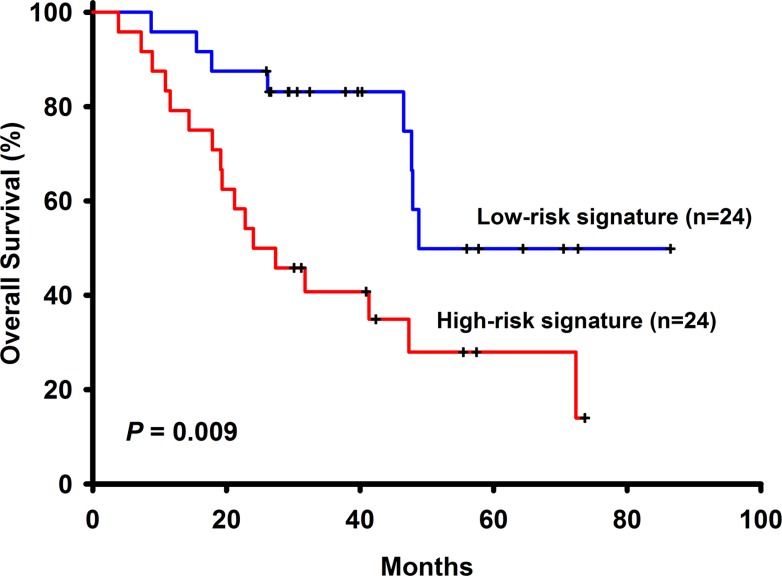
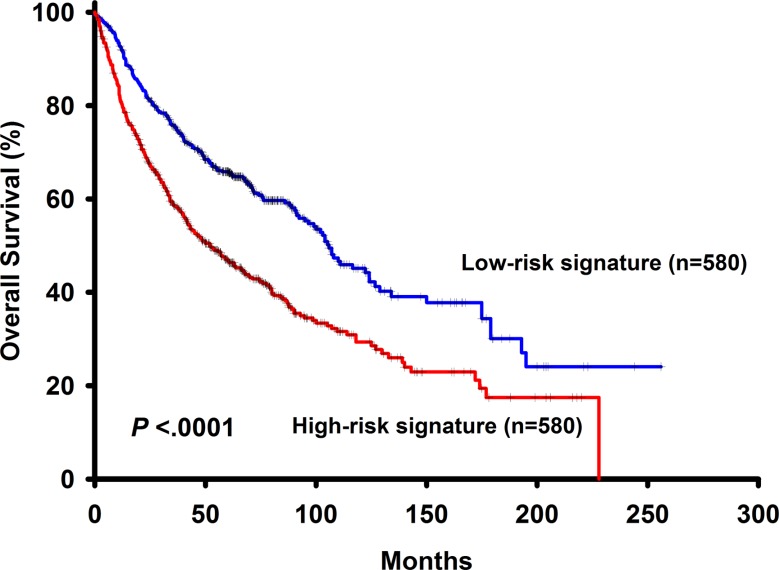
The current staging system for non-small cell lung cancer (NSCLC) is inadequate for predicting outcome. Risk score, a linear combination of the values for the expression of each gene multiplied by a weighting value which was estimated from univariate Cox proportional hazard regression, can be useful. The aim of this study is to analyze survival-related genes with TaqMan Low-Density Array (TLDA) and risk score to explore gene-signature in lung cancer. A total of 96 NSCLC specimens were collected and randomly assigned to a training (n = 48) or a testing cohort (n = 48). A panel of 219 survival-associated genes from published studies were used to develop a 6-gene risk score. The risk score was used to classify patients into high or low-risk signature and survival analysis was performed. Cox models were used to evaluate independent prognostic factors. A 6-gene signature including ABCC4, ADRBK2, KLHL23, PDS5A, UHRF1 and ZNF551 was identified. The risk score in both training (HR = 3.14, 95% CI: 1.14-8.67, p = 0.03) and testing cohorts (HR = 5.42, 95% CI: 1.56-18.84, p = 0.01) was the independent prognostic factor. In merged public datasets including GSE50081, GSE30219, GSE31210, GSE19188, GSE37745, GSE3141 and GSE31908, the risk score (HR = 1.50, 95% CI: 1.25-1.80, p < 0.0001) was also the independent prognostic factor. The risk score generated from expression of a small number of genes did perform well in predicting overall survival and may be useful in routine clinical practice.
目前的非小细胞肺癌(NSCLC)分期系统在预测预后方面存在不足。风险评分,即每个基因表达值乘以通过单变量Cox比例风险回归估计的权重值后的线性组合,可能会有所帮助。本研究的目的是使用TaqMan低密度阵列(TLDA)和风险评分分析与生存相关的基因,以探索肺癌的基因特征。共收集了96例NSCLC标本,并随机分为训练组(n = 48)或测试组(n = 48)。使用来自已发表研究的一组219个与生存相关的基因来制定一个6基因风险评分。该风险评分用于将患者分为高风险或低风险特征,并进行生存分析。使用Cox模型评估独立的预后因素。确定了一个包含ABCC4、ADRBK2、KLHL23、PDS5A、UHRF1和ZNF551的6基因特征。训练组(HR = 3.14,95% CI:1.14 - 8.67,p = 0.03)和测试组(HR = 5.42,95% CI:1.56 - 18.84,p = 0.01)中的风险评分均为独立的预后因素。在包括GSE50081、GSE30219、GSE31210、GSE19188、GSE37745、GSE3141和GSE