Sakai Kent, Sanders Kristen M, Youssef Marina R, Yanushefski Kevin M, Jensen Liselotte, Yosipovitch Gil, Akiyama Tasuku
Department of Dermatology, Temple Itch Center, Temple University, Philadelphia, PA, USA.
Department of Microbiology and Immunology, Temple Autoimmunity Center, Temple University, Philadelphia, PA, USA.
Pain. 2016 Nov;157(11):2536-2543. doi: 10.1097/j.pain.0000000000000674.
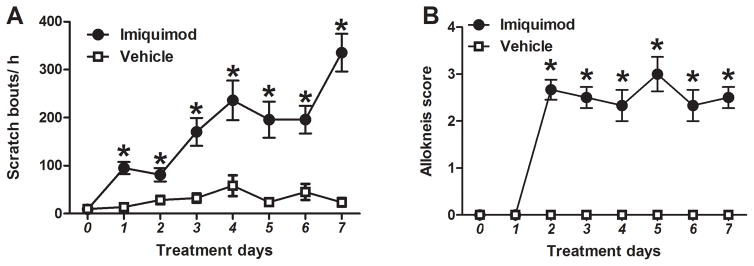
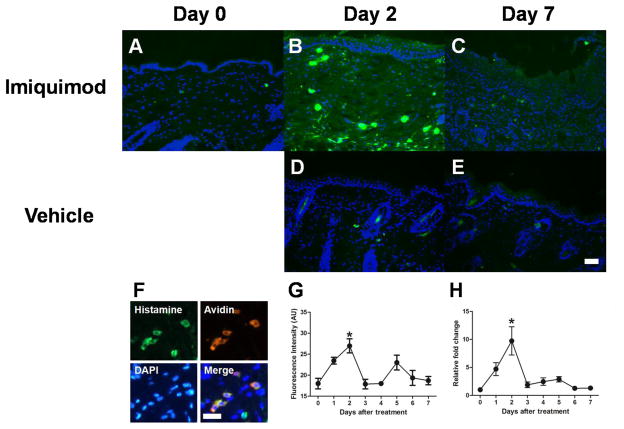
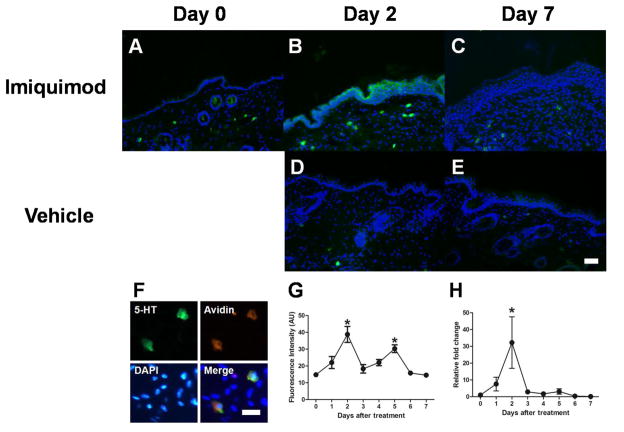
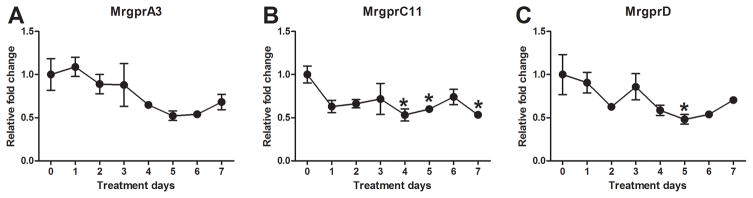
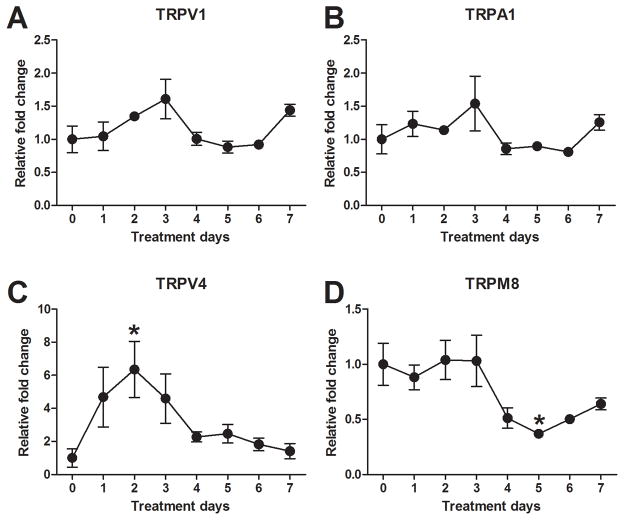
Itch is a major indicator of psoriasis, but the underlying mechanisms behind this symptom are largely unknown. To investigate the neuronal mechanisms of psoriatic itch, we tested whether mice subjected to the imiquimod-induced psoriasis model exhibit itch-associated behaviors. Mice received daily topical applications of imiquimod to the rostral back skin for 7 days. Imiquimod-treated mice exhibited a significant increase in spontaneous scratching behavior directed to the treated area as well as touch-evoked scratching (alloknesis). To characterize this model, we measured the mRNA expression levels of pruritogens and itch-relevant receptors/channels using real-time reverse transcription PCR. The mRNA expression of MrgprA3, MrgprC11, and MrgprD decreased gradually over time in the dorsal root ganglion (DRG) cells. There was no significant change in the mRNA expression of TRPV1 or TRPA1 in DRG cells. TRPV4 mRNA expression was transiently increased in the DRG cells, whereas TRPM8 mRNA was significantly decreased. The mRNA expression levels of histidine decarboxylase and tryptophan hydroxylase 1, as well as the intensity of histamine and serotonin immunoreactivity, were transiently increased in the skin on day 2, returning to baseline by day 7. Histamine H1-receptor antagonists, chlorpheniramine and olopatadine, significantly inhibited spontaneous scratching on day 2, but not day 7. Neither chlorpheniramine nor olopatadine affected alloknesis on day 2 or day 7. These results may reflect the limited antipruritic effects of histamine H1-receptor antagonists on human psoriasis. The imiquimod-induced psoriasis model seems to be useful for the investigation of itch and its sensitization in psoriasis.
瘙痒是银屑病的主要指标,但该症状背后的潜在机制在很大程度上尚不清楚。为了研究银屑病瘙痒的神经机制,我们测试了经咪喹莫特诱导的银屑病模型小鼠是否表现出与瘙痒相关的行为。小鼠每天在鼻背部皮肤局部涂抹咪喹莫特,持续7天。经咪喹莫特治疗的小鼠在治疗区域的自发搔抓行为以及触觉诱发的搔抓(异常性瘙痒)显著增加。为了表征该模型,我们使用实时逆转录PCR测量了瘙痒原和与瘙痒相关的受体/通道的mRNA表达水平。背根神经节(DRG)细胞中MrgprA3、MrgprC11和MrgprD的mRNA表达随时间逐渐下降。DRG细胞中TRPV1或TRPA1的mRNA表达没有显著变化。DRG细胞中TRPV4的mRNA表达短暂增加,而TRPM8的mRNA显著下降。组胺脱羧酶和色氨酸羟化酶1的mRNA表达水平以及组胺和5-羟色胺免疫反应的强度在第2天皮肤中短暂增加,到第7天恢复到基线水平。组胺H1受体拮抗剂氯苯那敏和奥洛他定在第2天显著抑制自发搔抓,但在第7天没有作用。氯苯那敏和奥洛他定在第2天或第7天都不影响异常性瘙痒。这些结果可能反映了组胺H1受体拮抗剂对人类银屑病的止痒作用有限。咪喹莫特诱导的银屑病模型似乎对研究银屑病中的瘙痒及其致敏作用有用。