Toivanen Susanna, Griep Rosane Härter, Mellner Christin, Vinberg Stig, Eloranta Sandra
Centre for Health Equity Studies, Stockholm University/Karolinska Institutet, Stockholm, Sweden.
Centre for Health Equity Studies, Stockholm University/Karolinska Institutet, Stockholm, Sweden Laboratory of Health and Environment Education, Oswaldo Cruz Institute, Oswaldo Cruz Foundation (Fiocruz), Rio de Janeiro, Brazil.
Occup Environ Med. 2016 Sep;73(9):627-36. doi: 10.1136/oemed-2015-103472. Epub 2016 Jul 21.
Analyse mortality differences between self-employed and paid employees with a focus on industrial sector, educational level and gender using Swedish register data.
A cohort of the total working population (4 776 135 individuals; 7.2% self-employed; 18-100 years of age at baseline 2003) in Sweden with a 5-year follow-up (2004-2008) for all-cause and cause-specific mortality (57 743 deaths). Self-employed individuals were categorised as sole proprietors or limited liability company (LLC) owners according to their enterprise's legal form. Cox proportional hazards models were applied to compare mortality rates between sole proprietors, LLC owners and paid employees, adjusted for sociodemographic confounders.
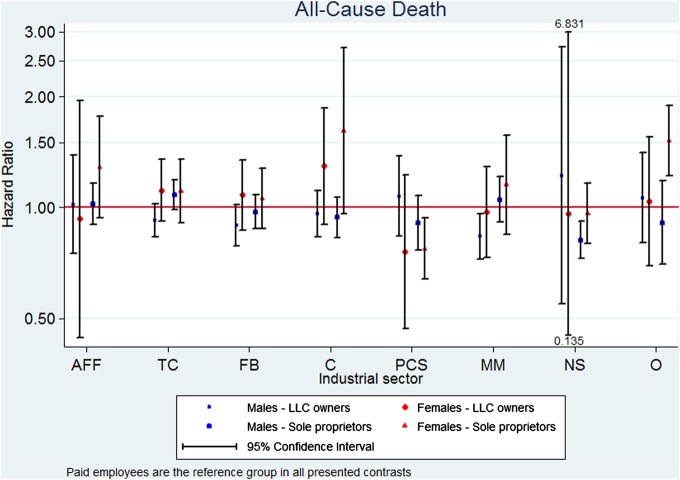
Mortality from cardiovascular diseases was 16% lower and from suicide 26% lower among LLC owners than among paid employees, adjusted for confounders. Within the industrial category, all-cause mortality was 13-15% lower among sole proprietors and LLC owners compared with employees in manufacturing and mining (MM) as well as personal and cultural services (PCS), and 11-20% higher in sole proprietors in trade, transport and communication and the welfare industry (W). A significant three-way interaction indicated 17-23% lower all-cause mortality among male LLC owners in MM and female sole proprietors in PCS, and 50% higher mortality in female sole proprietors in W than in employees in the same industries.
Mortality differences between self-employed individuals and paid employees vary by the legal form of self-employment, across industries, and by gender. Differences in work environment exposures and working conditions, varying market competition across industries and gender segregation in the labour market are potential mechanisms underlying these findings.
利用瑞典登记数据,分析个体经营者和受薪雇员之间的死亡率差异,重点关注行业部门、教育水平和性别。
对瑞典全体在职人口(4776135人;7.2%为个体经营者;2003年基线时年龄在18至100岁之间)进行队列研究,随访5年(2004 - 2008年),记录全因死亡率和特定原因死亡率(57743例死亡)。个体经营者根据其企业的法律形式分为独资经营者或有限责任公司(LLC)所有者。应用Cox比例风险模型比较独资经营者、LLC所有者和受薪雇员之间的死亡率,并对社会人口学混杂因素进行调整。
在调整混杂因素后,LLC所有者中心血管疾病死亡率比受薪雇员低16%,自杀死亡率低26%。在行业类别中,独资经营者和LLC所有者的全因死亡率比制造业和采矿业(MM)以及个人和文化服务业(PCS)的雇员低13 - 15%,而贸易、运输和通信以及福利行业(W)的独资经营者全因死亡率比同行业雇员高11 - 20%。显著的三向交互作用表明,MM行业中男性LLC所有者和PCS行业中女性独资经营者的全因死亡率低17 - 23%,而W行业中女性独资经营者的死亡率比同行业雇员高50%。
个体经营者和受薪雇员之间的死亡率差异因个体经营的法律形式、行业和性别而异。工作环境暴露和工作条件的差异、各行业不同的市场竞争以及劳动力市场中的性别隔离是这些研究结果的潜在机制。