College of Plant Science and Technology, Huazhong Agricultural University, Wuhan 430070, China.
Sci Rep. 2016 Jul 22;6:30303. doi: 10.1038/srep30303.
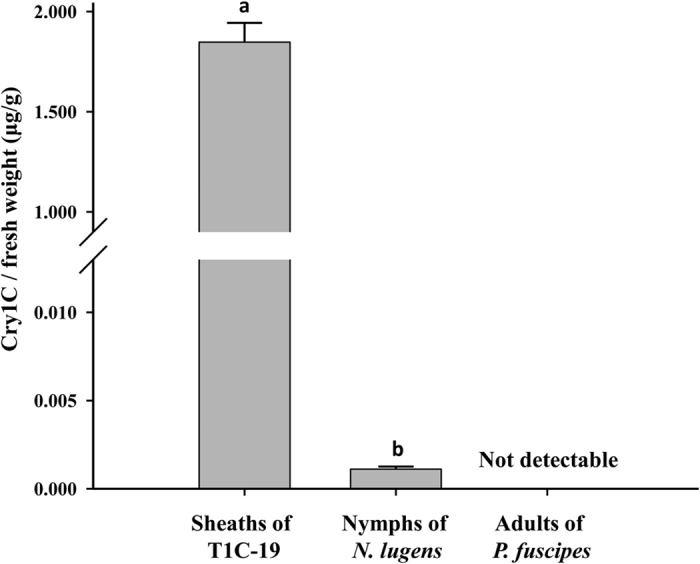
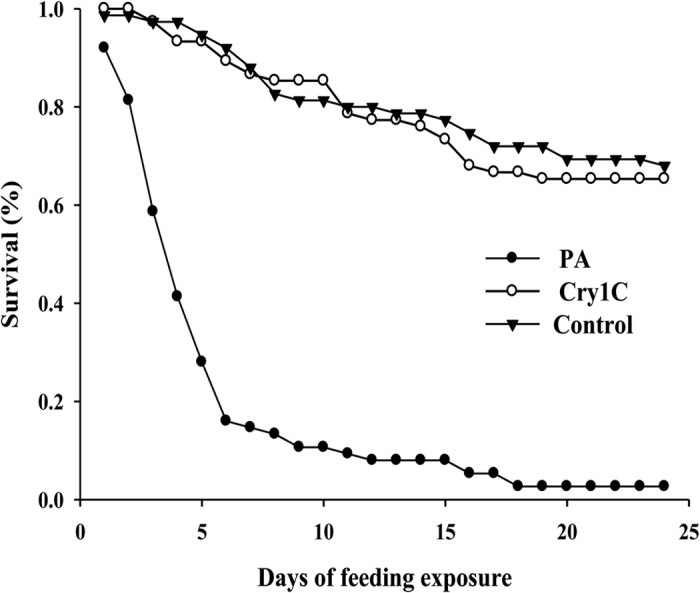
T1C-19 is newly developed transgenic rice active against lepidopteran pests, and expresses a synthesized cry1C gene driven by the maize ubiquitin promoter. The brown planthopper, Nilaparvata lugens, is a major non-target pest of rice, and the rove beetle (Paederus fuscipes) is a generalist predator of N. lugens nymphs. As P. fuscipes may be exposed to the Cry1C protein through preying on N. lugens, it is essential to assess the potential effects of transgenic cry1C rice on this predator. In this study, two experiments (a direct feeding experiment and a tritrophic experiment) were conducted to evaluate the ecological risk of cry1C rice to P. fuscipes. No significant negative effects were observed in the development, survival, female ratio and body weight of P. fuscipes in both treatments of direct exposure to elevated doses of Cry1C protein and prey-mediated exposure to realistic doses of the protein. This indicated that cry1C rice had no detrimental effects on P. fuscipes. This work represents the first study of an assessment continuum for the effects of transgenic cry1C rice on P. fuscipes. Use of the rove beetle as an indicator species to assess potential effects of genetically modified crops on non-target arthropods is feasible.
T1C-19 是一种新开发的抗鳞翅目害虫的转基因水稻,它表达了一种由玉米泛素启动子驱动的合成 cry1C 基因。褐飞虱是水稻的主要非靶标害虫,而步甲(Paederus fuscipes)是褐飞虱若虫的广谱捕食者。由于步甲可能通过捕食褐飞虱而接触到 Cry1C 蛋白,因此评估转基因 cry1C 水稻对这种捕食者的潜在影响至关重要。在这项研究中,进行了两项实验(直接喂食实验和三营养级实验)来评估 cry1C 水稻对步甲的生态风险。在直接暴露于高剂量 Cry1C 蛋白和通过猎物介导暴露于实际剂量蛋白的两种处理中,步甲的发育、存活、雌性比例和体重均未观察到显著的负面影响。这表明 cry1C 水稻对步甲没有不利影响。这项工作代表了对转基因 cry1C 水稻对步甲影响进行评估连续体的首次研究。使用步甲作为指示物种来评估转基因作物对非靶标节肢动物的潜在影响是可行的。