Voliotis Seraphim, Vlachos Pavlos A, Epitropaki Olga
ALBA Graduate Business School at the American College of Greece Athens, Greece.
Front Psychol. 2016 Jun 24;7:970. doi: 10.3389/fpsyg.2016.00970. eCollection 2016.
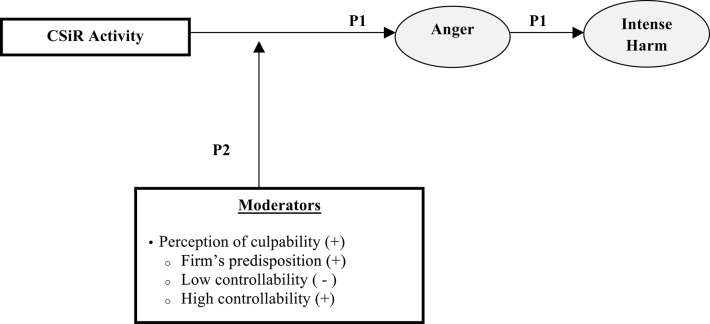
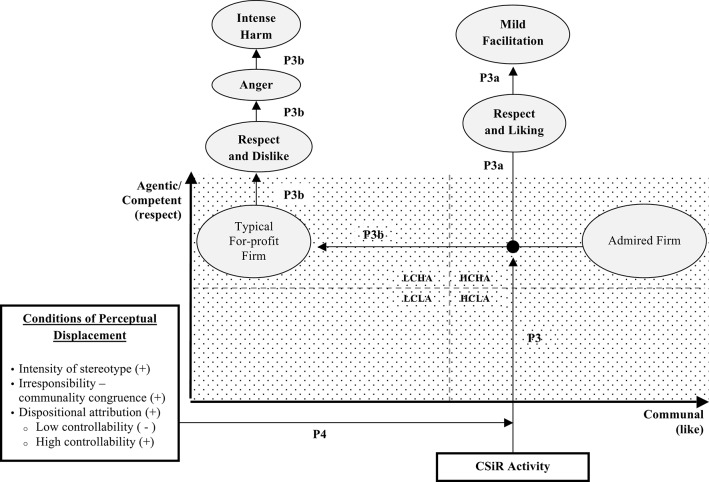
How do stakeholders react to Corporate Social Irresponsibility (CSiR)? What are the emotional mechanisms and behavioral outcomes following CSiR perception? The psychology of CSR literature has yet to address these important questions and has largely considered CSR and CSiR as the opposite poles of the same continuum. In contrast, we view CSR and CSiR as distinct constructs and theorize about the cognitive (perceptual), emotional, and behavioral effects of CSiR activity on observers (i.e., primary and secondary stakeholders) building on theories of intergroup perception. Specifically, building on the Stereotype Content Model (SCM; Fiske et al., 2002) and the BIAS map (i.e., Behaviors from Intergroup Affect and Stereotypes; Cuddy et al., 2007)-which extends the SCM by predicting behavioral responses-we make predictions on potential stakeholder reactions to CSiR focusing on two practice-relevant cases: (a) a typical for-profit firm that engages in a CSiR activity, (b) an atypical admired firm that engages in CSiR activity.
利益相关者如何应对企业社会责任缺失(CSiR)?在察觉到CSiR之后,情感机制和行为结果是什么?企业社会责任文献的心理学尚未解决这些重要问题,并且在很大程度上把企业社会责任和企业社会责任缺失视为同一连续体的相反两极。相比之下,我们将企业社会责任和企业社会责任缺失视为不同的概念,并基于群体间认知理论,对企业社会责任缺失活动对观察者(即主要和次要利益相关者)的认知(感知)、情感和行为影响进行理论化。具体而言,基于刻板印象内容模型(SCM;Fiske等人,2002年)和偏差地图(即群体间情感和刻板印象产生的行为;Cuddy等人,2007年)——该地图通过预测行为反应扩展了SCM——我们针对利益相关者对企业社会责任缺失的潜在反应进行预测,重点关注两个与实践相关的案例:(a)一家从事企业社会责任缺失活动的典型营利性公司,(b)一家从事企业社会责任缺失活动的非典型受钦佩公司。