Jungmann Stefanie M, Vollmer Noelle, Selby Edward A, Witthöft Michael
Department of Clinical Psychology and Psychotherapy, Johannes Gutenberg University of Mainz Mainz, Germany.
Hospital for Psychiatry, Psychotherapy, and Psychosomatics, Fachklinik Katzenelnbogen Katzenelnbogen, Germany.
Front Psychol. 2016 Jun 29;7:994. doi: 10.3389/fpsyg.2016.00994. eCollection 2016.
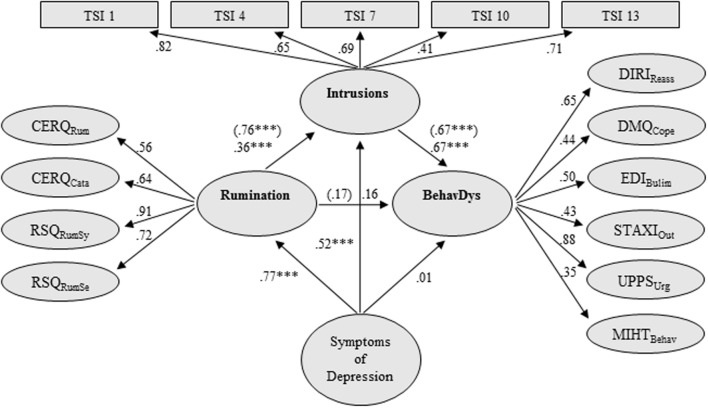
The Emotional Cascade Model (ECM) by Selby et al. (2008) proposes that people often engage in dysregulated behaviors to end extreme, aversive emotional states triggered by a self-perpetuating vicious cycle of (excessive) rumination, negative affect, and attempts to suppress negative thoughts.
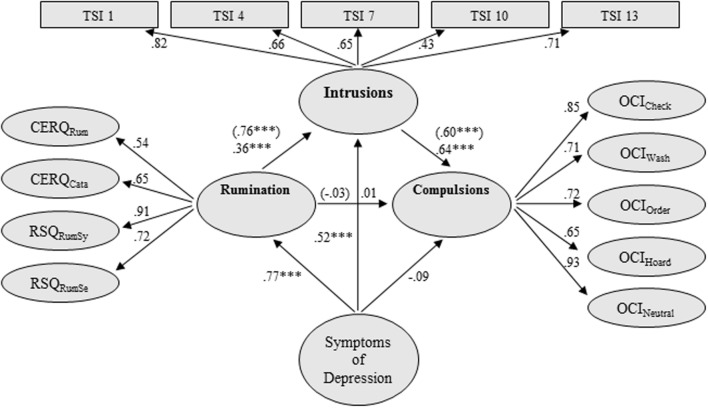
Besides replicating the ECM, we introduced intrusions as a mediator between rumination and behavioral dysregulation and tested this extended ECM for compulsions as part of obsessive-compulsive disorders. A structural equation modeling approach was used to test this in a sample of N = 414, randomly recruited from the general population.
Intrusions were found to fully mediate the effect of rumination on a broad array of dysregulated behaviors and compulsions. This mediation endured when controlling for symptoms of depression.
These findings support the idea that rumination fuels intrusions, which in turn foster dysregulated behaviors. Therefore, addressing rumination as well as intrusions may improve psychotherapeutic interventions for mental disorders characterized by dysregulated behaviors and/or extreme aversive emotional states.
塞尔比等人(2008年)提出的情绪级联模型(ECM)认为,人们常常会做出失调行为,以结束由(过度)沉思、消极情绪以及抑制消极想法的尝试所形成的自我延续恶性循环引发的极端厌恶情绪状态。
除了复制情绪级联模型外,我们引入侵入思维作为沉思与行为失调之间的中介变量,并将这个扩展后的情绪级联模型应用于强迫症中的强迫行为测试。我们采用结构方程模型方法,在从普通人群中随机招募的N = 414名样本中进行了测试。
研究发现,侵入思维完全介导了沉思对一系列失调行为和强迫行为的影响。在控制抑郁症状时,这种中介作用依然存在。
这些研究结果支持了这样一种观点,即沉思引发侵入思维,进而助长失调行为。因此,解决沉思以及侵入思维问题可能会改善针对以行为失调和/或极端厌恶情绪状态为特征的精神障碍的心理治疗干预。