Palmieri Sara, Mansueto Giovanni, Scaini Simona, Caselli Gabriele, Sapuppo Walter, Spada Marcantonio M, Sassaroli Sandra, Ruggiero Giovanni Maria
Division of Psychology, London South Bank University, London SE1 0AA, UK.
Studi Cognitivi, Cognitive Psychotherapy School and Research Center, 20132 Milan, Italy.
J Clin Med. 2021 May 31;10(11):2448. doi: 10.3390/jcm10112448.
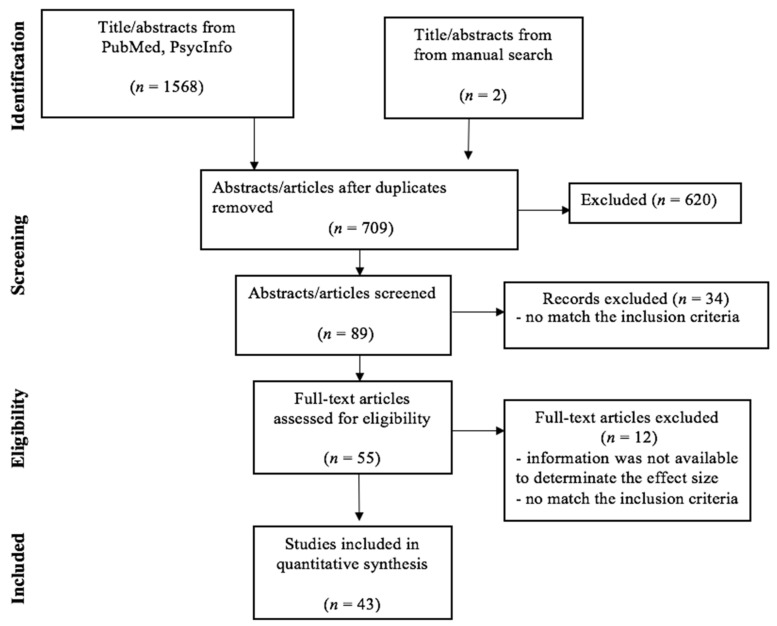
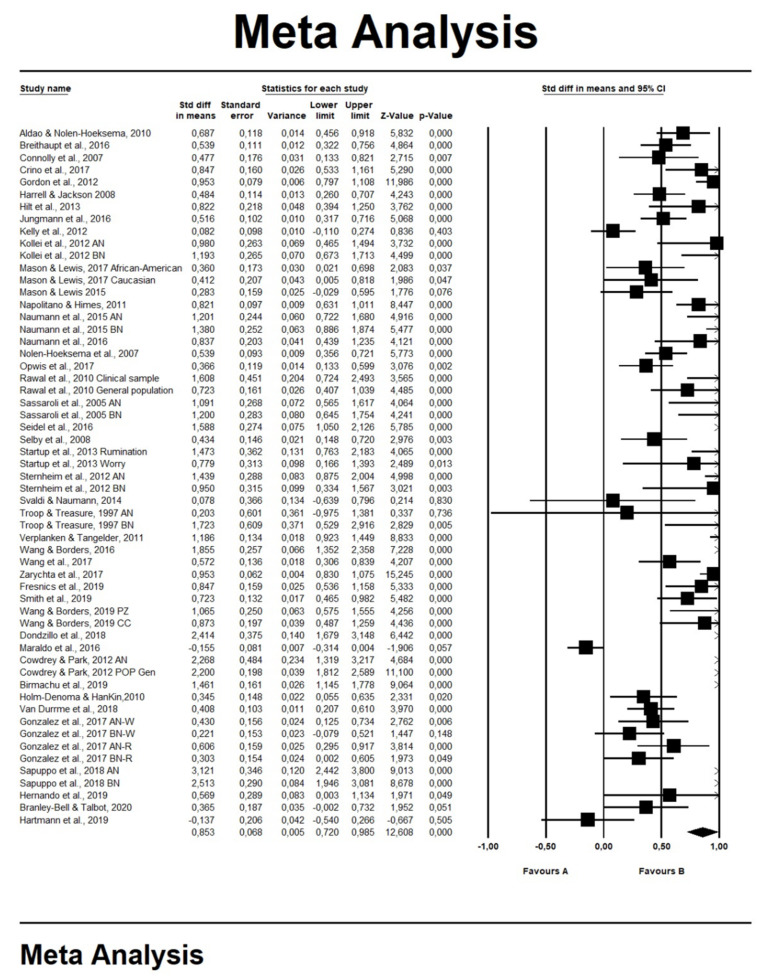
The role of worry and rumination in eating disorders (EDs) is controversial. This meta-analysis of the literature is aimed at clarifying the relationship between repetitive negative thinking (RNT) and EDs. In accordance with the PRISMA criteria, a comprehensive search of the literature was conducted on PubMed and PsycInfo from inception to March 2021. Search terms: "eating disorder/anorexia/bulimia/binge eating disorder" AND "worry/rumination/brooding/repetitive thinking". A manual search of reference lists was also run. Forty-three studies were included. RNT was found to be associated with anorexia, bulimia, and binge eating disorder. A moderating effect was found for "presence/absence ED diagnosis" and "subtype of ED symptom". ED patients showed higher RNT than the general population. No differences were observed for age or between worry and rumination in the magnitude of their association with EDs.
担忧和反复思考在饮食失调(EDs)中的作用存在争议。本对文献的荟萃分析旨在阐明重复性消极思维(RNT)与饮食失调之间的关系。根据PRISMA标准,对PubMed和PsycInfo从创刊至2021年3月的文献进行了全面检索。检索词:“饮食失调/厌食症/暴食症/暴饮暴食障碍”以及“担忧/反复思考/沉思/重复性思维”。还对手动检索参考文献列表进行了检索。纳入了43项研究。发现RNT与厌食症、暴食症和暴饮暴食障碍有关。发现“是否存在饮食失调诊断”和“饮食失调症状亚型”具有调节作用。饮食失调患者的RNT高于普通人群。在与饮食失调的关联程度上,未观察到年龄差异,也未观察到担忧和反复思考之间的差异。