Squarza Chiara, Picciolini Odoardo, Gardon Laura, Giannì Maria L, Murru Alessandra, Gangi Silvana, Cortinovis Ivan, Milani Silvano, Mosca Fabio
NICU, Department of Clinical Sciences and Community Health, Fondazione IRCCS Ca' Granda Ospedale Maggiore Policlinico, Università degli Studi di Milano Milan, Italy.
Laboratory of Medical Statistics, Biometry and Epidemiology, Department of Clinical Sciences and Community Health, Università degli Studi di Milano Milan, Italy.
Front Psychol. 2016 Jun 28;7:998. doi: 10.3389/fpsyg.2016.00998. eCollection 2016.
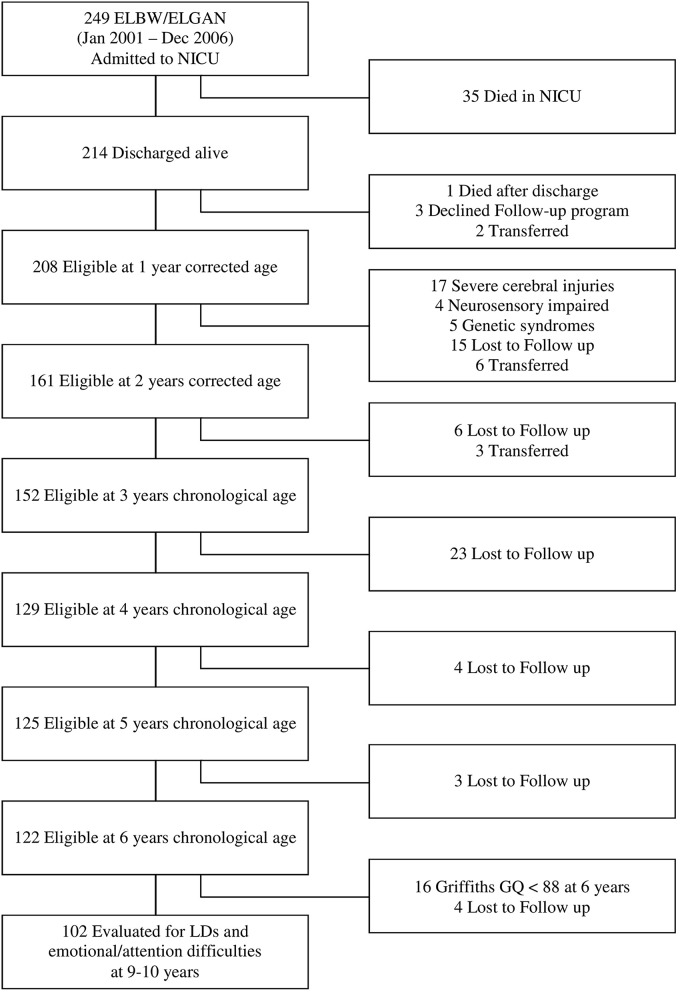
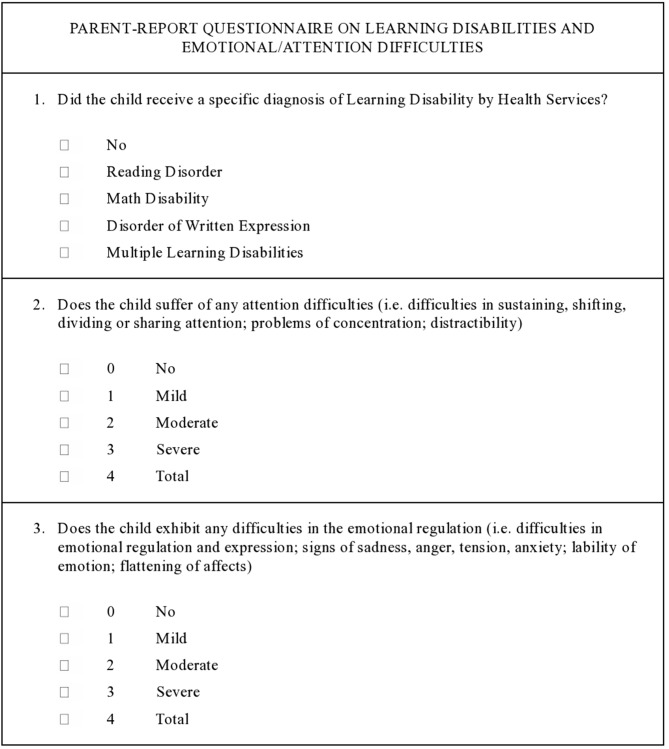
At school age extremely low birth weight (ELBW) and extremely low gestational age (ELGAN) children are more likely to show Learning Disabilities (LDs) and difficulties in emotional regulation. The aim of this study was to investigate the incidence of LDs at school age and to detect neurodevelopmental indicators of risk for LDs at preschool ages in a cohort of ELBW/ELGAN children with broadly average intelligence. All consecutively newborns 2001-2006 admitted to the same Institution entered the study. Inclusion criteria were BW < 1000 g and/or GA < 28 weeks. Exclusion criteria were severe cerebral injuries, neurosensory disabilities, genetic abnormalities, and/or a Developmental Quotient below normal limits (< 1 SD) at 6 years. The presence of learning disabilities at school age was investigated through a parent-report questionnaire at children's age range 9-10 years. Neurodevelopmental profiles were assessed through the Griffiths Mental Development Scales at 1 and 2 years of corrected age and at 3, 4, 5, and 6 years of chronological age and were analyzed comparing two groups of children: those with LDs and those without. At school age 24 on 102 (23.5%) of our ELBW/ELGAN children met criteria for LDs in one or more areas, with 70.8% comorbidity with emotional/attention difficulties. Children with LDs scored significantly lower in the Griffiths Locomotor and Language subscales at 2 years of corrected age and in the Personal-social, Performance and Practical Reasoning subscales at 5 years of chronological age. Our findings suggest that, among the early developmental indicators of adverse school outcome, there is a poor motor experimentation, language delay, and personal-social immaturity. Cognitive rigidity and poor ability to manage practical situations also affect academic attainment. Timely detection of these early indicators of risk is crucial to assist the transition to school.
在学龄期,极低出生体重(ELBW)和极早胎龄(ELGAN)儿童更有可能出现学习障碍(LDs)以及情绪调节困难。本研究的目的是调查一组智力大致处于平均水平的ELBW/ELGAN儿童在学龄期学习障碍的发生率,并检测其在学龄前出现学习障碍风险的神经发育指标。2001年至2006年期间在同一机构连续收治的所有新生儿均纳入本研究。纳入标准为出生体重<1000克和/或胎龄<28周。排除标准为严重脑损伤、神经感觉障碍、遗传异常以及6岁时发育商低于正常范围(<1个标准差)。通过一份针对9至10岁儿童的家长报告问卷来调查学龄期学习障碍的存在情况。通过格里菲斯心理发展量表在矫正年龄1岁和2岁以及实际年龄3岁、4岁、5岁和6岁时评估神经发育概况,并对两组儿童进行分析比较:有学习障碍的儿童和无学习障碍的儿童。在学龄期,我们的102名ELBW/ELGAN儿童中有24名(23.5%)在一个或多个领域符合学习障碍标准,其中70.8%伴有情绪/注意力困难。有学习障碍的儿童在矫正年龄2岁时的格里菲斯运动和语言分量表以及实际年龄5岁时的个人-社会、表现和实用推理分量表中的得分显著更低。我们的研究结果表明,在不良学业结果的早期发育指标中,存在运动体验不佳、语言发育迟缓以及个人-社会不成熟的情况。认知僵化和处理实际情况的能力较差也会影响学业成绩。及时发现这些早期风险指标对于帮助儿童顺利过渡到学校至关重要。