Gunaydin Gul, Selcuk Emre, Ong Anthony D
Department of Psychology, Bilkent University Ankara, Turkey.
Department of Psychology, Middle East Technical University Ankara, Turkey.
Front Psychol. 2016 Jun 28;7:1000. doi: 10.3389/fpsyg.2016.01000. eCollection 2016.
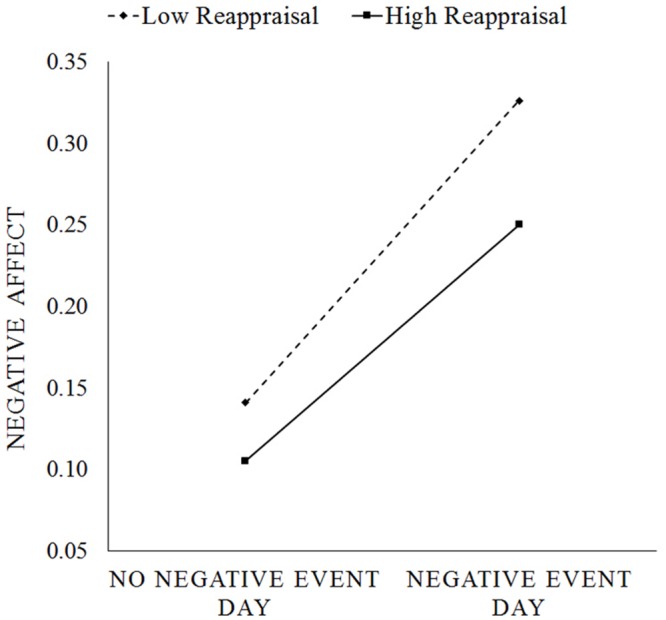
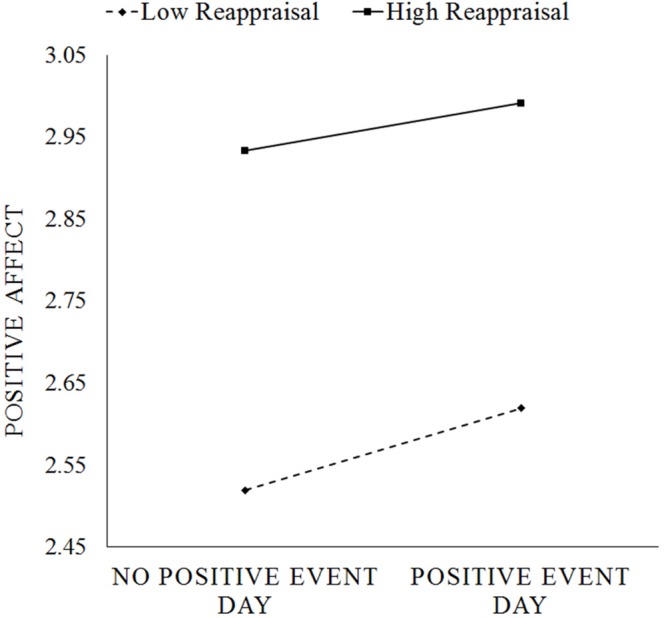
Past research on emotion regulation has provided evidence that cognitive reappraisal predicts reactivity to affective stimuli and challenge tests in laboratory settings. However, little is known about how trait reappraisal might contribute to affective reactivity to everyday positive and negative events. Using a large, life-span sample of adults (N = 1755), the present study addressed this important gap in the literature. Respondents completed a measure of trait reappraisal and reported on their daily experiences of positive and negative events and positive and negative affect for eight consecutive days. Results showed that trait reappraisal predicted lower increases in negative affect in response to daily negative events and lower increases in positive affect in response to daily positive events. These findings advance our understanding of the role of reappraisal in emotion regulation by showing how individual differences in the use of this strategy relate to emotional reactions to both positive and negative events outside the laboratory.
过去关于情绪调节的研究已提供证据表明,在实验室环境中,认知重评能预测对情感刺激和挑战测试的反应性。然而,对于特质重评如何影响对日常积极和消极事件的情感反应性,我们却知之甚少。本研究以一个大规模的成年人群体样本(N = 1755)为对象,填补了该领域文献中的这一重要空白。受访者完成了一项特质重评测量,并连续八天报告他们日常经历的积极和消极事件以及积极和消极情绪。结果表明,特质重评预示着在面对日常消极事件时负面情绪的增幅较小,以及在面对日常积极事件时正面情绪的增幅较小。这些发现通过展示这种策略使用上的个体差异如何与实验室外的积极和消极事件的情绪反应相关,推进了我们对重评在情绪调节中作用的理解。