Baudouin Emmanuel, Poilevey Aurélie, Hewage Nishodi Indiketi, Cochet Françoise, Puyaubert Juliette, Bailly Christophe
Sorbonne Universités, Université Pierre et Marie Curie (UPMC), CNRS, Institut de Biologie Paris-Seine (IBPS), Unité de Biologie du Développement Paris, France.
Front Plant Sci. 2016 Jun 27;7:930. doi: 10.3389/fpls.2016.00930. eCollection 2016.
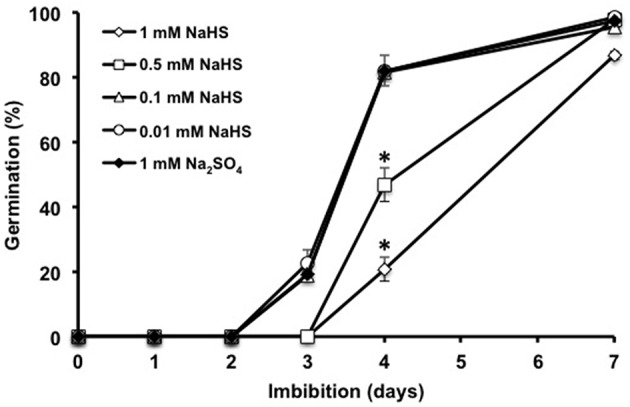
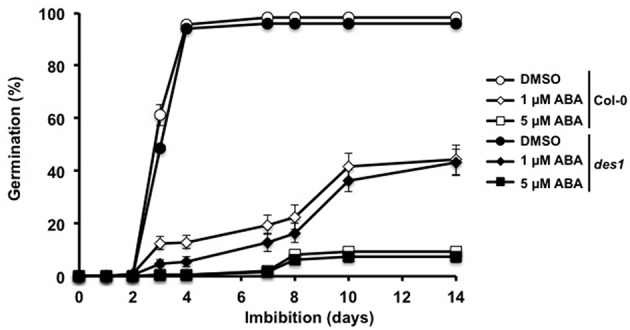
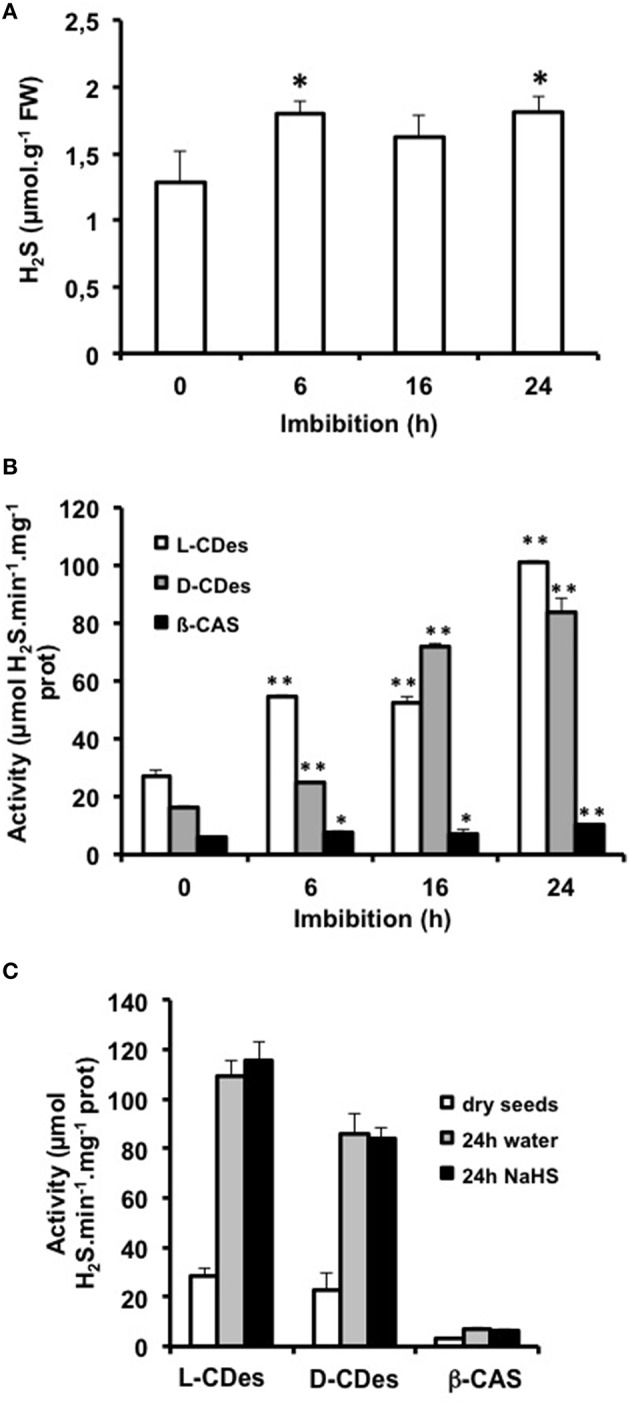
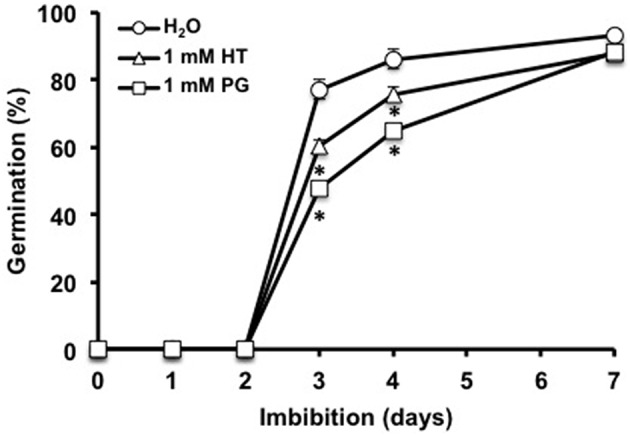
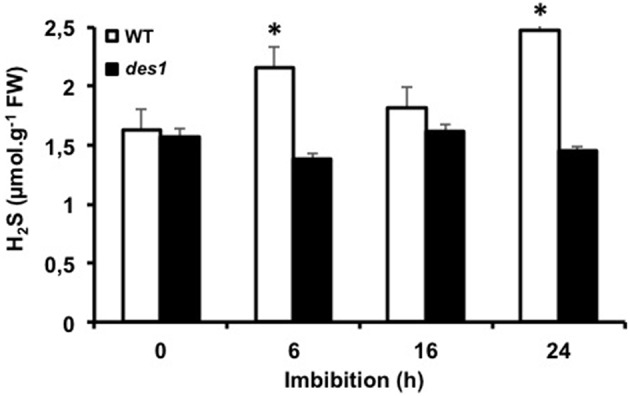
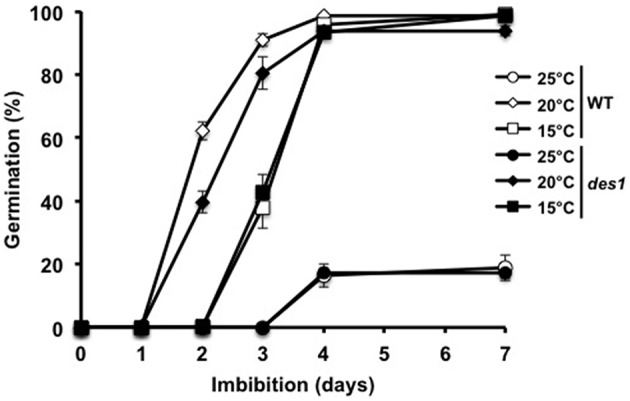
Hydrogen sulfide (H2S) recently emerged as an important gaseous signaling molecule in plants. In this study, we investigated the possible functions of H2S in regulating Arabidopsis seed germination. NaHS treatments delayed seed germination in a dose-dependent manner and were ineffective in releasing seed dormancy. Interestingly, endogenous H2S content was enhanced in germinating seeds. This increase was correlated with higher activity of three enzymes (L-cysteine desulfhydrase, D-cysteine desulfhydrase, and β-cyanoalanine synthase) known as sources of H2S in plants. The H2S scavenger hypotaurine and the D/L cysteine desulfhydrase inhibitor propargylglycine significantly delayed seed germination. We analyzed the germinative capacity of des1 seeds mutated in Arabidopsis cytosolic L-cysteine desulfhydrase. Although the mutant seeds do not exhibit germination-evoked H2S formation, they retained similar germination capacity as the wild-type seeds. In addition, des1 seeds responded similarly to temperature and were as sensitive to ABA as wild type seeds. Taken together, these data suggest that, although its metabolism is stimulated upon seed imbibition, H2S plays, if any, a marginal role in regulating Arabidopsis seed germination under standard conditions.
硫化氢(H₂S)最近成为植物中一种重要的气体信号分子。在本研究中,我们探究了H₂S在调控拟南芥种子萌发中的可能作用。硫氢化钠(NaHS)处理以剂量依赖的方式延迟种子萌发,且在解除种子休眠方面无效。有趣的是,萌发种子中的内源性H₂S含量增加。这种增加与植物中作为H₂S来源的三种酶(L-半胱氨酸脱硫酶、D-半胱氨酸脱硫酶和β-氰基丙氨酸合成酶)的较高活性相关。H₂S清除剂次牛磺酸和D/L半胱氨酸脱硫酶抑制剂炔丙基甘氨酸显著延迟种子萌发。我们分析了拟南芥胞质L-半胱氨酸脱硫酶突变的des1种子的萌发能力。尽管突变种子未表现出萌发诱发的H₂S形成,但它们保留了与野生型种子相似的萌发能力。此外,des1种子对温度的反应相似,并且与野生型种子一样对脱落酸(ABA)敏感。综上所述,这些数据表明,尽管种子吸胀时其代谢受到刺激,但在标准条件下,H₂S在调控拟南芥种子萌发中即使有作用,也发挥着边缘作用。