Chavez-Tapia Norberto C, Murúa-Beltrán Gall Sofía, Ordoñez-Vázquez Ana Luisa, Nuño-Lambarri Natalia, Vidal-Cevallos Paulina, Uribe Misael
Gastroenterology Department, Medica Sur Clinic & Foundation, Mexico City, Mexico.
Transational Research Department, Medica Sur Clinic & Foundation, Mexico City, Mexico.
J Hepatocell Carcinoma. 2022 Jul 5;9:583-593. doi: 10.2147/JHC.S283840. eCollection 2022.
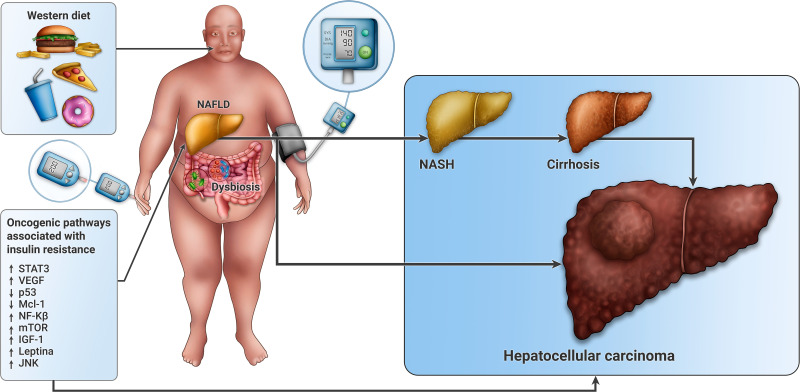
Hepatocellular carcinoma (HCC) and metabolic syndrome (MetS) have a rising prevalence worldwide. The relationship between these two entities has long been studied and understanding it has become a public health and clinical priority. This association follows, in most patients, the path through non-alcoholic fatty liver disease (NAFLD), non-alcoholic steatohepatitis (NASH), cirrhosis and finally HCC. Nonetheless, increasing evidence has been found, that shows MetS as an independent risk factor for the development of HCC. This review brings together the clinical evidence of the relationship between these highly prevalent diseases, with a particular interest in the impact of each component of MetS on HCC; It aims to summarize the complex physiopathological pathways that explain this relationship, and to shed light on the different clinical scenarios of this association, the impact of treating the different components of MetS on the risk of HCC and what is known about screening for HCC in patients with MetS. By doing so, it hopes to improve awareness on this topic.
肝细胞癌(HCC)和代谢综合征(MetS)在全球范围内的患病率都在上升。这两种疾病之间的关系早已得到研究,了解它们之间的关系已成为公共卫生和临床工作的重点。在大多数患者中,这种关联遵循从非酒精性脂肪性肝病(NAFLD)、非酒精性脂肪性肝炎(NASH)、肝硬化到最终发展为HCC的病程。尽管如此,越来越多的证据表明,代谢综合征是肝细胞癌发生的独立危险因素。这篇综述汇集了这些高发性疾病之间关系的临床证据,特别关注代谢综合征各组成部分对肝细胞癌的影响;旨在总结解释这种关系的复杂生理病理途径,阐明这种关联的不同临床情况、治疗代谢综合征各组成部分对肝细胞癌风险的影响以及代谢综合征患者肝细胞癌筛查的相关情况。通过这样做,希望提高对这一主题的认识。