Chang Kang-Ming, Chun Yu-Teng, Chen Sih-Huei, Lu Luo, Su Hsiao-Ting Jannis, Liang Hung-Meng, Santhosh Jayasree, Ching Congo Tak-Shing, Liu Shing-Hong
Department of Photonics and Communication Engineering, Asia University, 500, Lioufeng Rd., Wufeng, Taichung 41354, Taiwan.
Department of Medical Research, China Medical University Hospital, China Medical University, No. 91, Hsueh-Shih Road, Taichung 40402, Taiwan.
Sensors (Basel). 2016 Jul 20;16(7):1126. doi: 10.3390/s16071126.
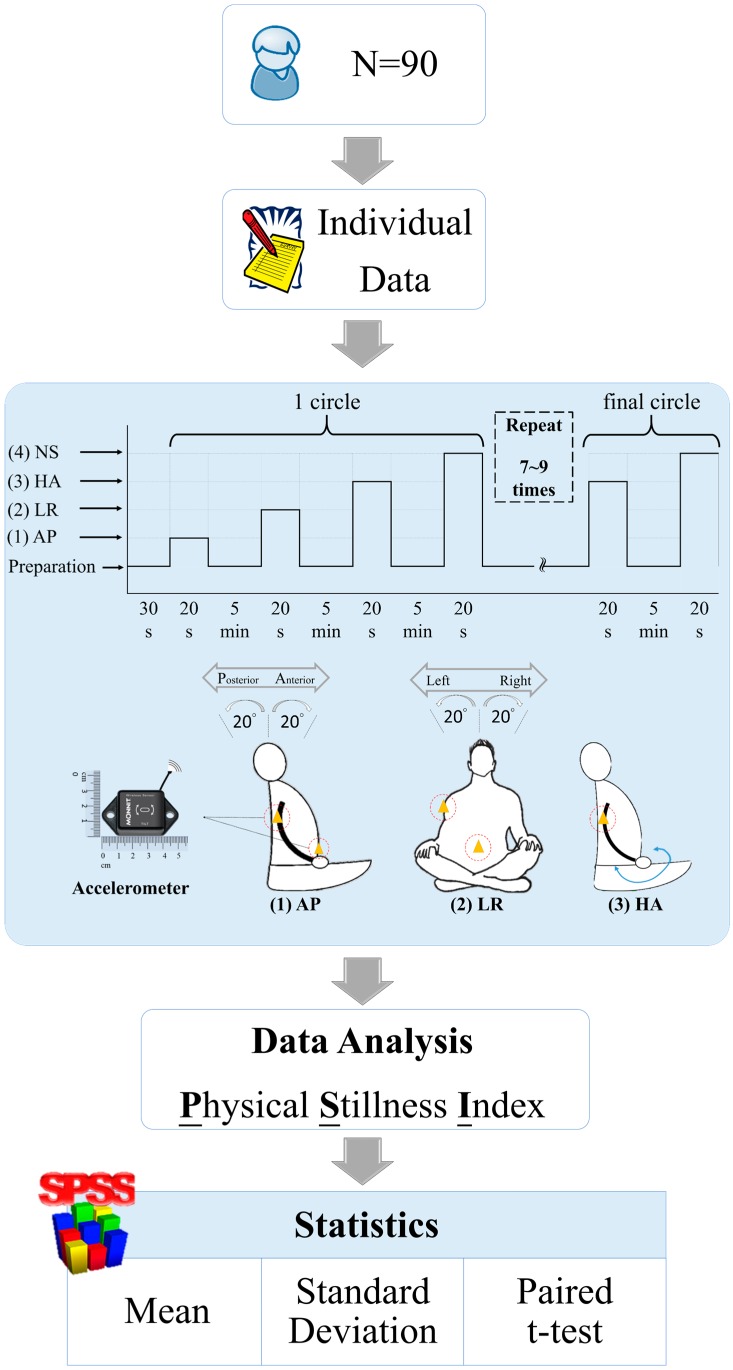
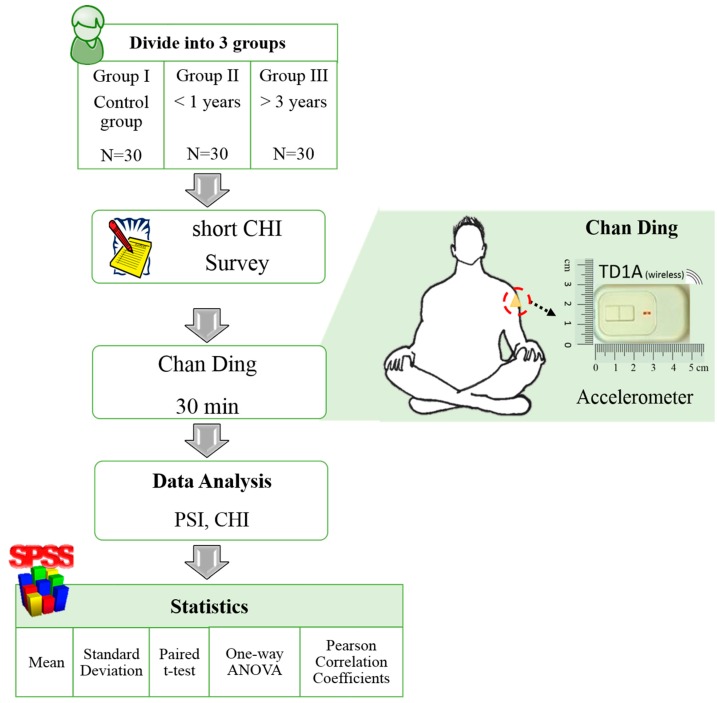
Chan Ding training is beneficial to health and emotional wellbeing. More and more people have taken up this practice over the past few years. A major training method of Chan Ding is to focus on the ten Mailuns, i.e., energy points, and to maintain physical stillness. In this article, wireless wearable accelerometers were used to detect physical stillness, and the created physical stillness index (PSI) was also shown. Ninety college students participated in this study. Primarily, accelerometers used on the arms and chest were examined. The results showed that the PSI values on the arms were higher than that of the chest, when participants moved their bodies in three different ways, left-right, anterior-posterior, and hand, movements with natural breathing. Then, they were divided into three groups to practice Chan Ding for approximately thirty minutes. Participants without any Chan Ding experience were in Group I. Participants with one year of Chan Ding experience were in Group II, and participants with over three year of experience were in Group III. The Chinese Happiness Inventory (CHI) was also conducted. Results showed that the PSI of the three groups measured during 20-30 min were 0.123 ± 0.155, 0.012 ± 0.013, and 0.001 ± 0.0003, respectively (p < 0.001 ***). The averaged CHI scores of the three groups were 10.13, 17.17, and 25.53, respectively (p < 0.001 ***). Correlation coefficients between PSI and CHI of the three groups were -0.440, -0.369, and -0.537, respectively (p < 0.01 **). PSI value and the wearable accelerometer that are presently available on the market could be used to evaluate the quality of the physical stillness of the participants during Chan Ding practice.
禅定训练有益于健康和情绪健康。在过去几年里,越来越多的人开始进行这种练习。禅定的一种主要训练方法是专注于十个脉轮,即能量点,并保持身体静止。在本文中,使用无线可穿戴加速度计来检测身体静止状态,并展示了所创建的身体静止指数(PSI)。90名大学生参与了这项研究。首先,对用于手臂和胸部的加速度计进行了检查。结果表明,当参与者以三种不同方式移动身体时,即左右、前后以及手部动作并自然呼吸,手臂上的PSI值高于胸部。然后,他们被分为三组进行约30分钟的禅定练习。没有任何禅定经验的参与者在第一组。有一年禅定经验的参与者在第二组,有三年以上经验的参与者在第三组。还进行了中国幸福量表(CHI)测试。结果显示,在20 - 30分钟内测量的三组的PSI分别为0.123±0.155、0.012±0.013和0.001±0.0003(p < 0.001 ***)。三组的平均CHI得分分别为10.13、17.17和25.53(p < 0.001 ***)。三组的PSI与CHI之间的相关系数分别为 -0.440、-0.369和 -0.537(p < 0.01 **)。目前市场上现有的PSI值和可穿戴加速度计可用于评估参与者在禅定练习期间身体静止的质量。