Voigt Karen, Gottschall Mandy, Köberlein-Neu Juliane, Schübel Jeannine, Quint Nadine, Bergmann Antje
Department of General Practice/Medical Clinic III, Medical School, Technische Universität Dresden, Dresden, Germany.
Department of Health Care Management and Public Health, Schumpeter School of Business and Economics, University of Wuppertal, Wuppertal, Germany.
BMC Fam Pract. 2016 Jul 22;17:93. doi: 10.1186/s12875-016-0482-3.
Based on changes in pharmacokinetics and -dynamics in elderly patients, there are potentially inappropriate medications (PIM) that should be avoided in patients aged ≥ 65 years. Current studies showed prescription rates of PIM between 22.5 and 28.4 % in the primary care setting. The evidence concerning reasons for PIM prescription by FPs is limited.
This mixed method study consisted of three research parts: 1) semi-standardized content analysis of patients' records, 2) qualitative interviews with FPs using a) open questions and b) selected patient-specific case vignettes and 3) qualitative interviews with FPs' medical assistants. The integration of qualitative interviews was used to explain the quantitative results (triangulation design). PIM were identified according to the German PRISCUS list. Descriptive and multivariate statistical analysis was done using SPSS 22.0. Qualitative content analysis of interviews was used to classify the content of the interviews for indicating pertinent categories. All data were pseudonymously recorded and analyzed.
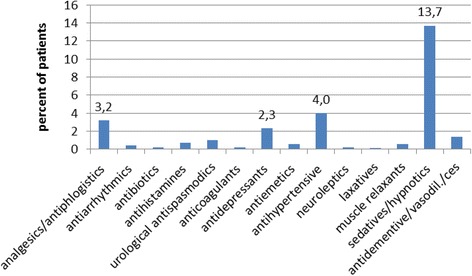
Content analysis of 1846 patients' records and interviews with 7 related FPs were conducted. Elderly patients [n = 1241, mean age: 76, females: 56.6 %] were characterized in average by 8.3 documented chronic diagnosis. 23.9 % of elderly patients received at least one PIM prescription. Sedatives/hypnotics were the most frequent prescribed PIM-drugs (13.7 %). Mental disorders, gender and number of long-term medication were detected as predictors for the probability of a PIM prescription. Common reported reasons for PIM prescription by FPs concerned limited knowledge regarding PIM, limited applicability of PIM lists in daily practice, lack of time, having no alternatives in medication, stronger patient-related factors than age that influence prescription, own bad experiences regarding changes of medication or refusal of following prescriptions of sedative/hypnotics.
It is essential to see FPs in a complex decision making situation with several influencing factors on their prescribing, including: patient-oriented prioritization, FPs' experiences in daily practice, FPs' knowledge regarding existing recommendations and their trust in it and organizational characteristics of FPs' daily medical practice. These pros and cons of PIM prescription in elderly patients should be considered in FPs' advanced training.
基于老年患者药代动力学和药效学的变化,65岁及以上患者应避免使用潜在不适当药物(PIM)。目前的研究表明,在初级保健机构中,PIM的处方率在22.5%至28.4%之间。关于家庭医生开具PIM处方原因的证据有限。
这项混合方法研究包括三个研究部分:1)对患者记录进行半标准化内容分析;2)对家庭医生进行定性访谈,采用a)开放式问题和b)选定的特定患者病例 vignettes;3)对家庭医生的医疗助理进行定性访谈。采用定性访谈的整合来解释定量结果(三角测量设计)。根据德国PRISCUS清单确定PIM。使用SPSS 22.0进行描述性和多变量统计分析。对访谈进行定性内容分析,以对访谈内容进行分类,以表明相关类别。所有数据均采用化名记录和分析。
对1846份患者记录进行了内容分析,并对7名相关家庭医生进行了访谈。老年患者[n = 1241,平均年龄:76岁,女性:56.6%]平均有8.3项记录在案的慢性诊断。23.9%的老年患者接受了至少一项PIM处方。镇静剂/催眠药是最常开具的PIM药物(13.7%)。精神障碍、性别和长期用药数量被检测为PIM处方可能性的预测因素。家庭医生开具PIM处方的常见原因包括对PIM的了解有限、PIM清单在日常实践中的适用性有限、时间不足、没有替代药物、影响处方的患者相关因素比年龄更重要、自己在药物变更方面的不良经历或拒绝遵循镇静剂/催眠药的处方。
必须在复杂的决策环境中看待家庭医生的开药情况,他们的开药受到多种因素影响,包括:以患者为导向的优先级、家庭医生的日常实践经验、家庭医生对现有建议的了解及其对建议的信任,以及家庭医生日常医疗实践的组织特征。在家庭医生的进阶培训中应考虑老年患者PIM处方中的这些利弊。