Stein Dan J, Karam Elie G, Shahly Victoria, Hill Eric D, King Andrew, Petukhova Maria, Atwoli Lukoye, Bromet Evelyn J, Florescu Silvia, Haro Josep Maria, Hinkov Hristo, Karam Aimee, Medina-Mora María Elena, Navarro-Mateu Fernando, Piazza Marina, Shalev Arieh, Torres Yolanda, Zaslavsky Alan M, Kessler Ronald C
Dept of Psychiatry and Mental Health, University of Cape Town and Groote Schuur Hospital, Cape Town, South Africa.
St George Hospital Medical Center, Balamand University, Faculty of Medicine, Institute for Development, Research, Advocacy & Applied Care, Beirut, Lebanon.
BMC Psychiatry. 2016 Jul 22;16:257. doi: 10.1186/s12888-016-0957-8.
Motor vehicle collisions (MVCs) are a substantial contributor to the global burden of disease and lead to subsequent post-traumatic stress disorder (PTSD). However, the relevant literature originates in only a few countries, and much remains unknown about MVC-related PTSD prevalence and predictors.
Data come from the World Mental Health Survey Initiative, a coordinated series of community epidemiological surveys of mental disorders throughout the world. The subset of 13 surveys (5 in high income countries, 8 in middle or low income countries) with respondents reporting PTSD after life-threatening MVCs are considered here. Six classes of predictors were assessed: socio-demographics, characteristics of the MVC, childhood family adversities, MVCs, other traumatic experiences, and respondent history of prior mental disorders. Logistic regression was used to examine predictors of PTSD. Mental disorders were assessed with the fully-structured Composite International Diagnostic Interview using DSM-IV criteria.
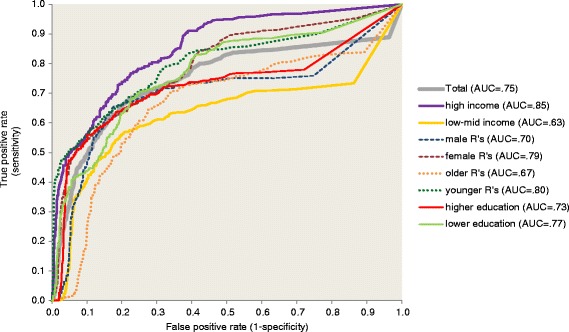
Prevalence of PTSD associated with MVCs perceived to be life-threatening was 2.5 % overall and did not vary significantly across countries. PTSD was significantly associated with low respondent education, someone dying in the MVC, the respondent or someone else being seriously injured, childhood family adversities, prior MVCs (but not other traumatic experiences), and number of prior anxiety disorders. The final model was significantly predictive of PTSD, with 32 % of all PTSD occurring among the 5 % of respondents classified by the model as having highest PTSD risk.
Although PTSD is a relatively rare outcome of life-threatening MVCs, a substantial minority of PTSD cases occur among the relatively small proportion of people with highest predicted risk. This raises the question whether MVC-related PTSD could be reduced with preventive interventions targeted to high-risk survivors using models based on predictors assessed in the immediate aftermath of the MVCs.
机动车碰撞事故(MVC)是全球疾病负担的一个重要因素,并会导致后续的创伤后应激障碍(PTSD)。然而,相关文献仅来自少数几个国家,关于与MVC相关的PTSD患病率及预测因素仍有很多未知之处。
数据来自世界心理健康调查倡议,这是一系列协调开展的全球精神障碍社区流行病学调查。本文考虑了13项调查的子集(5项来自高收入国家,8项来自中低收入国家),这些调查中的受访者报告了在危及生命的MVC后出现PTSD的情况。评估了六类预测因素:社会人口统计学因素、MVC的特征、童年家庭逆境、MVC、其他创伤经历以及受访者既往精神障碍史。采用逻辑回归分析来检验PTSD的预测因素。使用基于《精神疾病诊断与统计手册》第四版(DSM-IV)标准的完全结构化综合国际诊断访谈来评估精神障碍。
总体而言,与被视为危及生命的MVC相关的PTSD患病率为2.5%,各国之间无显著差异。PTSD与受访者低教育程度、MVC中有人员死亡、受访者或他人受重伤、童年家庭逆境、既往MVC(但不包括其他创伤经历)以及既往焦虑症的数量显著相关。最终模型对PTSD具有显著预测性,所有PTSD病例中有32%发生在被该模型归类为PTSD风险最高的5%的受访者中。
尽管PTSD是危及生命的MVC相对罕见的后果,但相当一部分PTSD病例发生在预测风险最高的相对少数人群中。这就提出了一个问题,即对于在MVC刚发生后根据评估的预测因素确定的高危幸存者,通过预防性干预措施是否可以降低与MVC相关的PTSD。