Triozzi Pierre L, Achberger Susan, Aldrich Wayne, Crabb John W, Saunthararajah Yogen, Singh Arun D
Taussig Cancer Institute, Cleveland Clinic Foundation, Cleveland, OH USA ; Wake Forest School of Medicine, Medical Center Boulevard, Winston-Salem, NC 27157 USA.
Taussig Cancer Institute, Cleveland Clinic Foundation, Cleveland, OH USA.
Clin Epigenetics. 2016 Jul 22;8:80. doi: 10.1186/s13148-016-0243-0. eCollection 2016.
Epigenetic events mediated by methylation and histone modifications have been associated with the development of metastasis in patients with uveal melanoma. The role of epigenetic events mediated by microRNA (miR) is less clear. Tumor and plasma miR expression was examined in patients with primary uveal melanoma with tumor monosomy-3, a predictor of metastasis.
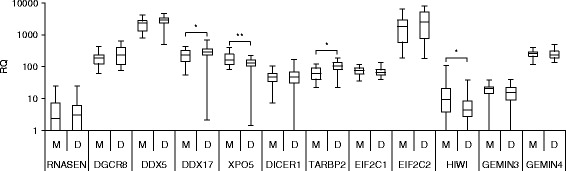
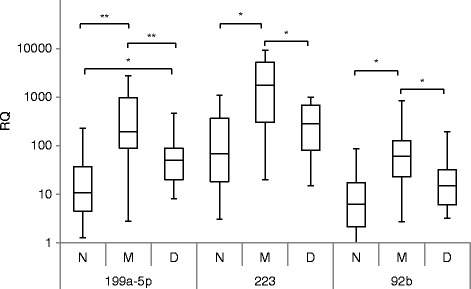
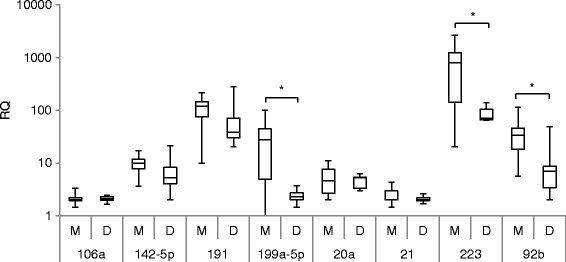
miR profiling of tumors by microarray found six miRs over-expressed and 19 under-expressed in 33 tumors with monosomy-3 compared to 22 without. None of the miRs differentially expressed in tumors with and without monosomy-3 was differentially expressed in tumors with and without tumor infiltrating lymphocytes. Tumors manifesting monosomy-3 were also characterized by higher levels of TARBP2 and DDX17 and by lower levels of XPO5 and HIWI, miR biogenesis factors. miR profiling of plasma by a quantitative nuclease protection assay found elevated levels of 11 miRs and reduction in four in patients with tumor monosomy-3. Only three miRs differentially expressed in the tumor arrays were detectable in plasma. miRs implicated in uveal melanoma development were not differentially expressed. Elevated plasma levels in patients with tumor monosomy-3 of miR-92b, identified in the tumor array, and of miR-199-5p and miR-223, identified in the plasma array, were confirmed by quantitative real-time polymerase chain reaction. Levels were also higher in patients compared to normal controls.
These results support a role for epigenetic mechanisms in the development of metastasis in patients with uveal melanoma and the analysis of miRs as biomarkers of metastatic risk. They also suggest that potentially useful blood miRs may be derived from the host response as well as the tumor.
由甲基化和组蛋白修饰介导的表观遗传事件与葡萄膜黑色素瘤患者转移的发生有关。由微小RNA(miR)介导的表观遗传事件的作用尚不清楚。对伴有肿瘤单体3(转移的一个预测指标)的原发性葡萄膜黑色素瘤患者的肿瘤和血浆miR表达进行了检测。
通过微阵列对肿瘤进行miR分析发现,与22例无单体3的肿瘤相比,33例有单体3的肿瘤中有6种miR表达上调,19种miR表达下调。在有和无单体3的肿瘤中差异表达的miR,在有和无肿瘤浸润淋巴细胞的肿瘤中均无差异表达。表现为单体3的肿瘤还具有较高水平的TARBP2和DDX17以及较低水平的XPO5和HIWI(miR生物合成因子)的特征。通过定量核酸酶保护试验对血浆进行miR分析发现,肿瘤单体3患者中有11种miR水平升高,4种miR水平降低。在血浆中仅可检测到在肿瘤阵列中差异表达的3种miR。与葡萄膜黑色素瘤发生有关的miR无差异表达。通过定量实时聚合酶链反应证实了肿瘤阵列中鉴定出的miR-92b以及血浆阵列中鉴定出的miR-199-5p和miR-223在肿瘤单体3患者中的血浆水平升高。患者中的水平也高于正常对照。
这些结果支持表观遗传机制在葡萄膜黑色素瘤患者转移发生中的作用以及将miR分析作为转移风险生物标志物的作用。它们还表明,潜在有用的血液miR可能源自宿主反应以及肿瘤。