Wang Joyce M, Zorek Joseph A
Pharmacy Practice Division, University of Wisconsin-Madison School of Pharmacy Madison, WI, USA.
Front Pharmacol. 2016 Jul 7;7:188. doi: 10.3389/fphar.2016.00188. eCollection 2016.
The theory of deliberate practice has been applied to many skill-based performance activities. The primary aim of this project was to integrate synergistic principles from deliberate practice and consensus-derived competencies for interprofessional education into a framework upon which educational models to advance interprofessional experiential education (IEE) might be built.
CINAHL, ERIC, and MEDLINE databases were searched using the keywords "deliberate practice" and "interprofessional education," both individually and in combination. Relevant articles were selected from the catalog based on support for the premise of the project. Defining characteristics of deliberate practice were distilled with particular emphasis on their application to the Interprofessional Education Collaborative's (IPEC) core competencies. Recommendations for IEE development were identified through the synthesis of deliberate practice principles and IPEC competencies.
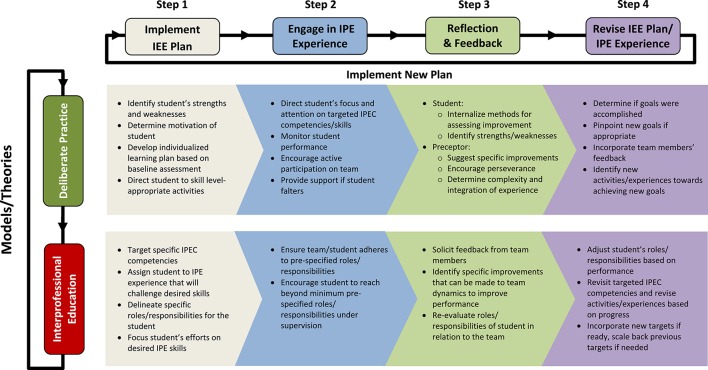
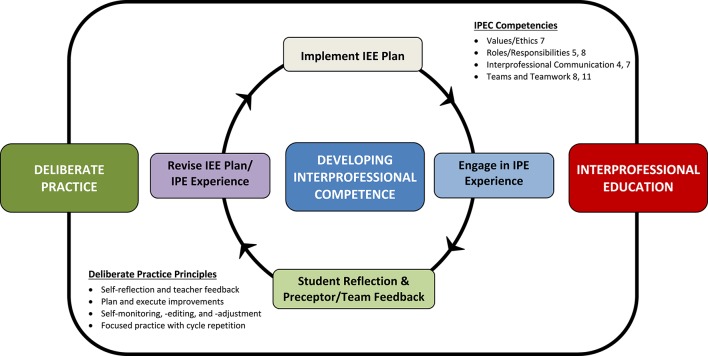
There is a high degree of synergy between deliberate practice principles and IPEC competencies. Our synthesis of the literature yielded a cyclical four-step process to advance IEE: (1) implement an IEE plan guided by the student's strengths/weaknesses and in consideration of the collaborative practice skills they wish to develop, (2) engage in IPE experiences that will challenge targeted skills according to the IEE plan, (3) embed frequent opportunities for student reflection and preceptor/team feedback within IEE plan, and (4) revise the IEE plan and the IPE experience based on insights gained during step 3.
The cyclical four-step process synthesized through this literature review may be used to guide the development of new IEE models. The purposeful development of IEE models grounded in a theory that has already been operationalized in other skill-based performance areas is an important step to address expanding accreditation standards throughout the health professions mandating interprofessional education for pre-licensure health professional students.
刻意练习理论已应用于许多基于技能的表现活动。本项目的主要目标是将刻意练习的协同原则以及从跨专业教育的共识性能力中提取的原则整合到一个框架中,以此构建推进跨专业体验式教育(IEE)的教育模式。
使用关键词“刻意练习”和“跨专业教育”,分别及组合搜索CINAHL、教育资源信息中心(ERIC)和医学文献数据库(MEDLINE)。根据对项目前提的支持程度从目录中选择相关文章。提炼刻意练习的定义特征,尤其强调其在跨专业教育协作组织(IPEC)核心能力中的应用。通过综合刻意练习原则和IPEC能力来确定IEE发展的建议。
刻意练习原则与IPEC能力之间存在高度协同。我们对文献的综合分析得出了一个推进IEE的循环四步过程:(1)实施以学生优势/劣势为指导并考虑他们希望培养的协作实践技能的IEE计划;(2)根据IEE计划参与能够挑战目标技能的IPEC体验;(3)在IEE计划中嵌入学生反思以及带教老师/团队反馈的频繁机会;(4)根据在第三步中获得的见解修订IEE计划和IPEC体验。
通过本次文献综述综合得出的循环四步过程可用于指导新IEE模式的开发。在一个已在其他基于技能的表现领域实施的理论基础上有目的地开发IEE模式,是应对整个卫生专业领域不断扩大的认证标准的重要一步,这些标准要求为预执业卫生专业学生开展跨专业教育。