Fuchs Boris, Zimmermann Barbara, Wabakken Petter, Bornstein Set, Månsson Johan, Evans Alina L, Liberg Olof, Sand Håkan, Kindberg Jonas, Ågren Erik O, Arnemo Jon M
Faculty of Applied Ecology and Agricultural Sciences, Hedmark University College, Campus Evenstad, N-2480, Koppang, Norway.
Department of Virology, Immunobiology and Parasitology, National Veterinary Institute, SE-75189, Uppsala, Sweden.
BMC Vet Res. 2016 Jul 27;12(1):156. doi: 10.1186/s12917-016-0780-y.
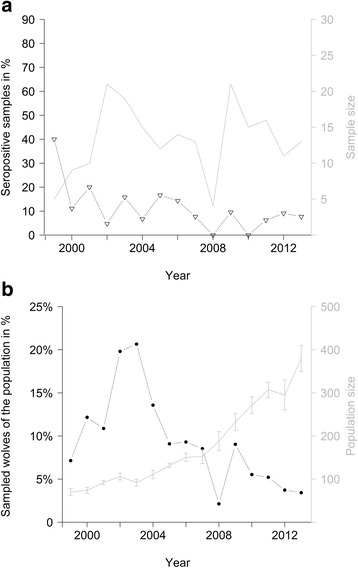
Sarcoptic mange, a parasitic disease caused by the mite Sarcoptes scabiei, is regularly reported on wolves Canis lupus in Scandinavia. We describe the distribution and transmission of this parasite within the small but recovering wolf population by analysing 269 necropsy reports and performing a serological survey on 198 serum samples collected from free-ranging wolves between 1998 and 2013.
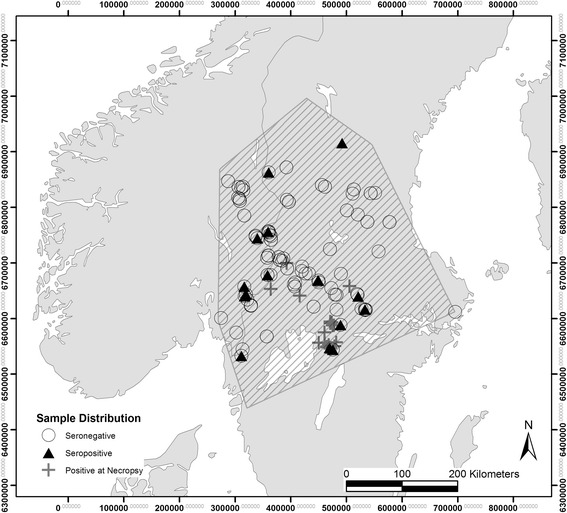
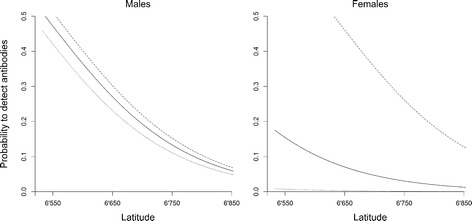
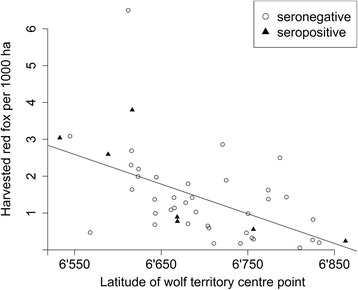
The serological survey among 145 individual captured Scandinavian wolves (53 recaptures) shows a consistent presence of antibodies against sarcoptic mange. Seropositivity among all captured wolves was 10.1 % (CI. 6.4 %-15.1 %). Sarcoptic mange-related mortality reported at necropsy was 5.6 % and due to secondary causes, predominantly starvation. In the southern range of the population, seroprevalence was higher, consistent with higher red fox densities. Female wolves had a lower probability of being seropositive than males, but for both sexes the probability increased with pack size. Recaptured individuals changing from seropositive to seronegative suggest recovery from sarcoptic mange. The lack of seropositive pups (8-10 months, N = 56) and the occurrence of seropositive and seronegative individuals in the same pack indicates interspecific transmission of S. scabiei into this wolf population.
We consider sarcoptic mange to have little effect on the recovery of the Scandinavian wolf population. Heterogenic infection patterns on the pack level in combination with the importance of individual-based factors (sex, pack size) and the north-south gradient for seroprevalence suggests low probability of wolf-to-wolf transmission of S. scabiei in Scandinavia.
疥螨病是由疥螨引起的一种寄生虫病,在斯堪的纳维亚半岛的狼(犬属灰狼)中时有报道。我们通过分析269份尸检报告,并对1998年至2013年间从自由放养的狼身上采集的198份血清样本进行血清学调查,来描述这种寄生虫在数量虽少但正在恢复的狼种群中的分布和传播情况。
对145只被捕获的斯堪的纳维亚狼(其中53只被重新捕获)进行的血清学调查显示,一直存在针对疥螨病的抗体。所有被捕获狼的血清阳性率为10.1%(置信区间为6.4% - 15.1%)。尸检报告中与疥螨病相关的死亡率为5.6%,且是由次要原因导致的,主要是饥饿。在该种群的南部区域,血清阳性率更高,这与赤狐密度较高相一致。雌狼血清阳性的概率低于雄狼,但对于两性来说,血清阳性概率都随狼群规模的增大而增加。从血清阳性转变为血清阴性的重新捕获个体表明其已从疥螨病中恢复。缺乏血清阳性的幼崽(8 - 10个月大,N = 56)以及同狼群中存在血清阳性和血清阴性个体,表明疥螨在该狼种群中存在种间传播。
我们认为疥螨病对斯堪的纳维亚狼种群的恢复影响不大。狼群层面的异质性感染模式,加上个体因素(性别、狼群规模)的重要性以及血清阳性率的南北梯度,表明在斯堪的纳维亚半岛,疥螨在狼之间传播的可能性较低。