Yang Xin, Zhang Bingxuan, Lu Xiaoguang, Yan Meihua, Wen Yumin, Zhao Tingting, Li Ping
Beijing Key Lab for Immune-Mediated Inflammatory Diseases, Institute of Clinical Medical Science, China-Japan Friendship Hospital, 2 East Yinghua Road, Chaoyang District, Beijing, 100029, China.
Beijing University of Chinese Medicine, 11 North Third Ring Road East, Beijing, 100029, China.
BMC Complement Altern Med. 2016 Jul 26;16:246. doi: 10.1186/s12906-016-1228-4.
Tangshen Formula (TSF) is a traditional Chinese medicine for the treatment of diabetic kidney disease (DKD). Liver-type fatty acid binding protein (L-FABP) is expressed in various tissues, including the kidney, where it is known as urinary L-FABP. Other studies demonstrated that urinary L-FABP may be a useful biomarker for monitoring DKD. This post-hoc analysis and cross-sectional study evaluated the changes in urinary L-FABP in DKD patients treated with TSF and conventional medicine.
Post-hoc analysis was conducted on a multicenter, randomized, double-blind, placebo-controlled trial. A total of 180 participants with DKD including 98 with microalbuminuria and 82 with macroalbuminuria were enrolled in the original study. In addition to conventional treatment, 122 participants were randomly assigned to receive TSF and 58 to receive placebo. After 24-weeks of treatment, the intention-to-treat population in microalbuminuria stage was 56 in the TSF group and 25 in the placebo group, and in the macroalbuminuria stage 42 and 19, respectively. The primary outcome in the original trial was urinary protein level. In the current study, urinary and plasma L-FABP levels were measured in 30 microalbuminuria patients (15 in the TSF group and 15 in the placebo group) and 30 macroalbuminuria patients (15 in the TSF group and 15 in the placebo group). In addition, another 30 patients with normoalbuminuria (urinary albumin excretion rate (UAER) < 20 μg/min) were recruited for the cross-sectional study.
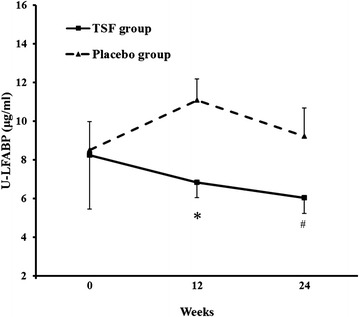
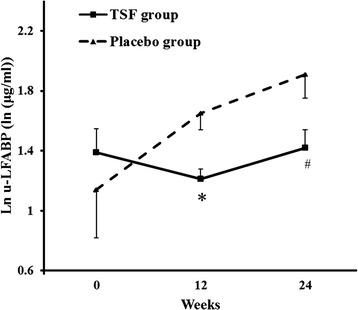
(1) In microalbuminuria patients, UAER in the TSF group displayed a significant decrease after 24 weeks of treatment (P = 0.045). Levels of urinary L-FABP in the TSF group were markedly lower than in the placebo group after 12 and 24 weeks (P = 0.004 and P = 0.047, respectively). (2) In macroalbuminuria patients, 24-h urinary protein levels decreased significantly compared with baseline in the TSF group at week 12 (P = 0.042) and week 24 (P = 0.041). The TSF group showed a significant decrease in urinary L-FABP after 12 and 24 weeks (P = 0.036 and P = 0.046, respectively). (3) Levels of urinary L-FABP increased markedly, correlating with severity of DKD. L-FABP in patients with normoalbuminuria, microalbuminuria, and macroalbuminuria were 5.9 (5.2, 7.8) μg/ml, 11.4 (6.8, 13.4) μg/ml and 18.5 (10.9, 23.4) μg/ml, respectively (P = 0.000).
TSF combined with conventional therapy appeared to be effective in reducing urinary protein and urinary L-FABP. Urinary L-FABP levels appear to be associated with the severity of DKD.
Chinese Clinical Trial Registry ChiCTR-TRC-10000843 . Registered 15 April 2010.
糖肾方(TSF)是一种用于治疗糖尿病肾病(DKD)的中药。肝型脂肪酸结合蛋白(L-FABP)在包括肾脏在内的多种组织中表达,在肾脏中它被称为尿L-FABP。其他研究表明,尿L-FABP可能是监测DKD的一种有用的生物标志物。这项事后分析和横断面研究评估了接受TSF和传统药物治疗的DKD患者尿L-FABP的变化。
对一项多中心、随机、双盲、安慰剂对照试验进行事后分析。共有180例DKD患者纳入原研究,其中98例为微量白蛋白尿患者,82例为大量白蛋白尿患者。除常规治疗外,122例患者被随机分配接受TSF治疗,58例接受安慰剂治疗。治疗24周后,微量白蛋白尿阶段的意向性治疗人群中,TSF组为56例,安慰剂组为25例;大量白蛋白尿阶段分别为42例和19例。原试验的主要结局是尿蛋白水平。在本研究中,检测了30例微量白蛋白尿患者(TSF组15例,安慰剂组15例)和30例大量白蛋白尿患者(TSF组15例,安慰剂组15例)尿和血浆L-FABP水平。此外,另招募了30例正常白蛋白尿患者(尿白蛋白排泄率(UAER)<20μg/min)进行横断面研究。
(1) 在微量白蛋白尿患者中,TSF组治疗24周后UAER显著降低(P=0.045)。TSF组治疗12周和治疗24周后的尿L-FABP水平显著低于安慰剂组(分别为P=0.004和P=0.047)。(2) 在大量白蛋白尿患者中,TSF组第12周(P=0.042)和第24周(P=0.041)的24小时尿蛋白水平与基线相比显著降低。TSF组在治疗12周和24周后尿L-FABP显著降低(分别为P=0.036和P=0.046)。(3) 尿L-FABP水平显著升高,与DKD的严重程度相关。正常白蛋白尿、微量白蛋白尿和大量白蛋白尿患者的L-FABP分别为5.9(5.2,7.8)μg/ml、11.4(6.8,13.4)μg/ml和18.5(10.9,23.4)μg/ml(P=0.000)。
TSF联合传统治疗似乎能有效降低尿蛋白和尿L-FABP。尿L-FABP水平似乎与DKD的严重程度相关。
中国临床试验注册中心ChiCTR-TRC-10000843。2010年4月15日注册。