Haas Andreas D, Msukwa Malango T, Egger Matthias, Tenthani Lyson, Tweya Hannock, Jahn Andreas, Gadabu Oliver J, Tal Kali, Salazar-Vizcaya Luisa, Estill Janne, Spoerri Adrian, Phiri Nozgechi, Chimbwandira Frank, van Oosterhout Joep J, Keiser Olivia
Institute of Social & Preventive Medicine.
Institute of Social & Preventive Medicine The Baobab Health Trust.
Clin Infect Dis. 2016 Nov 1;63(9):1227-1235. doi: 10.1093/cid/ciw500. Epub 2016 Jul 26.
Adherence to antiretroviral therapy (ART) is crucial to preventing mother-to-child transmission of human immunodeficiency virus (HIV) and ensuring the long-term effectiveness of ART, yet data are sparse from African routine care programs on maternal adherence to triple ART.
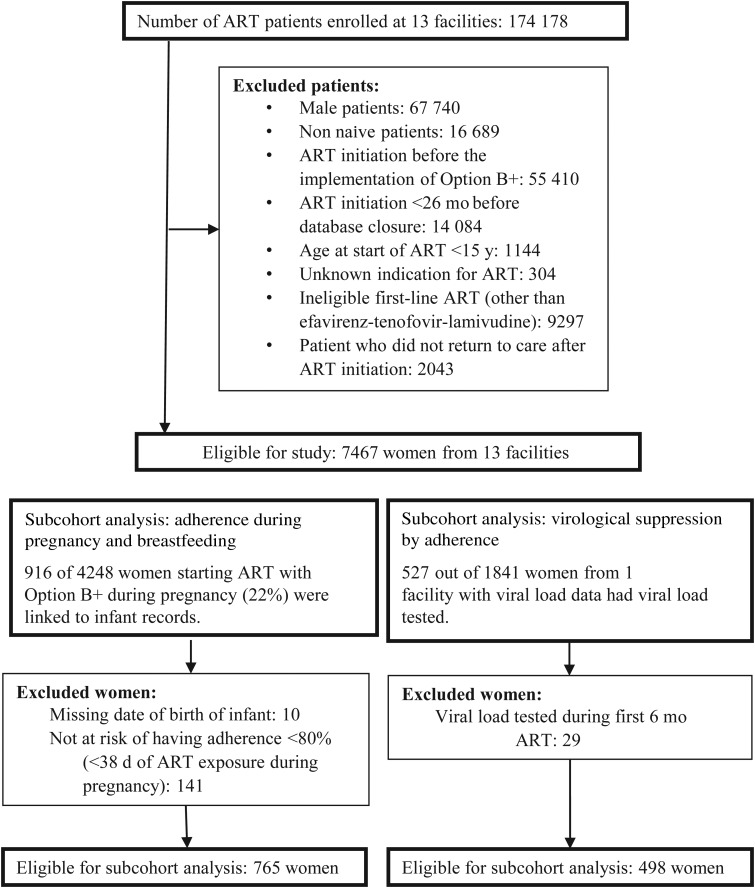
We analyzed data from women who started ART at 13 large health facilities in Malawi between September 2011 and October 2013. We defined adherence as the percentage of days "covered" by pharmacy claims. Adherence of ≥90% was deemed adequate. We calculated inverse probability of censoring weights to adjust adherence estimates for informative censoring. We used descriptive statistics, survival analysis, and pooled logistic regression to compare adherence between pregnant and breastfeeding women eligible for ART under Option B+, and nonpregnant and nonbreastfeeding women who started ART with low CD4 cell counts or World Health Organization clinical stage 3/4 disease.
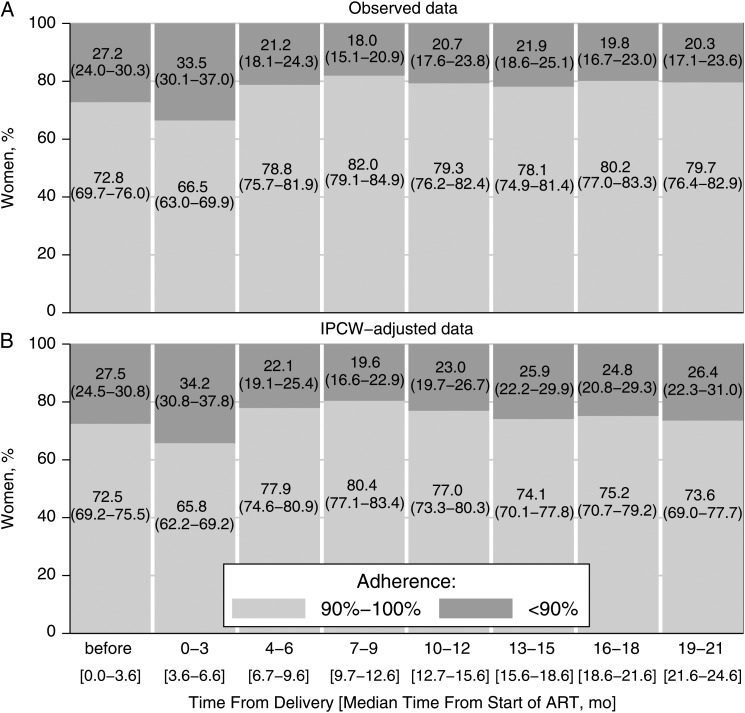
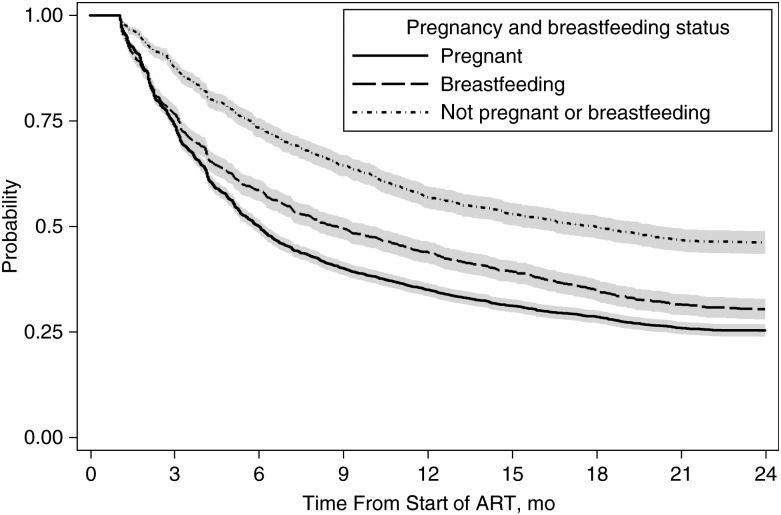
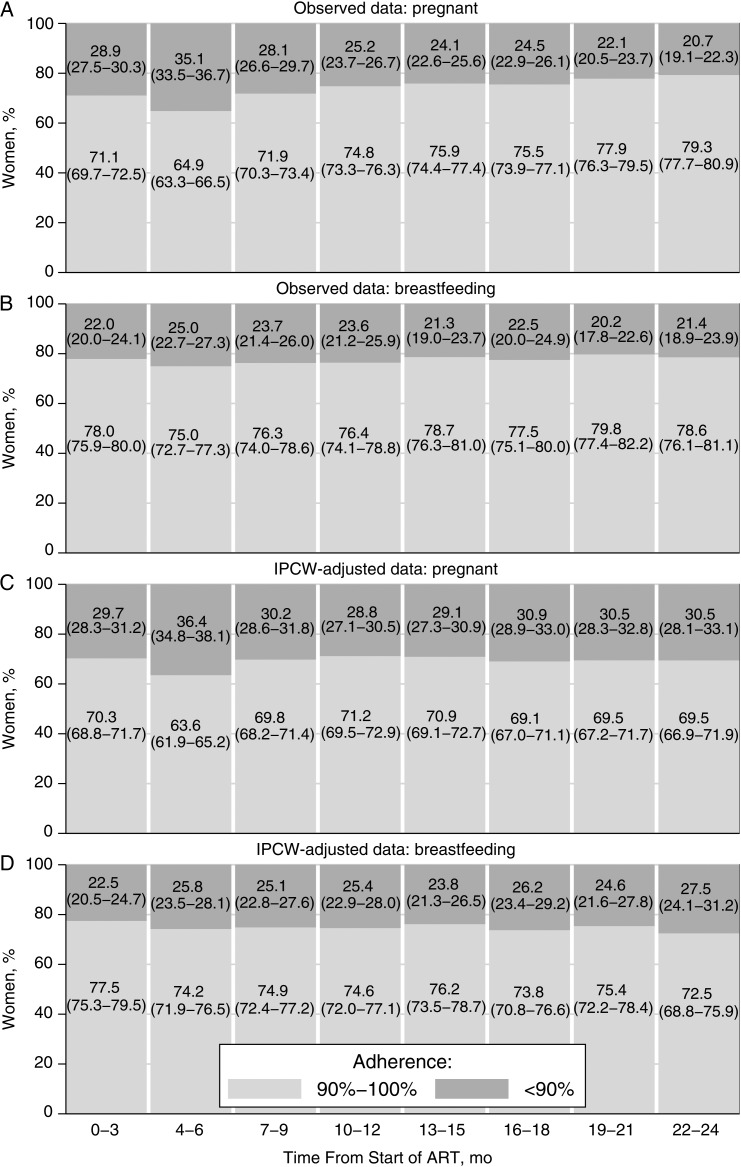
Adherence was adequate for 73% of the women during pregnancy, for 66% in the first 3 months post partum, and for about 75% during months 4-21 post partum. About 70% of women who started ART during pregnancy and breastfeeding adhered adequately during the first 2 years of ART, but only about 30% of them had maintained adequate adherence at every visit. Risk factors for inadequate adherence included starting ART with an Option B+ indication, at a younger age, or at a district hospital or health center.
One-third of women retained in the Option B+ program adhered inadequately during pregnancy and breastfeeding, especially soon after delivery. Effective interventions to improve adherence among women in this program should be implemented.
坚持抗逆转录病毒疗法(ART)对于预防人类免疫缺陷病毒(HIV)母婴传播以及确保ART的长期疗效至关重要,但非洲常规护理项目中关于孕产妇对三联ART的依从性数据稀少。
我们分析了2011年9月至2013年10月期间在马拉维13家大型医疗机构开始接受ART治疗的女性的数据。我们将依从性定义为药房记录所覆盖的天数百分比。≥90%的依从性被视为足够。我们计算了截尾权重的逆概率,以调整因信息性截尾而产生的依从性估计值。我们使用描述性统计、生存分析和汇总逻辑回归来比较符合“B+方案”条件的孕妇和哺乳期妇女与开始ART治疗时CD4细胞计数低或处于世界卫生组织临床分期3/4期疾病的非孕妇和非哺乳期妇女之间的依从性。
73%的女性在孕期依从性足够,产后前3个月为66%,产后4至21个月约为75%。在孕期和哺乳期开始接受ART治疗的女性中,约70%在ART治疗的前两年依从性足够,但其中只有约30%在每次就诊时都保持了足够的依从性。依从性不足的风险因素包括因“B+方案”指征开始ART治疗、年龄较小、在地区医院或保健中心开始治疗。
在“B+方案”项目中,三分之一的女性在孕期和哺乳期依从性不足,尤其是在分娩后不久。应实施有效的干预措施,以提高该项目中女性的依从性。