
储存物螨类腐食酪螨的种群在其细菌群落上存在差异。
Populations of Stored Product Mite Tyrophagus putrescentiae Differ in Their Bacterial Communities.
作者信息
Erban Tomas, Klimov Pavel B, Smrz Jaroslav, Phillips Thomas W, Nesvorna Marta, Kopecky Jan, Hubert Jan
机构信息
Biologically Active Substances in Crop Protection, Crop Research Institute Prague, Czech Republic.
Department of Ecology and Evolutionary Biology, University of Michigan, Ann ArborMI, USA; Faculty of Biology, Tyumen State UniversityTyumen, Russia.
出版信息
Front Microbiol. 2016 Jul 12;7:1046. doi: 10.3389/fmicb.2016.01046. eCollection 2016.
BACKGROUND
Tyrophagus putrescentiae colonizes different human-related habitats and feeds on various post-harvest foods. The microbiota acquired by these mites can influence the nutritional plasticity in different populations. We compared the bacterial communities of five populations of T. putrescentiae and one mixed population of T. putrescentiae and T. fanetzhangorum collected from different habitats.
MATERIAL
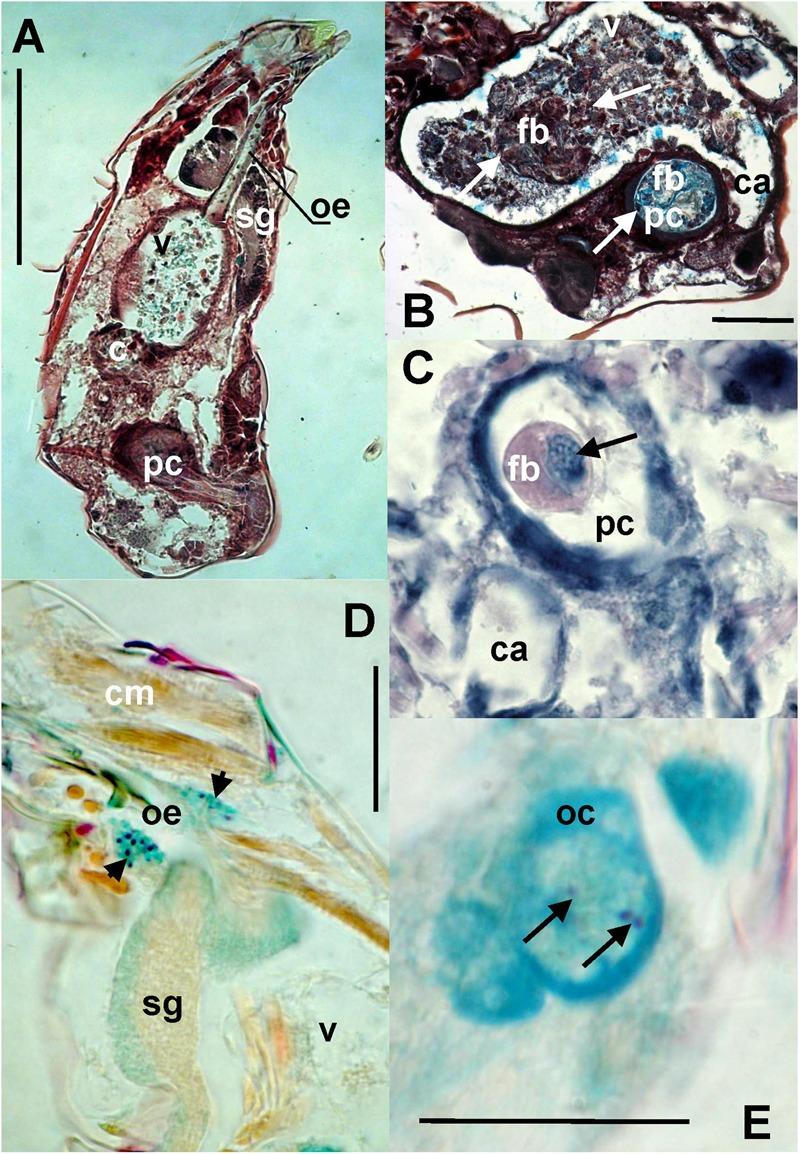
The bacterial communities of the six mite populations from different habitats and diets were compared by Sanger sequencing of cloned 16S rRNA obtained from amplification with universal eubacterial primers and using bacterial taxon-specific primers on the samples of adults/juveniles or eggs. Microscopic techniques were used to localize bacteria in food boli and mite bodies. The morphological determination of the mite populations was confirmed by analyses of CO1 and ITS fragment genes.
RESULTS
The following symbiotic bacteria were found in compared mite populations: Wolbachia (two populations), Cardinium (five populations), Bartonella-like (five populations), Blattabacterium-like symbiont (three populations), and Solitalea-like (six populations). From 35 identified OTUs97, only Solitalea was identified in all populations. The next most frequent and abundant sequences were Bacillus, Moraxella, Staphylococcus, Kocuria, and Microbacterium. We suggest that some bacterial species may occasionally be ingested with food. The bacteriocytes were observed in some individuals in all mite populations. Bacteria were not visualized in food boli by staining, but bacteria were found by histological means in ovaria of Wolbachia-infested populations.
CONCLUSION
The presence of Blattabacterium-like, Cardinium, Wolbachia, and Solitalea-like in the eggs of T. putrescentiae indicates mother to offspring (vertical) transmission. RESULTS of this study indicate that diet and habitats influence not only the ingested bacteria but also the symbiotic bacteria of T. putrescentiae.
背景
腐食酪螨栖息于不同的人类相关环境中,并以各种收获后的食物为食。这些螨虫获得的微生物群会影响不同种群的营养可塑性。我们比较了从不同栖息地采集的五个腐食酪螨种群以及一个腐食酪螨和范氏酪螨混合种群的细菌群落。
材料
通过对使用通用真细菌引物扩增得到的克隆16S rRNA进行桑格测序,并在成虫/幼虫或卵的样本上使用细菌分类群特异性引物,比较了来自不同栖息地和食物的六个螨种种群的细菌群落。使用显微镜技术将细菌定位在食物团和螨体中。通过对CO1和ITS片段基因的分析确认了螨种种群的形态学鉴定。
结果
在比较的螨种种群中发现了以下共生细菌:沃尔巴克氏体(两个种群)、卡定菌(五个种群)、类巴尔通体(五个种群)、类blattabacterium共生菌(三个种群)和类Solitalea(六个种群)。在所有鉴定出的35个OTU97中,只有Solitalea在所有种群中都有发现。其次最常见和丰富的序列是芽孢杆菌属、莫拉克斯氏菌属、葡萄球菌属、考克氏菌属和微杆菌属。我们认为某些细菌物种可能偶尔会随食物摄入。在所有螨种种群的一些个体中观察到了含菌细胞。通过染色在食物团中未观察到细菌,但通过组织学方法在感染沃尔巴克氏体的种群的卵巢中发现了细菌。
结论
腐食酪螨卵中存在类blattabacterium、卡定菌、沃尔巴克氏体和类Solitalea表明存在母系到后代的(垂直)传播。本研究结果表明,食物和栖息地不仅会影响摄入的细菌,还会影响腐食酪螨的共生细菌。




 Zotero 插件