Naumann Johannes, Sadaghiani Catharina, Bureau Nina, Schmidt Stefan, Huber Roman
Interdisciplinary Center for Treatment and Research in Balneology, Institute for Environmental Health Sciences and Hospital Infection Control, Medical Faculty, Medical Center University of Freiburg, Breisacher Straße 115b, Freiburg im Breisgau, 79106, Germany.
Department of Psychosomatic Medicine, Medical Faculty, Medical Center University of Freiburg, Hauptstraße 8, Freiburg im Breisgau, 79104, Germany.
BMC Complement Altern Med. 2016 Jul 27;16:250. doi: 10.1186/s12906-016-1241-7.
Cardiovascular diseases are a main cause of mortality worldwide. Spa bathing and immersion in thermoneutral water (ITW) have a long history in the treatment of cardiovascular risk factors.
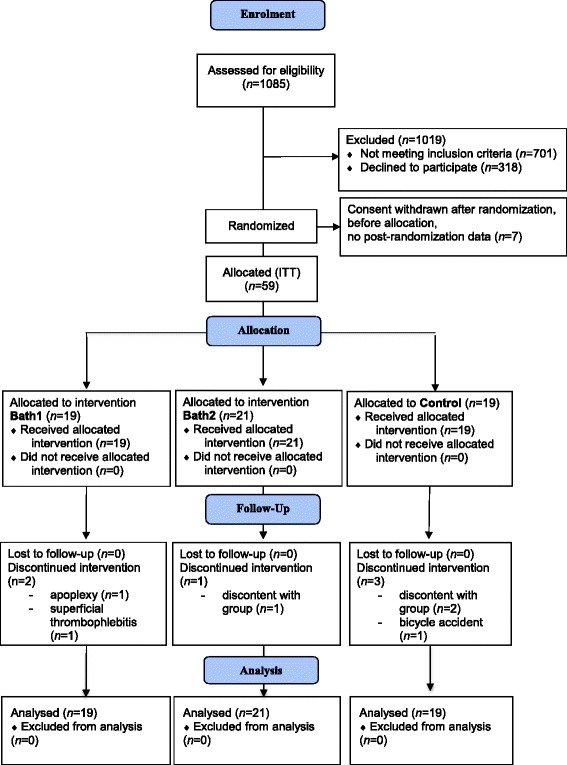
We conducted a three-arm parallel-group, randomized controlled study to investigate the effects of frequent ITW on moderately elevated blood pressure (BP). Here, we report on the secondary outcomes, i.e. the influence of immersion in thermoneutral water on further cardiovascular risk factors: body mass index (BMI), waist circumference, blood lipids, fasting blood glucose and C-reactive protein. Patients (age 57.6 ± 9.6 years, BMI 29.5 ± 5.7 kg/m(2)) with mild to moderately elevated BP received ITW for 45-60 min in pools of thermal-mineral water at 34.0-36.0 °C four times a week for 4 weeks. One group (Bath1) reduced the intensity to one bath a week for a further 20 weeks, while the other group (Bath2) continued bathing four times a week. The control group was instructed to relax for 45-60 min four times a week for 24 weeks using a relaxation CD.
The secondary analysis of the intention-to-treat population (N = 59) did not show a significant reduction of BMI, waist circumference, blood lipids, fasting blood glucose or C-reactive protein in patients with a mild to moderately elevated BP after 4 and 24 weeks ITW, respectively. There were no significant differences between the groups.
Thus, we did not find evidence to support our ITW program being an efficacious intervention to induce cardiovascular alterations in this population of hypertensive patients.
DRKS00003980 at drks-neu.uniklinik-freiburg.de, German Clinical Trials Register (registration date 2012-07-10).
心血管疾病是全球范围内主要的死亡原因。温泉浴和浸泡于热中性水中(ITW)在治疗心血管危险因素方面有着悠久的历史。
我们开展了一项三臂平行组随机对照研究,以调查频繁进行ITW对中度升高的血压(BP)的影响。在此,我们报告次要结果,即浸泡于热中性水中对其他心血管危险因素的影响:体重指数(BMI)、腰围、血脂、空腹血糖和C反应蛋白。血压轻度至中度升高的患者(年龄57.6±9.6岁,BMI 29.5±5.7kg/m²)在温度为34.0 - 36.0°C的热矿泉水池中接受45 - 60分钟的ITW治疗,每周4次,共4周。一组(Bath1)在接下来的20周中将治疗强度减至每周1次,而另一组(Bath2)继续每周进行4次洗浴。对照组被指导使用放松CD,每周4次,每次45 - 60分钟,共24周。
在意向性治疗人群(N = 59)的次要分析中,血压轻度至中度升高的患者在接受ITW治疗4周和24周后,BMI、腰围、血脂、空腹血糖或C反应蛋白均未出现显著降低。各治疗组之间无显著差异。
因此,我们没有找到证据支持我们的ITW方案是一种能有效干预该高血压患者群体心血管改变的方法。
德国临床试验注册中心(drks-neu.uniklinik-freiburg.de)的DRKS00003980(注册日期2012 - 07 - 10)