Rugani Rosa, McCrink Koleen, de Hevia Maria-Dolores, Vallortigara Giorgio, Regolin Lucia
Department of General Psychology, University of Padova, Padova, Italy.
Department of Psychology, Barnard College, Columbia University, USA.
Sci Rep. 2016 Jul 28;6:30114. doi: 10.1038/srep30114.
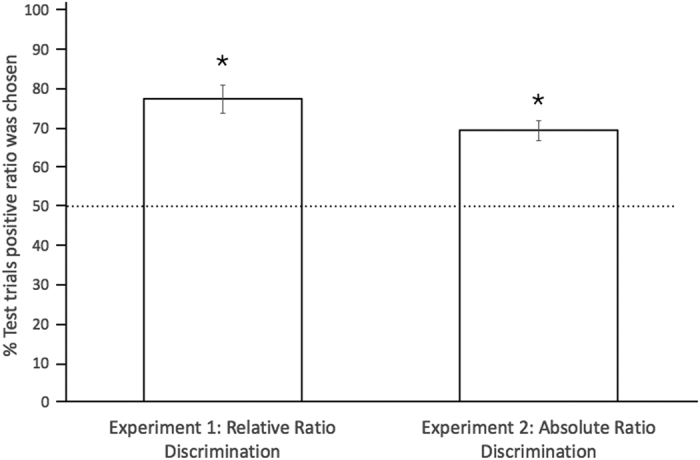
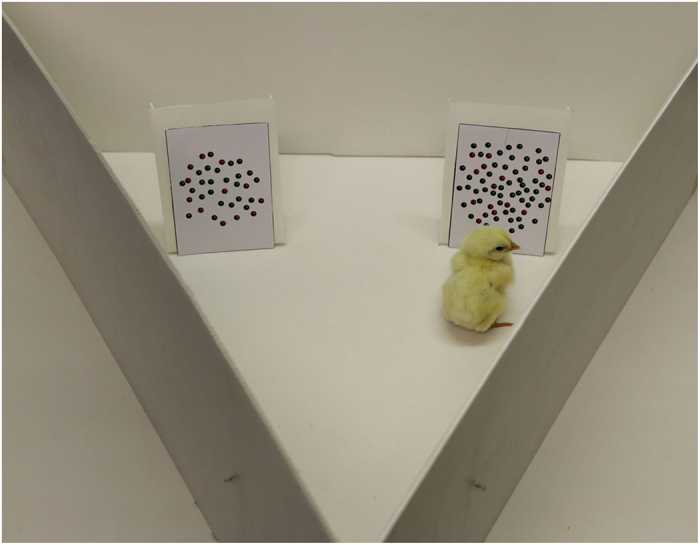
A large body of literature shows that non-human animals master a variety of numerical tasks, but studies involving proportional discrimination are sparse and primarily done with mature animals. Here we trained 4-day-old domestic chicks (Gallus gallus) to respond to stimuli depicting multiple examples of the proportion 4:1 when compared with the proportion 2:1. Stimuli were composed of green and red dot arrays; for the rewarded 4:1 proportion, 4 green dots for every red dot (e.g. ratios: 32:8, 12:3, and 44:11). The birds continued to discriminate when presented with new ratios at test (such as 20:5), characterized by new numbers of dots and new spatial configurations (Experiment 1). This indicates that chicks can extract the common proportional value shared by different ratios and apply it to new ones. In Experiment 2, chicks identified a specific proportion (2:1) from either a smaller (4:1) or a larger one (1:1), demonstrating an ability to represent the specific, and not relative, value of a particular proportion. Again, at test, chicks selectively responded to the previously reinforced proportion from new ratios. These findings provide strong evidence for very young animals' ability to extract, identify, and productively use proportion information across a range of different amounts.
大量文献表明,非人类动物能够掌握各种数字任务,但涉及比例辨别能力的研究却很少,且主要是针对成年动物开展的。在此,我们对4日龄的家鸡(原鸡)进行训练,使其在面对描绘4:1比例的多个示例的刺激时做出反应,并与2:1比例的刺激进行比较。刺激由绿色和红色点阵组成;对于奖励的4:1比例,每一个红点对应4个绿点(例如比例:32:8、12:3和44:11)。在测试中,当呈现新的比例(如20:5)时,这些家鸡能够继续进行辨别,新比例具有新的点数和新的空间配置(实验1)。这表明雏鸡能够提取不同比例所共有的共同比例值,并将其应用于新的比例。在实验2中,雏鸡能够从较小的比例(4:1)或较大的比例(1:1)中识别出特定比例(2:1),这表明它们能够表征特定比例的具体值,而非相对值。同样,在测试中,雏鸡对新比例中先前强化过的比例做出了选择性反应。这些发现为幼小动物在一系列不同数量范围内提取、识别和有效使用比例信息的能力提供了有力证据。