Xin Chuanwei, Xia Zhongni, Jiang Cheng, Lin Mengmeng, Li Gonghua
Department of Pharmacy, Zhejiang Academy of Traditional Chinese Medicine, Tongde Hospital of Zhejiang Province, Hangzhou, People's Republic of China.
Patient Prefer Adherence. 2016 Jul 11;10:1197-203. doi: 10.2147/PPA.S110167. eCollection 2016.
COPD is rapidly becoming one of the most challenging health problems worldwide, which is characterized by not fully reversible airflow limitation. Although a lot of treatment medications have been delivered, the treatment goals of COPD are often not achieved. Furthermore, few well-designed randomized controlled trials in the People's Republic of China have been reported to evaluate the impact of pharmacist-managed clinic (PMC) on medication adherence and health-related quality of life in patients with COPD.
A prospective randomized controlled study (on a PMC group and a control group) was conducted between January 2015 and December 2015. A structured education about COPD was provided by a clinical pharmacist to the PMC group. Primary outcomes were medication adherence (assessed by medication refill adherence scores) and health-related quality of life (assessed by St George's Respiratory Questionnaire). Secondary outcomes were exacerbation rate, hospitalization rate, and smoking behavior.
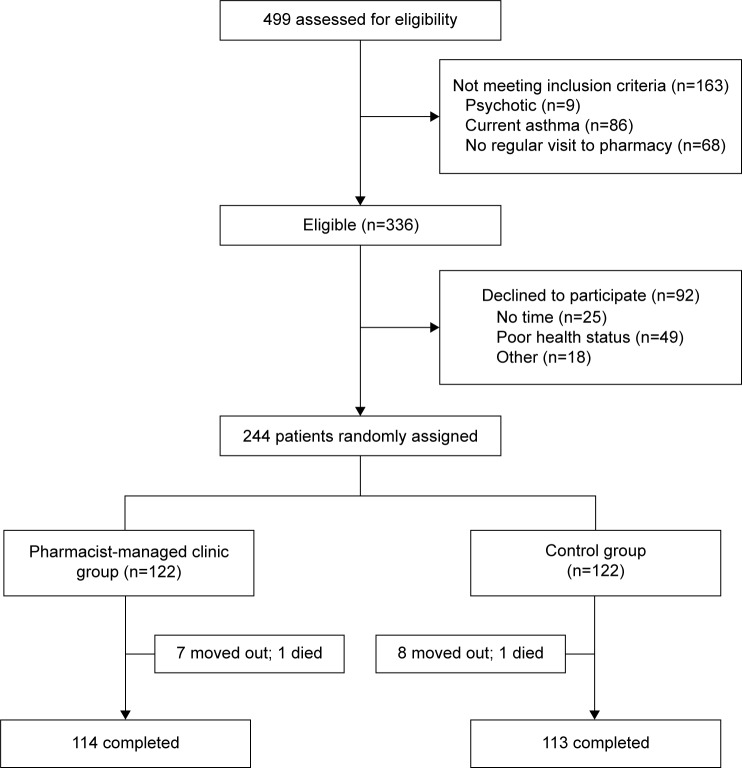
A total of 244 patients were enrolled for our study. The PMC group showed a significantly greater improvement in medication adherence compared with the baseline (93.1±14.2 vs 78.8±12.3, P<0.01). When compared with the control group, there were more patients whose medication refill adherence score was ≥80 in the PMC group (83.3% vs 51.3%, P<0.01). The total St George's Respiratory Questionnaire scores was found to be improved significantly in the PMC group (42.7±3.2 vs 52.4±5.2, P<0.05). There was a lower hospitalization rate in the PMC group, and more patients in the PMC group quit smoking (71.0% vs 52.2%, P<0.05).
The PMC may result in improvement of medication adherence and the health-related quality of life in patients with COPD. In the PMC group, a significant reduction in exacerbation rate, hospitalization rate, and smoking behavior was observed; therefore, our study provides support for a greater involvement of PMC in the care of patients with COPD.
慢性阻塞性肺疾病(COPD)正迅速成为全球最具挑战性的健康问题之一,其特征为气流受限不完全可逆。尽管已有多种治疗药物,但COPD的治疗目标往往难以实现。此外,在中国,鲜有设计良好的随机对照试验报道评估药师管理门诊(PMC)对COPD患者药物依从性及健康相关生活质量的影响。
于2015年1月至2015年12月进行了一项前瞻性随机对照研究(分为PMC组和对照组)。临床药师为PMC组提供了关于COPD的结构化教育。主要结局指标为药物依从性(通过药物再填充依从性评分评估)和健康相关生活质量(通过圣乔治呼吸问卷评估)。次要结局指标为急性加重率、住院率和吸烟行为。
共有244例患者纳入本研究。与基线相比,PMC组的药物依从性有显著改善(93.1±14.2 vs 78.8±12.3,P<0.01)。与对照组相比,PMC组中药物再填充依从性评分≥80的患者更多(83.3% vs 51.3%,P<0.01)。发现PMC组的圣乔治呼吸问卷总评分有显著改善(42.7±3.2 vs 52.4±5.2,P<0.05)。PMC组的住院率较低,且PMC组中更多患者戒烟(71.0% vs 52.2%,P<0.05)。
PMC可能会改善COPD患者的药物依从性和健康相关生活质量。在PMC组中,观察到急性加重率、住院率和吸烟行为显著降低;因此,我们的研究为PMC更多地参与COPD患者的护理提供了支持。