Blondeau Andréanne, Lucier Jean-François, Matteau Dominick, Dumont Lauralyne, Rodrigue Sébastien, Jacques Pierre-Étienne, Blouin Richard
Département de biologie, Faculté des sciences, Université de Sherbrooke, 2500 Boul. de l'Université, Sherbrooke, Québec, J1K 2R1, Canada.
Département d'informatique, Faculté des sciences, Université de Sherbrooke, Sherbrooke, Québec, Canada.
Neural Dev. 2016 Jul 28;11(1):13. doi: 10.1186/s13064-016-0068-8.
Recent genetic studies in model organisms, such as Drosophila, C. elegans and mice, have highlighted a critical role for dual leucine zipper kinase (DLK) in neural development and axonal responses to injury. However, exactly how DLK fulfills these functions remains to be determined. Using RNA-seq profiling, we evaluated the global changes in gene expression that are caused by shRNA-mediated knockdown of endogenous DLK in differentiated Neuro-2a neuroblastoma cells.
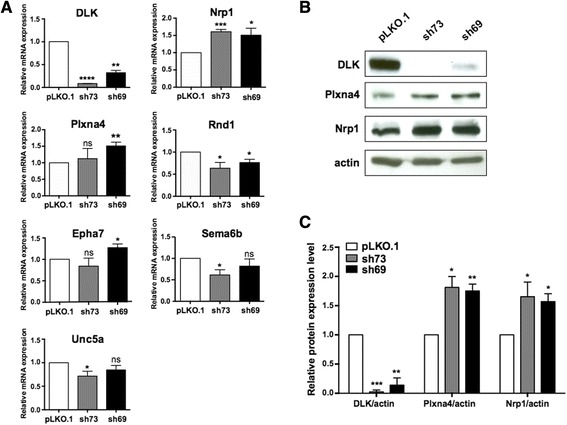
Our analysis led to the identification of numerous up- and down-regulated genes, among which several were found to be associated with system development and axon guidance according to gene ontology (GO) and Kyoto Encyclopedia of Genes and Genomes (KEGG) pathway analyses, respectively. Because of their importance in axonal growth, pruning and regeneration during development and adult life, we then examined by quantitative RT-PCR the mRNA expression levels of the identified axon guidance genes in DLK-depleted cells. Consistent with the RNA-seq data, our results confirmed that loss of DLK altered expression of the genes encoding neuropilin 1 (Nrp1), plexin A4 (Plxna4), Eph receptor A7 (Epha7), Rho family GTPase 1 (Rnd1) and semaphorin 6B (Sema6b). Interestingly, this regulation of Nrp1 and Plxna4 mRNA expression by DLK in Neuro-2a cells was also reflected at the protein level, implicating DLK in the modulation of the function of these axon guidance molecules.
Collectively, these results provide the first evidence that axon guidance genes are downstream targets of the DLK signaling pathway, which through their regulation probably modulates neuronal cell development, structure and function.
近期在果蝇、秀丽隐杆线虫和小鼠等模式生物中的遗传学研究强调了双亮氨酸拉链激酶(DLK)在神经发育和轴突损伤反应中的关键作用。然而,DLK究竟如何履行这些功能仍有待确定。我们使用RNA测序分析,评估了在分化的Neuro-2a神经母细胞瘤细胞中,由shRNA介导的内源性DLK敲低所引起的基因表达的整体变化。
我们的分析鉴定出了众多上调和下调的基因,根据基因本体论(GO)和京都基因与基因组百科全书(KEGG)通路分析,其中分别有几个基因与系统发育和轴突导向相关。由于它们在发育和成年期轴突生长、修剪和再生中的重要性,我们随后通过定量RT-PCR检测了DLK缺失细胞中所鉴定的轴突导向基因的mRNA表达水平。与RNA测序数据一致,我们的结果证实,DLK的缺失改变了编码神经纤毛蛋白1(Nrp1)、丛状蛋白A4(Plxna4)、Eph受体A7(Epha7)、Rho家族GTP酶1(Rnd1)和信号素6B(Sema6b)的基因的表达。有趣的是,DLK对Neuro-2a细胞中Nrp1和Plxna4 mRNA表达的这种调节在蛋白质水平上也有体现,这表明DLK参与了这些轴突导向分子功能的调节。
总的来说,这些结果提供了首个证据,即轴突导向基因是DLK信号通路的下游靶点,该通路可能通过对它们的调节来调控神经元细胞的发育、结构和功能。