Biswas Lisa, Harrison Erin, Gong Yongzhen, Avusula Ramachandram, Lee Jonathan, Zhang Meiyu, Rousselle Thomas, Lage Janice, Liu Xiu
Department of Pathology, University of Mississippi Medical Center, 2500 North State Street, Jackson, MS, 39216, USA.
Psychopharmacology (Berl). 2016 Sep;233(18):3417-27. doi: 10.1007/s00213-016-4391-x. Epub 2016 Jul 29.
Tobacco smoking is a leading preventable cause of premature death in the USA. Menthol is a significant flavoring additive in tobacco products. Clinical evidence suggests that menthol may promote tobacco smoking and nicotine dependence. However, it is unclear whether menthol enhances the reinforcing actions of nicotine and thus facilitates nicotine consumption. This study employed a rat model of nicotine self-administration to examine the effects of menthol on nicotine-taking behavior.
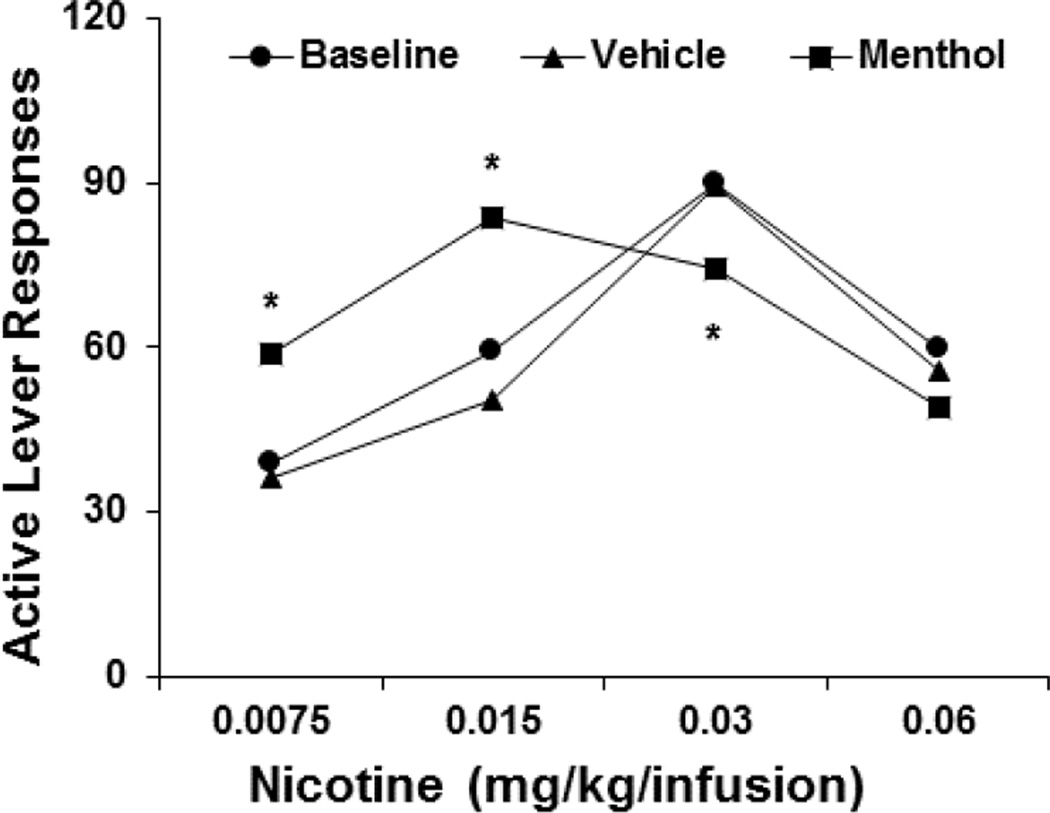
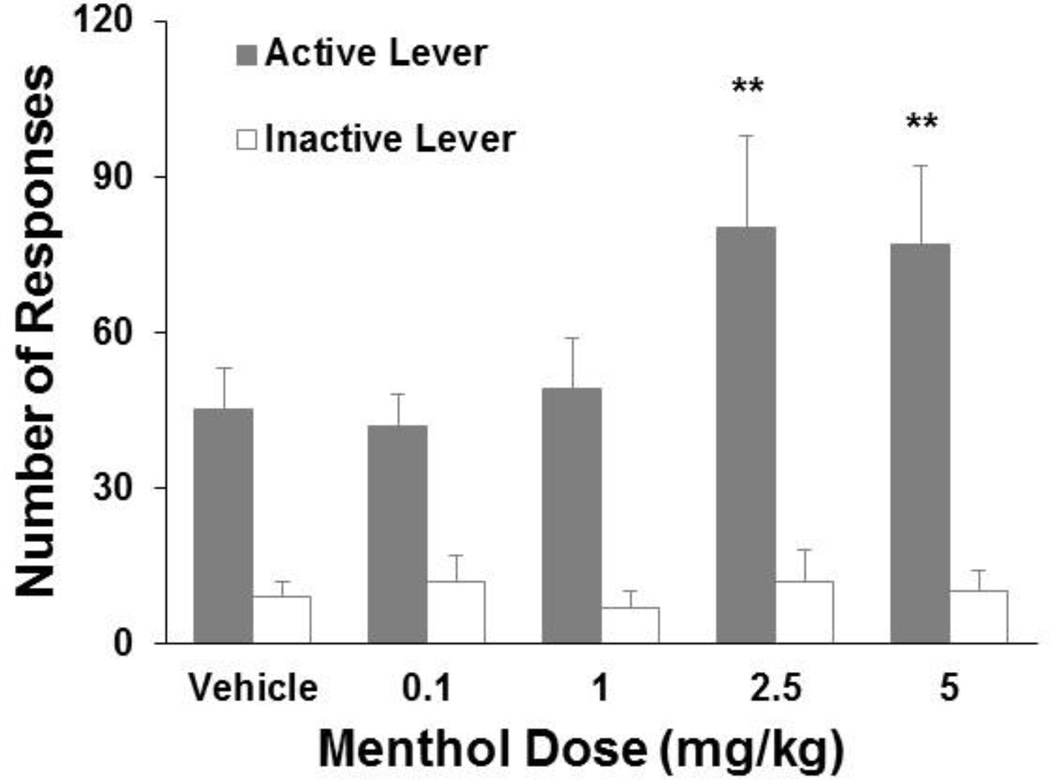
Male Sprague-Dawley rats were trained in daily 1-h sessions to press a lever for intravenous nicotine self-administration under a fixed-ratio 5 schedule of reinforcement. In separate groups, rats self-administered nicotine at four different doses (0.0075, 0.015, 0.03, and 0.06 mg/kg/infusion). Five minutes prior to the two test sessions, menthol (5 mg/kg) or its vehicle was administered intraperitoneally in all rats in a counterbalanced design within each group. In separate rats that self-administered 0.015 mg/kg/infusion nicotine, menthol dose-response function was determined. Menthol was also tested on food self-administration.
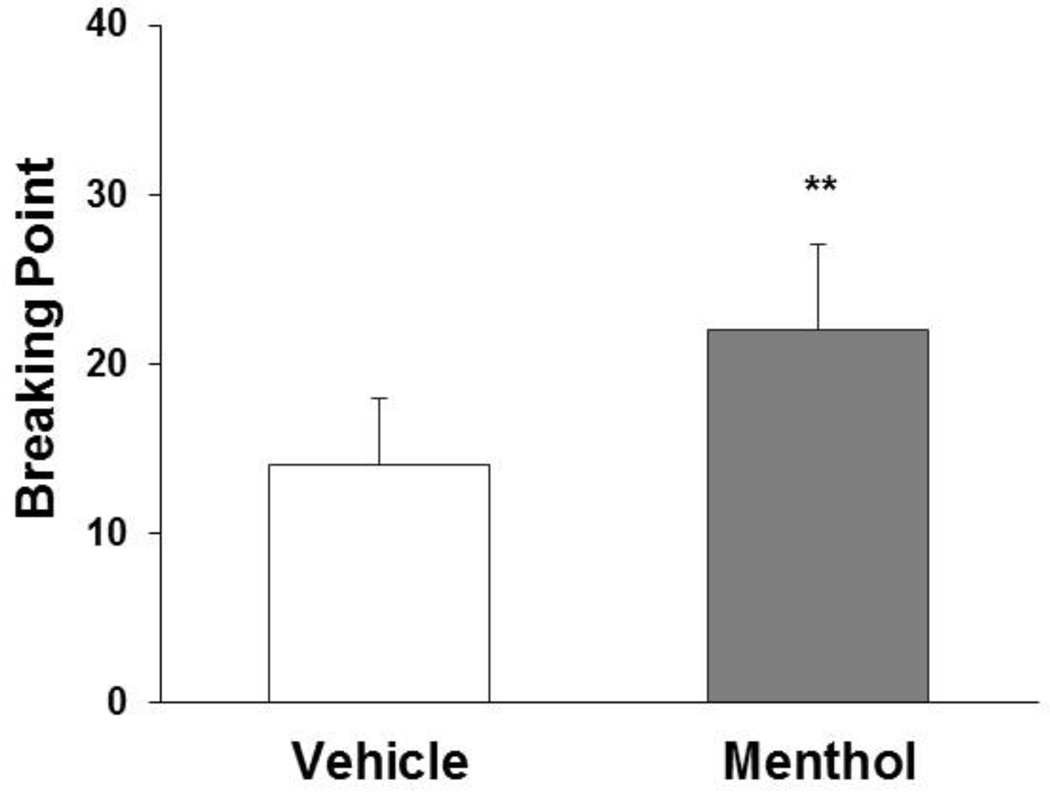
An inverted U-shaped nicotine dose-response curve was observed. Menthol pretreatment shifted the nicotine dose-response curve to the left. The facilitating effect of menthol on the self-administration of 0.015 mg/kg/infusion nicotine was dose-dependent, whereas it produced similar effects at doses above the threshold of 2.5 mg/kg. Menthol tended to suppress the self-administration of food pellets.
These data demonstrate that menthol enhances the reinforcing effects of nicotine, and the effect of menthol was specific to nicotine. The findings suggest that menthol directly facilitates nicotine consumption, thereby contributing to tobacco smoking.
在美国,吸烟是可预防的过早死亡的主要原因。薄荷醇是烟草制品中的一种重要调味添加剂。临床证据表明,薄荷醇可能会促进吸烟和尼古丁依赖。然而,尚不清楚薄荷醇是否会增强尼古丁的强化作用,从而促进尼古丁的消费。本研究采用尼古丁自我给药的大鼠模型来研究薄荷醇对尼古丁摄取行为的影响。
雄性Sprague-Dawley大鼠每天接受1小时的训练,在固定比率5的强化程序下按压杠杆以进行静脉内尼古丁自我给药。在不同的组中,大鼠以四种不同剂量(0.0075、0.015、0.03和0.06mg/kg/次注射)自我给药尼古丁。在两次测试前5分钟,在每组内以平衡设计给所有大鼠腹腔注射薄荷醇(5mg/kg)或其溶媒。在自我给药0.015mg/kg/次注射尼古丁的单独大鼠中,确定薄荷醇的剂量反应函数。还对薄荷醇进行了食物自我给药测试。
观察到倒U形的尼古丁剂量反应曲线。薄荷醇预处理使尼古丁剂量反应曲线向左移动。薄荷醇对0.015mg/kg/次注射尼古丁自我给药的促进作用呈剂量依赖性,而在高于2.5mg/kg阈值的剂量下产生类似效果。薄荷醇倾向于抑制食物颗粒的自我给药。
这些数据表明,薄荷醇增强了尼古丁的强化作用,且薄荷醇的作用对尼古丁具有特异性。研究结果表明,薄荷醇直接促进尼古丁的消费,从而导致吸烟。