Laubacher Marco, Aksöz Efe A, Binder-Macleod Stuart, Hunt Kenneth J
Institute for Rehabilitation and Performance Technology, Bern University of Applied Sciences, Burgdorf, Switzerland; Sensory Motor Systems Lab, ETH Zurich, Zürich, Switzerland.
Department of Physical Therapy, University of Delaware , Newark, United States of America.
Eur J Transl Myol. 2016 Jun 13;26(2):6016. doi: 10.4081/ejtm.2016.6016.
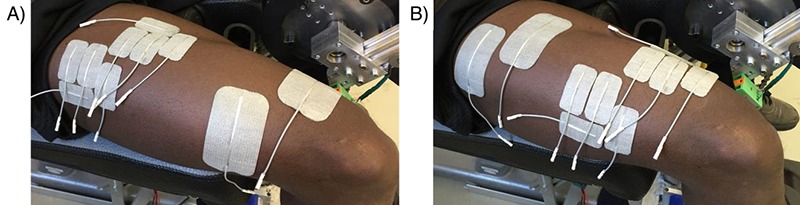
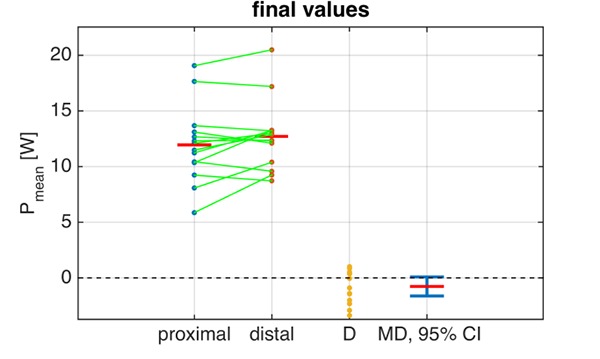
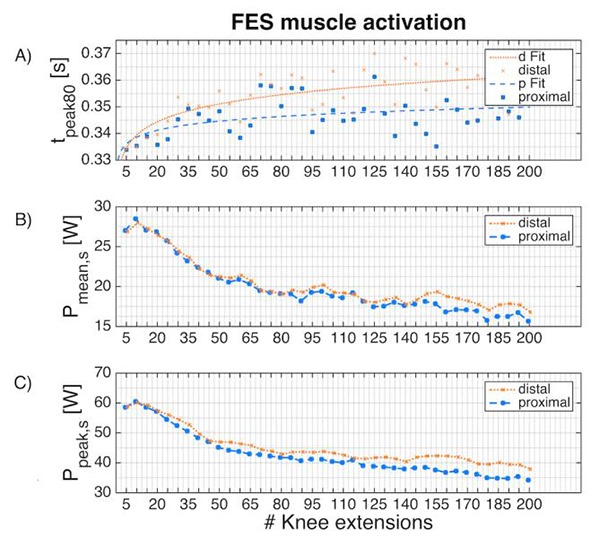
Spatially distributed sequential stimulation (SDSS) has demonstrated substantial power output and fatigue benefits compared to single electrode stimulation (SES) in the application of functional electrical stimulation (FES). This asymmetric electrode setup brings new possibilities but also new questions since precise placement of the electrodes is one critical factor for good muscle activation. The aim of this study was to compare the power output, fatigue and activation properties of proximally versus distally placed SDSS electrodes in an isokinetic knee extension task simulating knee movement during recumbent cycling. M. vastus lateralis and medialis of seven able-bodied subjects were stimulated with rectangular bi-phasic pulses of constant amplitude of 40 mA and at an SDSS frequency of 35 Hz for 6 min on both legs with both setups (i.e. n=14). Torque was measured during knee-extension movement by a dynamometer at an angular velocity of 110 deg/s. Mean power, peak power and activation time were calculated and compared for the initial and final stimulation phases, together with an overall fatigue index. Power output values (Pmean, Ppeak) were scaled to a standardised reference input pulse width of 100 μs (Pmean,s, Ppeak,s). The initial evaluation phase showed no significant differences between the two setups for all outcome measures. Ppeak and Ppeak,s were both significantly higher in the final phase for the distal setup (25.4 ± 8.1 W vs. 28.2 ± 6.2 W, p=0.0062 and 34.8 ± 9.5 W vs. 38.9 ± 6.7 W, p=0.021, respectively). With distal SDSS, there was modest evidence of higher Pmean and Pmean,s (p=0.071, p=0.14, respectively) but of longer activation time (p=0.096). The rate of fatigue was similar for both setups. For practical FES applications, distal placement of the SDSS electrodes is preferable.
在功能性电刺激(FES)的应用中,与单电极刺激(SES)相比,空间分布顺序刺激(SDSS)已显示出强大的功率输出和疲劳缓解效果。这种不对称的电极设置带来了新的可能性,但也引发了新的问题,因为电极的精确放置是实现良好肌肉激活的关键因素之一。本研究的目的是在模拟卧式骑行时膝关节运动的等速膝关节伸展任务中,比较近端和远端放置的SDSS电极的功率输出、疲劳和激活特性。对7名身体健全的受试者的股外侧肌和股内侧肌,使用幅度恒定为40 mA的矩形双相脉冲,以35 Hz的SDSS频率,在双腿上采用两种设置(即n = 14)进行6分钟的刺激。在膝关节伸展运动期间,通过测力计以110度/秒的角速度测量扭矩。计算并比较初始和最终刺激阶段的平均功率、峰值功率和激活时间,以及总体疲劳指数。功率输出值(Pmean、Ppeak)按比例缩放到标准化参考输入脉冲宽度100 μs(Pmean,s、Ppeak,s)。初始评估阶段显示,两种设置在所有结果指标上均无显著差异。在最终阶段,远端设置的Ppeak和Ppeak,s均显著更高(分别为25.4±8.1 W对28.2±6.2 W,p = 0.0062;34.8±9.5 W对38.9±6.7 W,p = 0.021)。对于远端SDSS,有适度证据表明Pmean和Pmean,s更高(分别为p = 0.071,p = 0.14),但激活时间更长(p = 0.096)。两种设置的疲劳率相似。对于实际的FES应用,SDSS电极的远端放置更可取。