Bertaut Aurélie, Truntzer Caroline, Madkouri Rachid, Kaderbhai Coureche Guillaume, Derangère Valentin, Vincent Julie, Chauffert Bruno, Aubriot-Lorton Marie Hélene, Farah Wahlid, Mourier Klaus Luc, Boidot Romain, Ghiringhelli Francois
Biostatistics unit Georges Francois Leclerc Cancer Center, Dijon, France.
CLIPP, Research Center, University of Burgundy, Dijon, France.
Oncotarget. 2016 Oct 25;7(43):70948-70958. doi: 10.18632/oncotarget.10898.
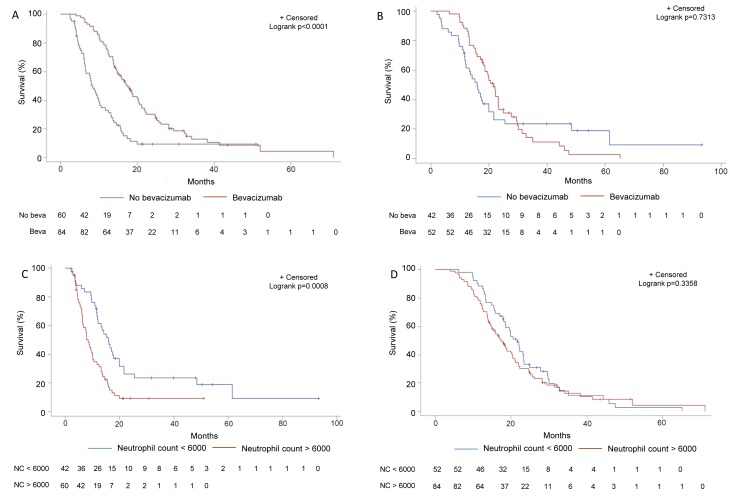
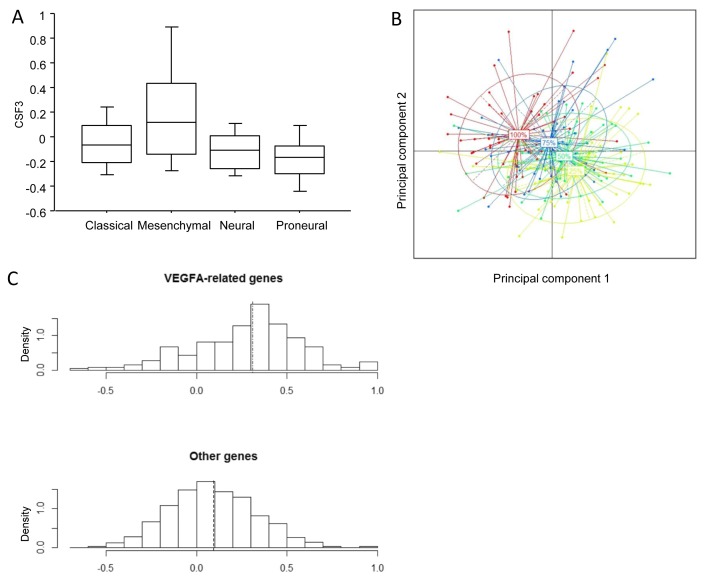
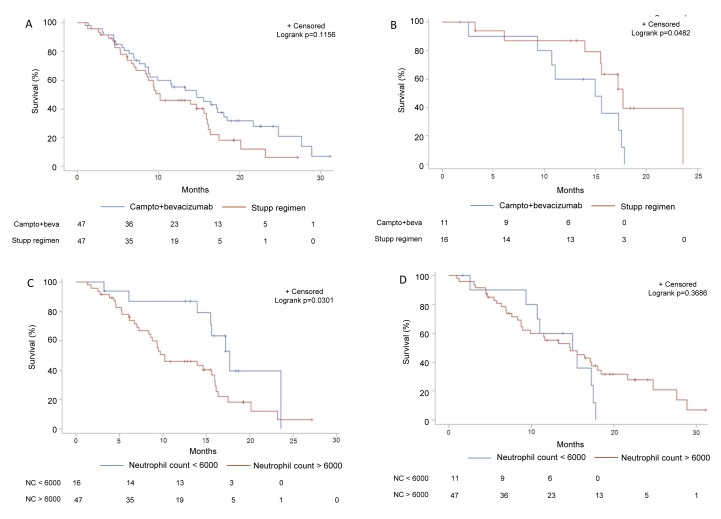
Bevacizumab is used to treat glioblastoma; however, no current biomarker predicts its efficacy. We used an exploratory cohort of patients treated with the radiochemotherapy then bevacizumab or chemotherapy at recurrence (N = 265). Bevacizumab use increased median overall survival (OS) 18.7 vs 11.3 months, p = 0.0014). In multivariate analysis, age, initial surgery, neutrophil count, Karnofsky status >70% and bevacizumab administration were independent prognostic factors of survival. We found an interaction between bevacizumab use and baseline neutrophil count. The cut-off value for the neutrophil count was set at 6000/mm3. Only patients with a high neutrophil count benefited from the bevacizumab treatment (17.3 vs 8.8 months p < 0.0001). We validated this result using data from the TEMAVIR trial, which tested the efficacy of neoadjuvant bevacizumab plus irinotecan versus radiochemotherapy in the first-line treatment of glioblastoma. Transcriptomic data from TCGA underlined that CSF3 expression, the gene encoding G-CSF, the growth factor for neutrophils, correlated with VEGF-A-dependent angiogenesis. In another independent cohort (BELOB trial), which compared lomustine versus lomustine plus bevacizumab at recurrence, bevacizumab only benefited patients with high CSF3 expression in the tumor. These data suggest that only patients with a high peripheral neutrophil count before bevacizumab treatment benefited from this therapy.
贝伐单抗用于治疗胶质母细胞瘤;然而,目前尚无生物标志物可预测其疗效。我们使用了一个探索性队列,这些患者接受了放化疗,然后在复发时接受贝伐单抗或化疗(N = 265)。使用贝伐单抗使中位总生存期(OS)延长,分别为18.7个月和11.3个月,p = 0.0014)。在多变量分析中,年龄、初次手术、中性粒细胞计数、卡诺夫斯基状态>70%以及贝伐单抗给药是生存的独立预后因素。我们发现贝伐单抗的使用与基线中性粒细胞计数之间存在相互作用。中性粒细胞计数的临界值设定为6000/mm3。只有中性粒细胞计数高的患者从贝伐单抗治疗中获益(17.3个月对8.8个月,p < 0.0001)。我们使用TEMAVIR试验的数据验证了这一结果,该试验测试了新辅助贝伐单抗加伊立替康与放化疗在胶质母细胞瘤一线治疗中的疗效。来自TCGA的转录组数据强调,CSF3表达,即编码G-CSF(中性粒细胞生长因子)的基因,与VEGF-A依赖性血管生成相关。在另一个独立队列(BELOB试验)中,该试验比较了复发时洛莫司汀与洛莫司汀加贝伐单抗的疗效,贝伐单抗仅使肿瘤中CSF3高表达的患者获益。这些数据表明,只有在接受贝伐单抗治疗前外周中性粒细胞计数高的患者才能从该治疗中获益。