Kilama Maxwell, Smith David L, Hutchinson Robert, Kigozi Ruth, Yeka Adoke, Lavoy Geoff, Kamya Moses R, Staedke Sarah G, Donnelly Martin J, Drakeley Chris, Greenhouse Bryan, Dorsey Grant, Lindsay Steve W
Infectious Diseases Research Collaboration, Kampala, Uganda.
Malar J. 2014 Mar 21;13:111. doi: 10.1186/1475-2875-13-111.
The Plasmodium falciparum entomological inoculation rate (PfEIR) is a measure of exposure to infectious mosquitoes. It is usually interpreted as the number of P. falciparum infective bites received by an individual during a season or annually (aPfEIR). In an area of perennial transmission, the accuracy, precision and seasonal distribution (i.e., month by month) of aPfEIR were investigated. Data were drawn from three sites in Uganda with differing levels of transmission where falciparum malaria is transmitted mainly by Anopheles gambiae s.l. Estimates of aPfEIR derived from human-landing catches--the classic method for estimating biting rates--were compared with data from CDC light traps, and with catches of knock down and exit traps separately and combined.
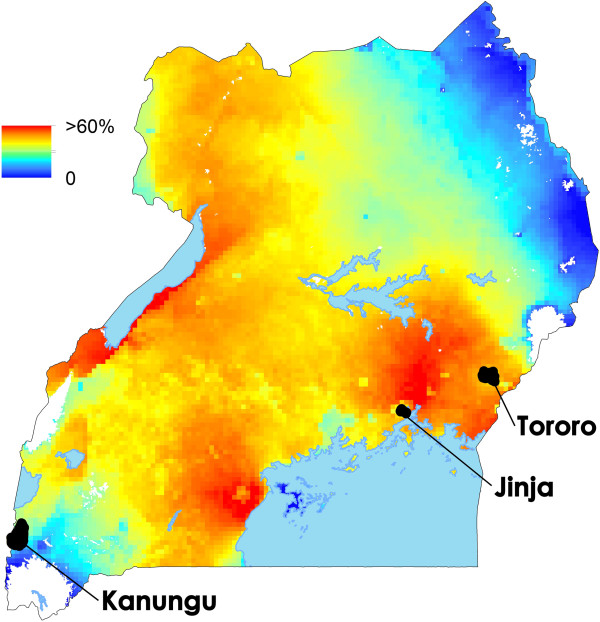
Entomological surveillance was carried out over one year in 2011/12 in three settings: Jinja, a peri-urban area with low transmission; Kanungu, a rural area with moderate transmission; and Nagongera, Tororo District, a rural area with exceptionally high malaria transmission. Three sampling approaches were used from randomly selected houses with collections occurring once a month: human-landing collections (eight houses), CDC light traps (100 houses) and paired knock-down and exit traps each month (ten houses) for each setting. Up to 50 mosquitoes per month from each household were tested for sporozoites with P. falciparum by ELISA. Human biting rate (HBR) data were estimated month by month. P. falciparum Sporozoite rate (PfSR) for yearly and monthly data and confidence intervals were estimated using the binomial exact test. Monthly and yearly estimates of the HBR, the PfSR, and the PfEIR were estimated and compared.
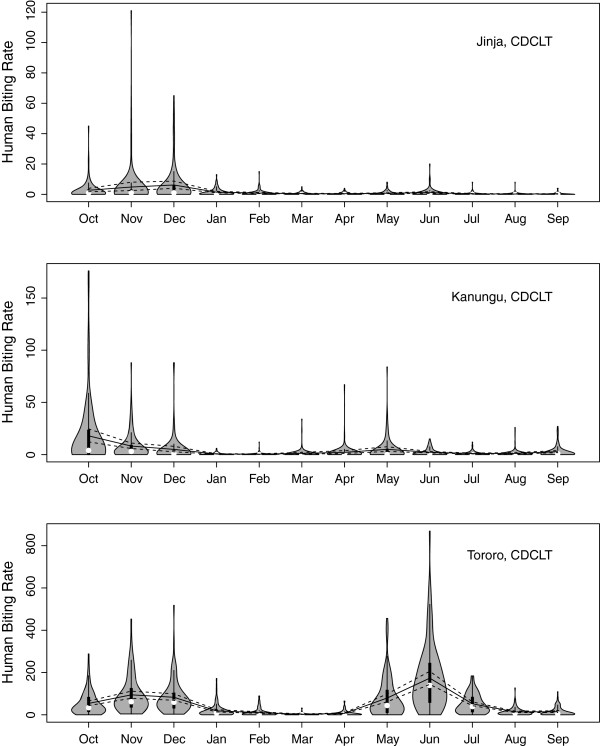
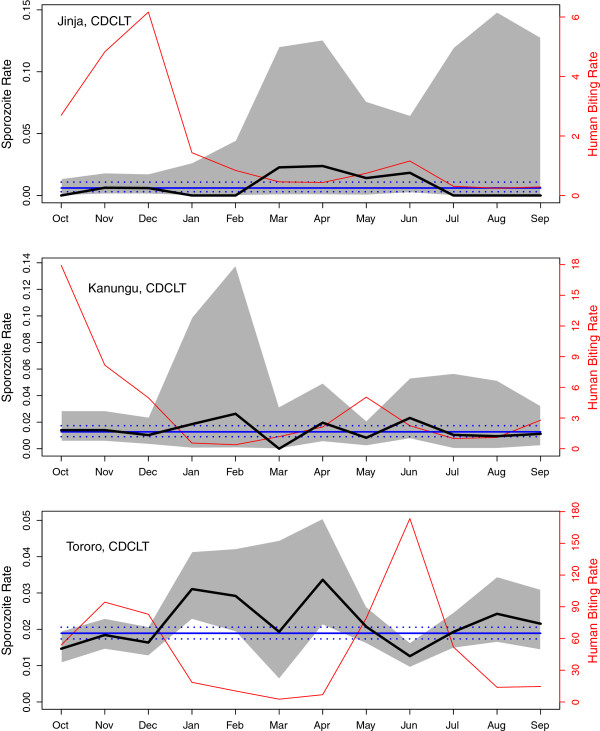
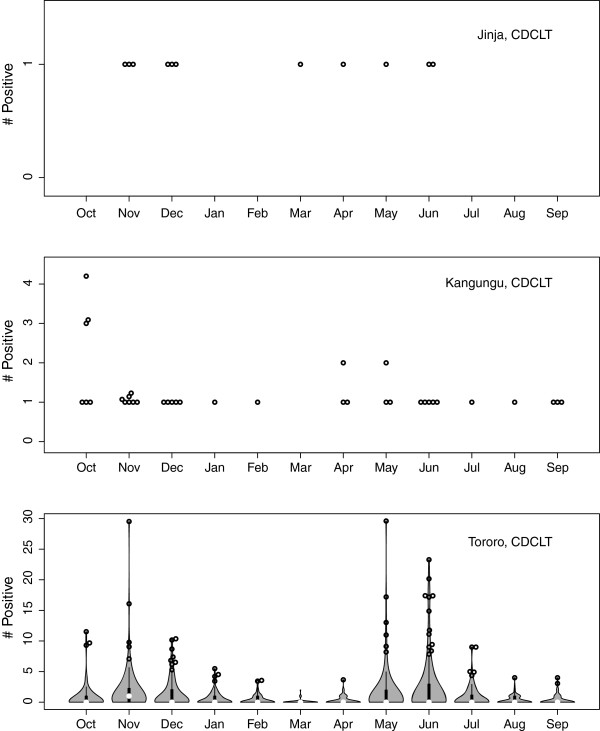
The estimated aPfEIR values using human-landing catch data were 3.8 (95% Confidence Intervals, CI 0-11.4) for Jinja, 26.6 (95% CI 7.6-49.4) for Kanungu, and 125 (95% CI 72.2-183.0) for Tororo. In general, the monthly PfEIR values showed strong seasonal signals with two peaks from May-June and October-December, although the precise timing of the peaks differed between sites. Estimated HBRs using human-landing catches were strongly correlated with those made using CDC light traps (r(2) = 0.67, p < 0.001), and with either knock-down catches (r(2) = 0.56, p < 0.001) and exit traps (r(2) = 0.82, p < 0.001) or the combined catches (r(2) = 0.73, p < 0.001). Using CDC light trap catch data, the PfSR in Tororo was strongly negatively correlated with monthly HBR (r(2) = 0.44, p = 0.01). In other sites, no patterns in the PfSR were discernible because either the number P. falciparum of sporozoite positive mosquitoes or the total number of mosquitoes caught was too low.
In these settings, light traps provide an alternative method for sampling indoor-resting mosquitoes to human-landing catches and have the advantage that they protect individuals from being bitten during collection, are easy to use and are not subject to collector bias. Knock-down catches and exit traps could also be used to replace human-landing catches. Although these are cheaper, they are subject to collector bias.
恶性疟原虫昆虫接种率(PfEIR)是衡量接触感染性蚊子程度的指标。通常将其解释为个体在一个季节或每年(年度PfEIR,aPfEIR)中接受的恶性疟原虫感染性叮咬次数。在常年传播疟疾的地区,对aPfEIR的准确性、精确性和季节性分布(即逐月分布)进行了调查。数据取自乌干达三个传播水平不同的地点,在这些地点,恶性疟主要由冈比亚按蚊复合种传播。将源自人饵诱捕法(估计叮咬率的经典方法)的aPfEIR估计值与疾控中心光诱捕器的数据进行比较,并分别与击倒式诱捕器和出口诱捕器的捕获数据以及二者合并后的捕获数据进行比较。
2011/12年在三个地点进行了为期一年的昆虫学监测:金贾,一个传播水平低的城市周边地区;卡农古,一个传播水平中等的农村地区;纳贡埃拉(托罗罗区),一个疟疾传播水平极高的农村地区。从随机选择的房屋中采用三种采样方法,每月采集一次:人饵诱捕(8所房屋)、疾控中心光诱捕器(100所房屋)以及每个地点每月使用成对的击倒式诱捕器和出口诱捕器(10所房屋)。每月从每户最多采集50只蚊子,通过酶联免疫吸附测定法检测其是否感染恶性疟原虫子孢子。逐月估计人叮咬率(HBR)数据。使用二项式精确检验估计年度和月度数据的恶性疟原虫子孢子率(PfSR)及其置信区间。估计并比较HBR、PfSR和PfEIR的月度和年度值。
使用人饵诱捕数据估计的aPfEIR值,金贾为3.8(95%置信区间,CI 0 - 11.4),卡农古为26.6(95% CI 7.6 - 49.4),托罗罗为125(95% CI 72.2 - 183.0)。总体而言,月度PfEIR值呈现出强烈的季节性信号,有两个峰值,分别在5 - 6月和10 - 12月,尽管各地点峰值的确切时间有所不同。使用人饵诱捕法估计的HBR与使用疾控中心光诱捕器估计的HBR高度相关(r² = 0.67,p < 0.001),与击倒式诱捕器捕获数据(r² = 0.56,p < 0.001)、出口诱捕器捕获数据(r² = 0.82,p < 0.001)或二者合并后的捕获数据(r² = 0.73,p < 0.001)也高度相关。使用疾控中心光诱捕器捕获数据时,托罗罗的PfSR与月度HBR呈强烈负相关(r² = 0.44,p = 0.01)。在其他地点,由于感染恶性疟原虫子孢子阳性蚊子的数量或捕获的蚊子总数过低,未发现PfSR的规律。
在这些地点,光诱捕器为采集室内栖息蚊子提供了一种替代人饵诱捕法的方法,其优点是在采集过程中可保护个体不被叮咬、易于使用且不受采集者偏差影响。击倒式诱捕器和出口诱捕器也可用于替代人饵诱捕法。虽然它们成本较低,但会受到采集者偏差的影响。