Division of Cancer Epidemiology and Genetics, National Cancer Institute, National Institutes of Health, 9609 Medical Center Dr, Rm. 6E118 MSC 9706, Bethesda, MD, 20892-9704, USA.
EMBLEM Study, African Field Epidemiology Network, Kampala & St. Mary's Hospital, Lacor, Gulu, Uganda.
Malar J. 2018 Jun 20;17(1):240. doi: 10.1186/s12936-018-2379-1.
Plasmodium falciparum malaria is an important cause of morbidity in northern Uganda. This study was undertaken to assess village-, household-, and individual-level risk factors of asymptomatic falciparum malaria in children in 12 villages in northern Uganda.
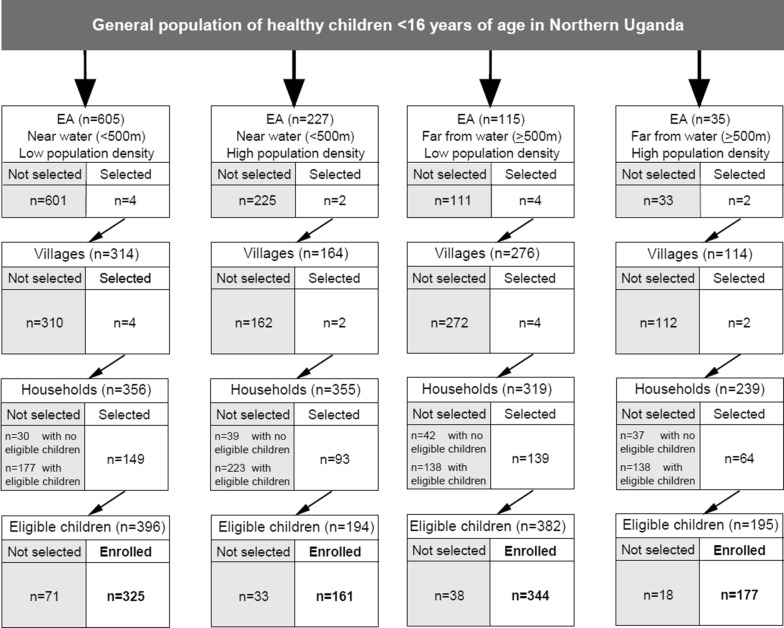
Between 10/2011 and 02/2014, 1006 apparently healthy children under 16 years old were enrolled in 12 villages using a stratified, multi-stage, cluster survey design and assessed for P. falciparum malaria infection using the rapid diagnostic test (RDT) and thick film microscopy (TFM), and structured interviewer-administered questionnaires. Associations between weighted P. falciparum malaria prevalence (pfPR), based on RDT, and covariates were estimated as odds ratios and 95% confidence intervals (ORs, 95% CIs) using logistic models accounting for the survey design.
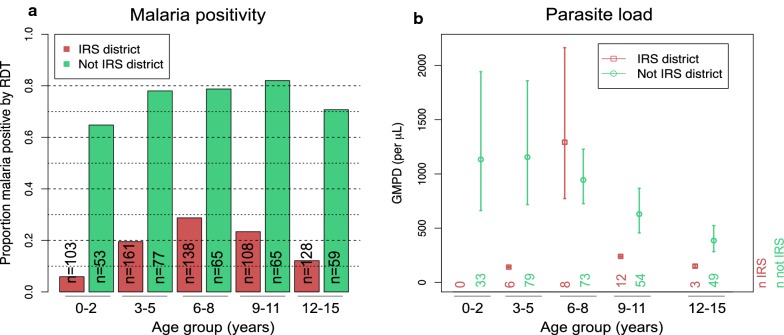
Among 942 (93.5%) children successfully tested, pfPR was 52.4% by RDT and 32.7% by TFM. Overall pfPR was lower in villages where indoor residual insecticide spray (IRS) was, versus not, implemented (18.4% versus 75.2%, P < 0.0001). However, pfPR was heterogeneous both within IRS (10.6-34.8%) and non-IRS villages (63.6-86.2%). Elevated pfPR was associated with having a sibling who was RDT positive (OR 5.39, 95% CI 2.94-9.90, P = 0.0006) and reporting a fever at enrollment (aOR 4.80, 95% CI 1.94-11.9, P = 0.0094). Decreased pfPR was associated with living in an IRS village (adjusted OR 0.06, 95% CI 0.04-0.07, P < 0.0001), in a household with one (aOR 0.48, 95% CI 0.30-0.76) or more than one child below 5 years (aOR 0.23, 95% CI 0.12-0.44, P = 0.014), and reporting keeping a goat inside or near the house (aOR 0.42, 95% CI 0.29-0.62, P = 0.0021).
The results show high but heterogeneous pfPR in villages in northern Uganda, confirm significantly decreased pfPR associated with IRS implementation, and suggest significant associations with some household characteristics. Further research is needed to elucidate the factors influencing malaria heterogeneity in villages in Uganda.
恶性疟原虫疟疾是乌干达北部发病率的重要原因。本研究旨在评估乌干达北部 12 个村庄中儿童无症状恶性疟原虫疟疾的村庄、家庭和个体风险因素。
2011 年 10 月至 2014 年 2 月,采用分层、多阶段、聚类调查设计,在 12 个村庄招募了 1006 名年龄在 16 岁以下的看似健康的儿童,并使用快速诊断测试 (RDT) 和厚涂片显微镜检查 (TFM) 评估儿童是否感染恶性疟原虫。使用考虑到调查设计的逻辑模型,根据 RDT 计算加权恶性疟原虫疟疾患病率 (pfPR),并估计 pfPR 与协变量之间的关联,作为比值比和 95%置信区间 (ORs, 95% CIs)。
在 942 名(93.5%)成功接受检测的儿童中,RDT 检测的 pfPR 为 52.4%,TFM 检测的 pfPR 为 32.7%。在接受室内残留杀虫剂喷洒 (IRS) 的村庄,pfPR 总体上低于未接受 IRS 的村庄 (18.4%比 75.2%,P<0.0001)。然而,IRS 内 (10.6-34.8%)和非 IRS 村庄 (63.6-86.2%)的 pfPR 存在异质性。与 RDT 阳性的兄弟姐妹同住 (OR 5.39, 95% CI 2.94-9.90, P=0.0006) 和报告发病时发热 (aOR 4.80, 95% CI 1.94-11.9, P=0.0094) 与较高的 pfPR 相关。与居住在 IRS 村庄 (调整后的 OR 0.06, 95% CI 0.04-0.07, P<0.0001)、家中有一个( aOR 0.48, 95% CI 0.30-0.76)或多个五岁以下儿童(aOR 0.23, 95% CI 0.12-0.44, P=0.014)以及报告山羊在屋内或附近饲养 (aOR 0.42, 95% CI 0.29-0.62, P=0.0021) 与较低的 pfPR 相关。
研究结果表明,乌干达北部村庄的恶性疟原虫疟疾患病率较高,但存在异质性,IRS 的实施显著降低了恶性疟原虫疟疾的患病率,并提示与一些家庭特征有显著关联。需要进一步研究以阐明影响乌干达村庄疟疾异质性的因素。