Yadav Dhananjay, Choi Eunhee, Ahn Song Vogue, Koh Sang Baek, Sung Ki-Chul, Kim Jang-Young, Huh Ji Hye
Department of Preventive Medicine, Yonsei University, Wonju College of Medicine, Wonju Institute of Lifestyle Medicine, Yonsei University, Wonju College of Medicine, Wonju Institute of Genomic Cohort, Yonsei University, Wonju College of Medicine, Wonju Division of Cardiology, Department of Medicine, Kangbuk Samsung Hospital, Sungkyunkwan University School of Medicine, Seoul Division of Cardiology, Department of Internal Medicine, Yonsei University, Wonju College of Medicine, Wonju Division of Endocrinology and Metabolism, Department of Internal Medicine, Yonsei University, Wonju College of Medicine, Wonju, South Korea.
Medicine (Baltimore). 2016 Aug;95(31):e4447. doi: 10.1097/MD.0000000000004447.
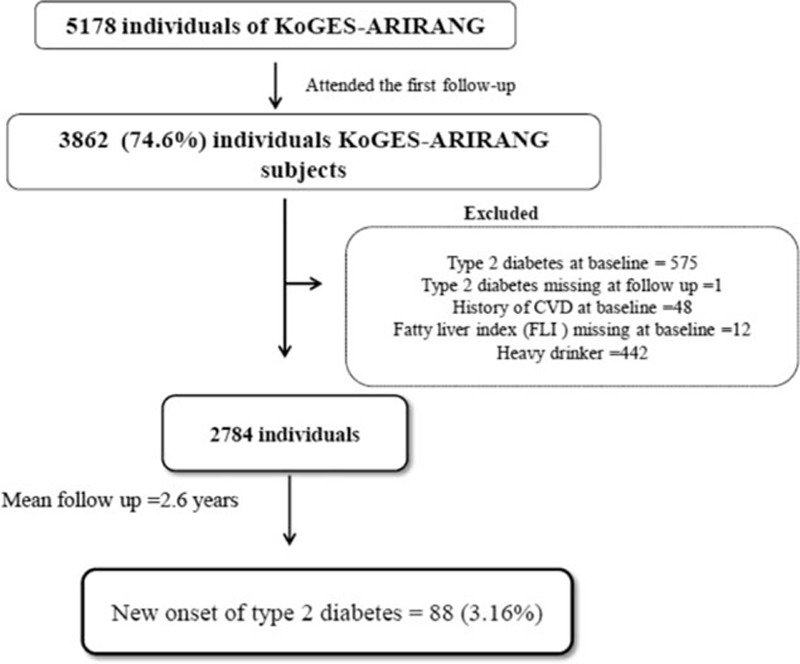
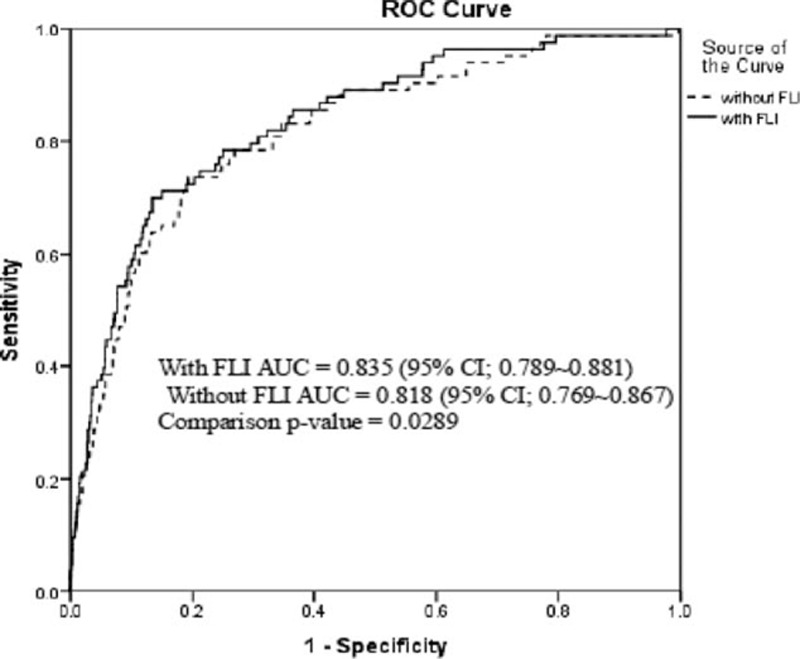
The fatty liver index (FLI), calculated from serum triglyceride, body mass index, waist circumference, and gamma-glutamyltransferase, is considered a surrogate marker of nonalcoholic fatty liver disease (NAFLD). We investigated whether FLI predicts the development of diabetes mellitus (DM) and assessed the predictive ability of FLI for new onset of DM in a prospective population-based cohort study.We analyzed a total of 2784 adults (944 men and 1840 women) aged 40 to 70 years without DM at baseline. Participants were classified according to FLI values into 3 groups: FLI < 30, no NAFLD; 30 ≤ FLI ≤ 59, intermediate NAFLD; and FLI ≥ 60, participants with NAFLD. The area under the receiver-operating characteristic curve (AUC), net reclassification improvement (NRI), and integrated discrimination improvement (IDI) were calculated to determine whether FLI improved DM risk prediction.During a mean of 2.6 years follow-up, 88 (3.16%) participants developed DM. The odds ratio analyzed from multivariable-adjusted models (95% confidence interval [CI]) for new onset of DM increased in a continuous manner with increased FLI (<30 vs 30-59 vs ≥60 = 1 vs 1.87 [95% CI 1.05-3.33] vs 2.84 [95% CI 1.4-5.75], respectively). The AUC significantly increased when FLI was added to the conventional DM prediction model (0.835, 95% CI: 0.789-0.881, P = 0.0289 vs traditional DM prediction model). The category-free NRI was 0.417 (95% CI: 0.199-0.635) and the IDI was 0.015 (95% CI: 0.003-0.026) for overall study participants.We found that FLI, a surrogate marker of hepatic steatosis, resulted in significant improvement in DM risk prediction. Our finding suggests that FLI may have clinical and prognostic information for incident DM among the Korean adult population.
由血清甘油三酯、体重指数、腰围和γ-谷氨酰转移酶计算得出的脂肪肝指数(FLI),被视为非酒精性脂肪性肝病(NAFLD)的替代标志物。在一项基于人群的前瞻性队列研究中,我们调查了FLI是否能预测糖尿病(DM)的发生,并评估了FLI对新发DM的预测能力。我们分析了总共2784名年龄在40至70岁之间、基线时无DM的成年人(944名男性和1840名女性)。参与者根据FLI值分为3组:FLI<30,无NAFLD;30≤FLI≤59,中度NAFLD;FLI≥60,患有NAFLD的参与者。计算受试者工作特征曲线下面积(AUC)、净重新分类改善(NRI)和综合判别改善(IDI),以确定FLI是否改善了DM风险预测。在平均2.6年的随访期间,88名(3.16%)参与者患上了DM。多变量调整模型(95%置信区间[CI])分析得出的DM新发的比值比随着FLI的增加而持续升高(<30 vs 30 - 59 vs≥60分别为1 vs 1.87[95%CI 1.05 - 3.33] vs 2.84[95%CI 1.4 - 5.75])。当将FLI添加到传统的DM预测模型中时,AUC显著增加(0.835,95%CI:0.789 - 0.881,P = 0.0289 vs传统DM预测模型)。总体研究参与者的无类别NRI为0.417(95%CI:0.199 - 0.635),IDI为0.015(95%CI:0.003 - 0.026)。我们发现,作为肝脂肪变性替代标志物的FLI,在DM风险预测方面有显著改善。我们的研究结果表明,FLI可能对韩国成年人群中DM的发生具有临床和预后信息。