Xu Zhenqiang, Ji Congliang, Zhang Yan, Zhang Zhe, Nie Qinghua, Xu Jiguo, Zhang Dexiang, Zhang Xiquan
Guangdong Provincial Key Lab of Agro-Animal Genomics and Molecular Breeding and Key Lab of Chicken Genetics, Breeding and Reproduction, Ministry of Agriculture, Guangzhou, 510642, Guangdong Province, China.
Wen's Nanfang Poultry Breeding Co. Ltd, Guangdong Province, Yunfu, 527400, China.
BMC Genomics. 2016 Aug 9;17:594. doi: 10.1186/s12864-016-2861-5.
Residual feed intake (RFI) is a powerful indicator for energy utilization efficiency and responds to selection. Low RFI selection enables a reduction in feed intake without affecting growth performance. However, the effective variants or major genes dedicated to phenotypic differences in RFI in quality chickens are unclear. Therefore, a genome-wide association study (GWAS) and RNA sequencing were performed on RFI to identify genetic variants and potential candidate genes associated with energy improvement.
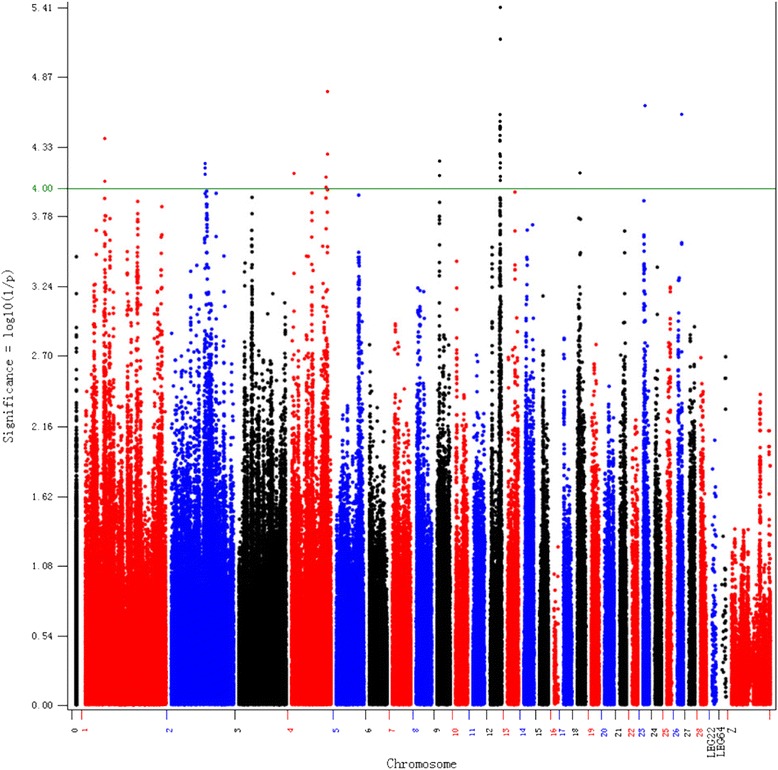
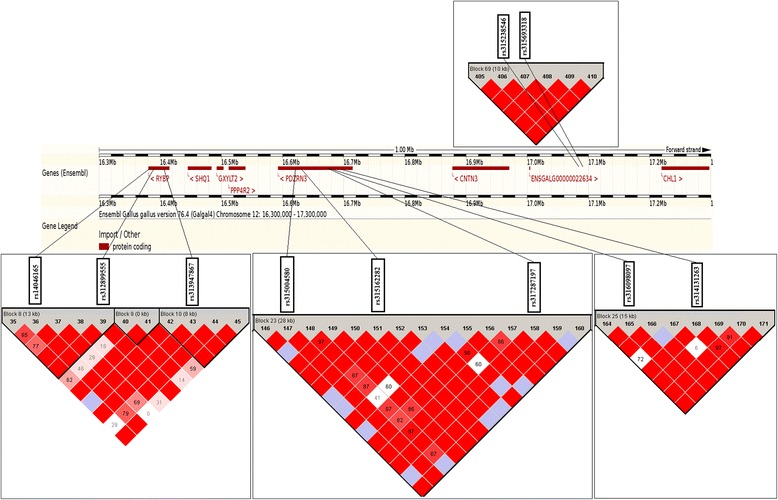
A lower average daily feed intake was found in low-RFI birds compared to high-RFI birds. The heritability of RFI measured from 44 to 83 d of age was 0.35. GWAS showed that 32 of the significant single nucleotide polymorphisms (SNPs) associated with the RFI (P < 10(-4)) accounted for 53.01 % of the additive genetic variance. More than half of the effective SNPs were located in a 1 Mb region (16.3-17.3 Mb) of chicken (Gallus gallus) chromosome (GGA) 12. Thus, focusing on this region should enable a deeper understanding of energy utilization. RNA sequencing was performed to profile the liver transcriptomes of four male chickens selected from the high and low tails of the RFI. One hundred and sixteen unique genes were identified as differentially expressed genes (DEGs). Some of these genes were relevant to appetite, cell activities, and fat metabolism, such as CCKAR, HSP90B1, and PCK1. Some potential genes within the 500 Kb flanking region of the significant RFI-related SNPs detected in GWAS (i.e., MGP, HIST1H110, HIST1H2A4L3, OC3, NR0B2, PER2, ST6GALNAC2, and G0S2) were also identified as DEGs in chickens with divergent RFIs.
The GWAS findings showed that the 1 Mb narrow region of GGA12 should be important because it contained genes involved in energy-consuming processes, such as lipogenesis, social behavior, and immunity. Similar results were obtained in the transcriptome sequencing experiments. In general, low-RFI birds seemed to optimize energy employment by reducing energy expenditure in cell activities, immune responses, and physical activity compared to eating.
剩余采食量(RFI)是能量利用效率的一个有力指标,且对选择有响应。低RFI选择能够在不影响生长性能的情况下降低采食量。然而,优质鸡中导致RFI表型差异的有效变异或主基因尚不清楚。因此,对RFI进行了全基因组关联研究(GWAS)和RNA测序,以鉴定与能量改善相关的遗传变异和潜在候选基因。
与高RFI鸡相比,低RFI鸡的平均日采食量更低。44至83日龄测得的RFI遗传力为0.35。GWAS显示,与RFI相关的32个显著单核苷酸多态性(SNP)(P < 10^(-4))占加性遗传方差的53.01%。超过一半的有效SNP位于鸡(原鸡)12号染色体(GGA)的1 Mb区域(16.3 - 17.3 Mb)。因此,聚焦于该区域应能更深入地了解能量利用情况。对从RFI高低两端选取的四只雄性鸡的肝脏转录组进行了RNA测序。116个独特基因被鉴定为差异表达基因(DEG)。其中一些基因与食欲、细胞活动和脂肪代谢相关,如CCKAR、HSP90B1和PCK1。在GWAS中检测到的与RFI显著相关的SNP侧翼500 Kb区域内的一些潜在基因(即MGP、HIST1H110、HIST1H2A4L3、OC3、NR0B2、PER2、ST6GALNAC2和G0S2)在RFI不同的鸡中也被鉴定为DEG。
GWAS结果表明,GGA12的1 Mb狭窄区域应很重要,因为它包含参与脂肪生成、社会行为和免疫等耗能过程的基因。转录组测序实验也得到了类似结果。总体而言,与进食相比,低RFI鸡似乎通过减少细胞活动、免疫反应和体力活动中的能量消耗来优化能量利用。