Yuan Jingwei, Wang Kehua, Yi Guoqiang, Ma Meng, Dou Taocun, Sun Congjiao, Qu Lu-Jiang, Shen Manman, Qu Liang, Yang Ning
National Engineering Laboratory for Animal Breeding and MOA Key Laboratory of Animal Genetics and Breeding, College of Animal Science and Technology, China Agricultural University, Beijing, 100193, People's Republic of China.
Jiangsu Institute of Poultry Science, Yangzhou, 225125, People's Republic of China.
Genet Sel Evol. 2015 Oct 16;47:82. doi: 10.1186/s12711-015-0161-1.
Feed contributes to over 60 % of the total production costs in the poultry industry. Increasing feed costs prompt geneticists to include feed intake and efficiency as selection goals in breeding programs. In the present study, we used an F2 chicken population in a genome-wide association study (GWAS) to detect potential genetic variants and candidate genes associated with daily feed intake (FI) and feed efficiency, including residual feed intake (RFI) and feed conversion ratio (FCR).
A total of 1534 F2 hens from a White Leghorn and Dongxiang reciprocal cross were phenotyped for feed intake and efficiency between 37 and 40 weeks (FI1, RFI1, and FCR1) and between 57 and 60 weeks (FI2, RFI2, and FCR2), and genotyped using the chicken 600 K single nucleotide polymorphism (SNP) genotyping array. Univariate, bivariate, and conditional genome-wide association studies (GWAS) were performed with GEMMA, a genome-wide efficient mixed model association algorithm. The statistical significance threshold for association was inferred by the simpleM method.
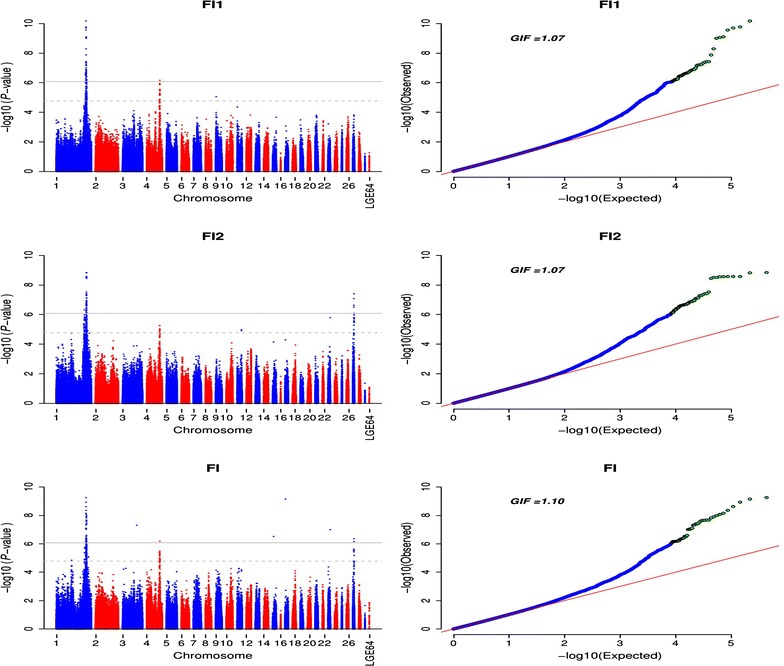
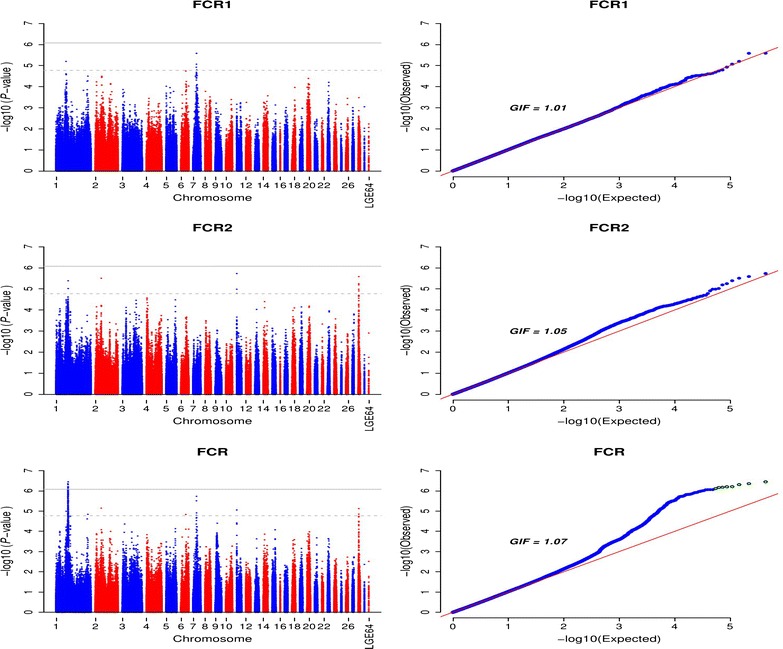
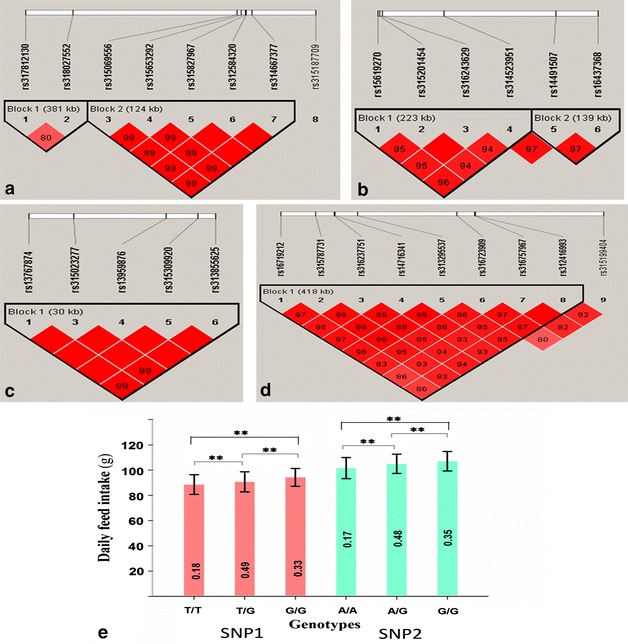
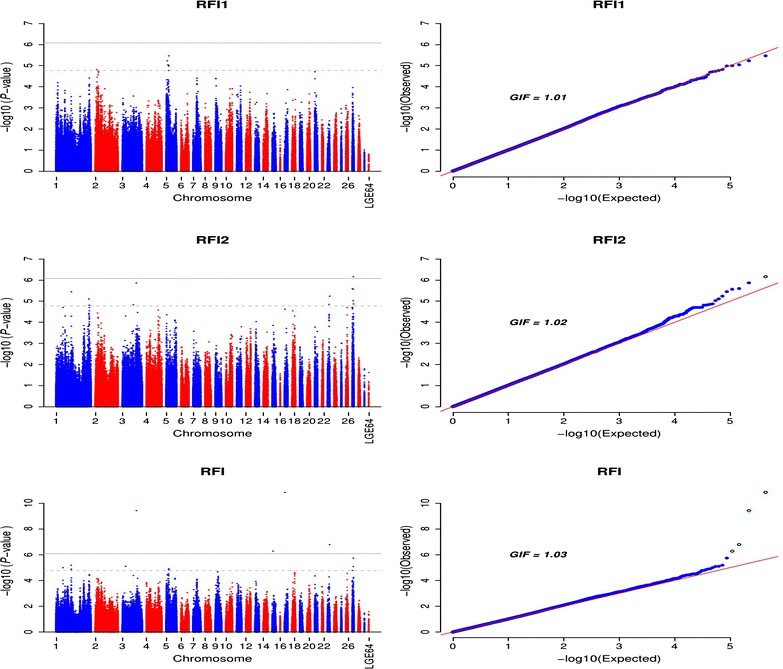
We identified eight genomic regions that each contained at least one genetic variant that showed a significant association with FI. Genomic regions on Gallus gallus (GGA) chromosome 4 coincided with known quantitative trait loci (QTL) that affect feed intake of layers. Of particular interest, eight SNPs on GGA1 in the region between 169.23 and 171.55 Mb were consistently associated with FI in both univariate and bivariate GWAS, which explained 3.72 and 2.57 % of the phenotypic variance of FI1 and FI2, respectively. The CAB39L gene can be considered as a promising candidate for FI1. For RFI, a haplotype block on GGA27 harbored a significant SNP associated with RFI2. The major allele of rs315135692 was favorable for a lower RFI, with a phenotypic difference of 3.35 g/day between opposite homozygous genotypes. Strong signals on GGA1 were detected in the bivariate GWAS for FCR.
The results demonstrated the polygenic nature of feed intake. GWAS identified novel variants and confirmed a QTL that was previously reported for feed intake in chickens. Genetic variants associated with feed efficiency may be used in genomic breeding programs to select more efficient layers.
饲料成本占家禽业总生产成本的60%以上。饲料成本的增加促使遗传学家将采食量和效率纳入育种计划的选择目标。在本研究中,我们在全基因组关联研究(GWAS)中使用F2代鸡群体来检测与日采食量(FI)和饲料效率相关的潜在遗传变异和候选基因,包括剩余采食量(RFI)和饲料转化率(FCR)。
总共1534只来自白来航鸡和东乡鸡正反交的F2代母鸡,在37至40周龄(FI1、RFI1和FCR1)以及57至60周龄(FI2、RFI2和FCR2)时测定采食量和效率,并使用鸡600K单核苷酸多态性(SNP)基因分型芯片进行基因分型。使用全基因组高效混合模型关联算法GEMMA进行单变量、双变量和条件全基因组关联研究(GWAS)。通过simpleM方法推断关联的统计显著性阈值。
我们鉴定出8个基因组区域,每个区域至少包含一个与FI显著相关的遗传变异。原鸡(GGA)4号染色体上的基因组区域与影响蛋鸡采食量的已知数量性状位点(QTL)一致。特别值得关注的是,在169.23至171.55 Mb区域内GGA1上的8个SNP在单变量和双变量GWAS中均与FI持续相关,分别解释了FI1和FI2表型变异的3.72%和2.57%。CAB39L基因可被视为FI1的一个有前景的候选基因。对于RFI,GGA27上的一个单倍型块包含一个与RFI2相关的显著SNP。rs315135692的主要等位基因有利于降低RFI,相反纯合基因型之间的表型差异为3.35克/天。在FCR的双变量GWAS中检测到GGA1上有强烈信号。
结果证明了采食量的多基因性质。GWAS鉴定出了新的变异,并证实了先前报道的鸡采食量的一个QTL。与饲料效率相关的遗传变异可用于基因组育种计划,以选择更高效的蛋鸡。