Section of Animal Genetics, Bioinformatics and Breeding, Department of Veterinary Clinical and Animal Sciences, Faculty of Health and Medical Sciences, University of Copenhagen, 1870 Frederiksberg C, Denmark.
BMC Genet. 2014 Feb 17;15:27. doi: 10.1186/1471-2156-15-27.
Feed efficiency is one of the major components determining costs of animal production. Residual feed intake (RFI) is defined as the difference between the observed and the expected feed intake given a certain production. Residual feed intake 1 (RFI1) was calculated based on regression of individual daily feed intake (DFI) on initial test weight and average daily gain. Residual feed intake 2 (RFI2) was as RFI1 except it was also regressed with respect to backfat (BF). It has been shown to be a sensitive and accurate measure for feed efficiency in livestock but knowledge of the genomic regions and mechanisms affecting RFI in pigs is lacking. The study aimed to identify genetic markers and candidate genes for RFI and its component traits as well as pathways associated with RFI in Danish Duroc boars by genome-wide associations and systems genetic analyses.
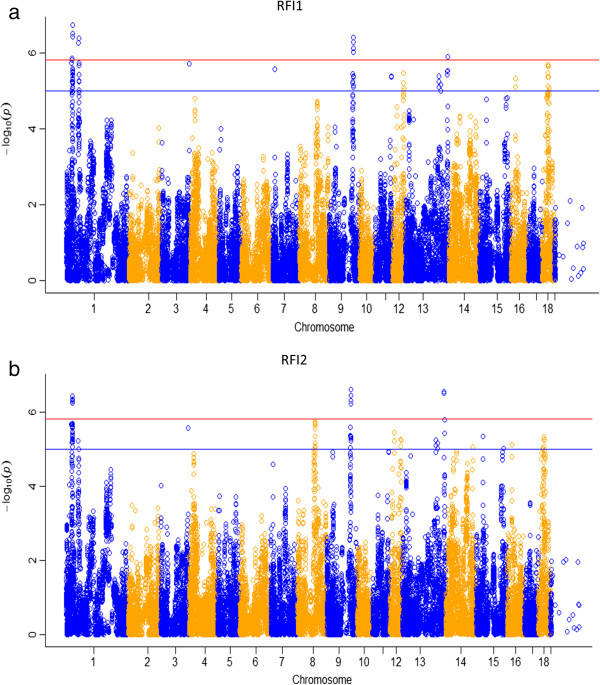
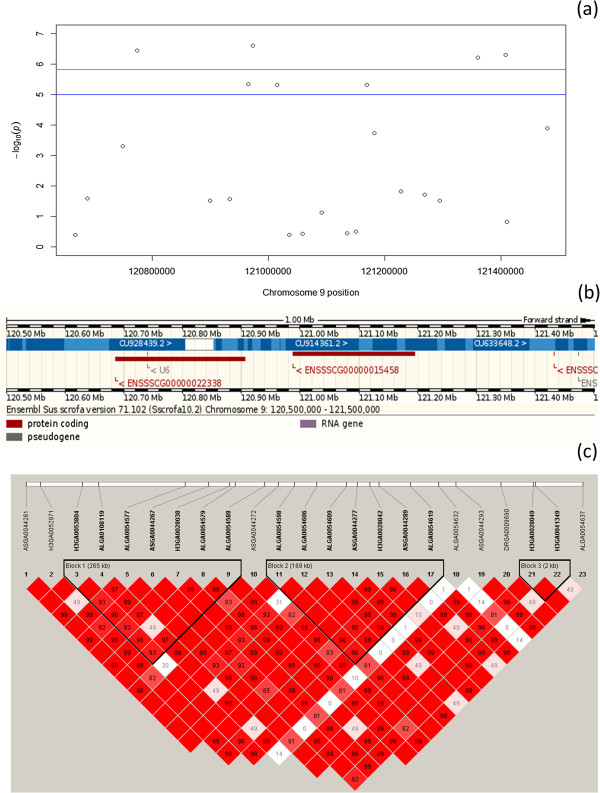
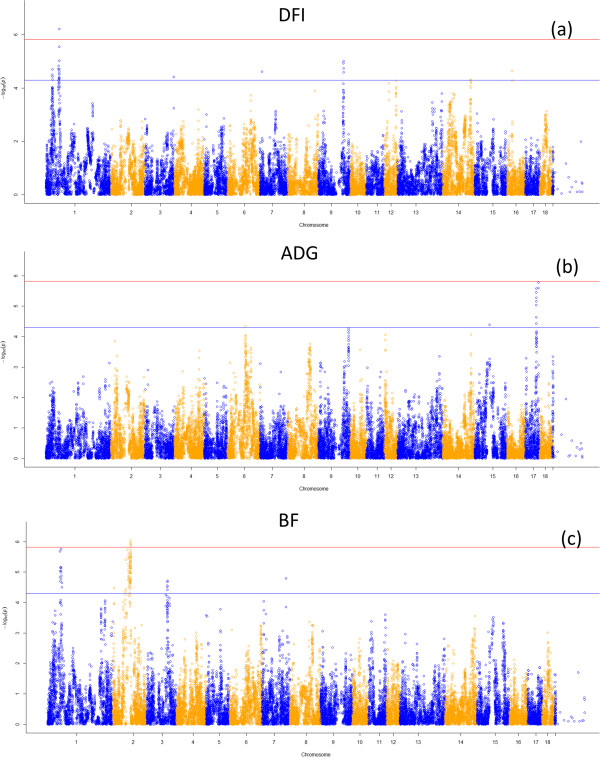
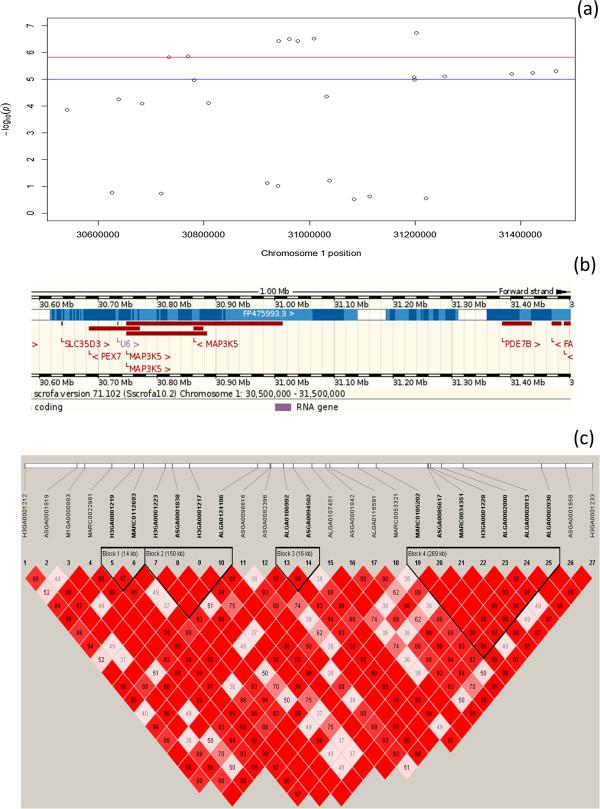
Phenotypic and genotypic records (using the Illumina Porcine SNP60 BeadChip) were available on 1,272 boars. Fifteen and 12 loci were significantly associated (p < 1.52 × 10⁻⁶) with RFI1 and RFI2, respectively. Among them, 10 SNPs were significantly associated with both RFI1 and RFI2 implying the existence of common mechanisms controlling the two RFI measures. Significant QTL regions for component traits of RFI (DFI and BF) were detected on pig chromosome (SSC) 1 (for DFI) and 2 for (BF). The SNPs within MAP3K5 and PEX7 on SSC 1, ENSSSCG00000022338 on SSC 9, and DSCAM on SSC 13 might be interesting markers for both RFI measures. Functional annotation of genes in 0.5 Mb size flanking significant SNPs indicated regulation of protein and lipid metabolic process, gap junction, inositol phosphate metabolism and insulin signaling pathway are significant biological processes and pathways for RFI, respectively.
The study detected novel genetic variants and QTLs on SSC 1, 8, 9, 13 and 18 for RFI and indicated significant biological processes and metabolic pathways involved in RFI. The study also detected novel QTLs for component traits of RFI. These results improve our knowledge of the genetic architecture and potential biological pathways underlying RFI; which would be useful for further investigations of key candidate genes for RFI and for development of biomarkers.
饲料效率是决定动物生产成本的主要因素之一。剩余饲料摄入量(RFI)定义为给定特定生产水平下观察到的饲料摄入量与预期饲料摄入量之间的差异。RFI1 是根据个体日采食量(DFI)与初始测试体重和平均日增重的回归计算得出的。RFI2 是 RFI1 的回归,只是它也与背膘(BF)有关。它已被证明是衡量家畜饲料效率的敏感而准确的指标,但缺乏影响猪 RFI 的基因组区域和机制的知识。本研究旨在通过全基因组关联和系统遗传分析,确定丹麦杜洛克公猪的 RFI 及其组成性状以及与 RFI 相关的途径的遗传标记和候选基因。
在 1272 头公猪上获得了表型和基因型记录(使用 Illumina Porcine SNP60 BeadChip)。RFI1 和 RFI2 分别有 15 和 12 个位点与显著相关(p < 1.52×10⁻⁶)。其中,有 10 个 SNP 与 RFI1 和 RFI2 均显著相关,表明存在控制这两个 RFI 测量的共同机制。在猪染色体(SSC)1 上检测到与 RFI 组成性状(DFI 和 BF)显著相关的 QTL 区域,在 SSC2 上检测到 BF。SSC1 上的 MAP3K5 和 PEX7 内的 SNPs、SSC9 上的 ENSSSCG00000022338 以及 SSC13 上的 DSCAM 可能是这两个 RFI 测量的有趣标记。在显著 SNP 侧翼 0.5 Mb 大小的基因功能注释表明,蛋白质和脂质代谢过程、间隙连接、肌醇磷酸盐代谢和胰岛素信号通路的调节是 RFI 的重要生物学过程和途径。
本研究在 SSC1、8、9、13 和 18 上检测到与 RFI 相关的新的遗传变异和 QTL,并表明了 RFI 所涉及的重要生物学过程和代谢途径。本研究还检测到 RFI 组成性状的新的 QTL。这些结果提高了我们对 RFI 遗传结构和潜在生物学途径的认识,这将有助于进一步研究 RFI 的关键候选基因,并开发生物标志物。