Department of Surgery, Division of Surgical Oncology, Johns Hopkins University School of Medicine, Baltimore, MD, USA.
Department of Pathology, Sidney Kimmel Cancer Center, Johns Hopkins University School of Medicine, Baltimore, MD, USA.
J Hepatocell Carcinoma. 2015 Jun 18;2:69-78. doi: 10.2147/JHC.S48505. eCollection 2015.
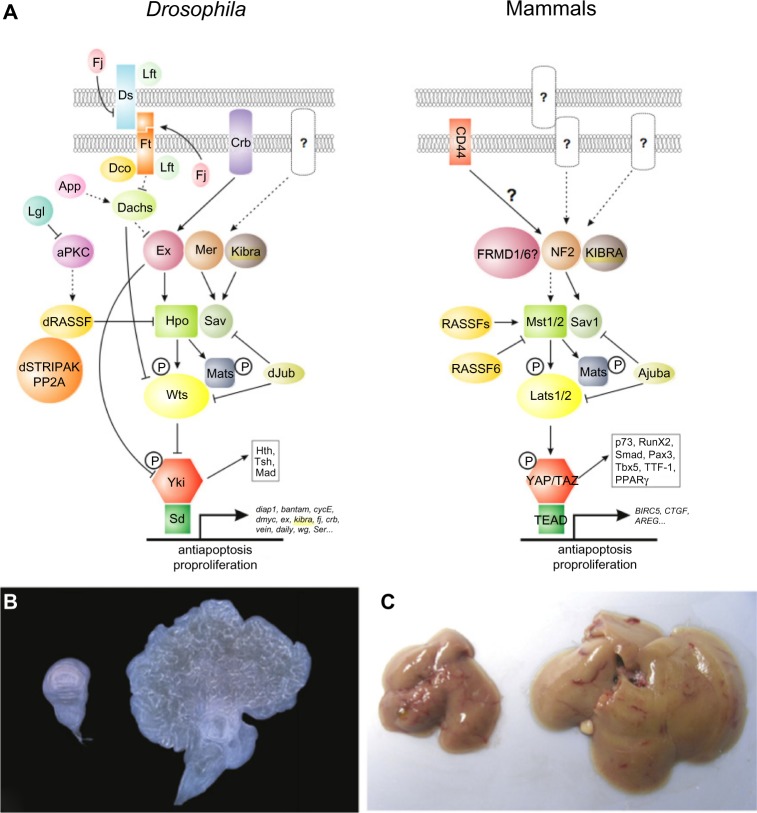
Hepatocellular carcinoma (HCC) is the sixth most common cancer and the third most common cause of cancer-related mortality worldwide. Due to the poor prognosis and limited therapeutic options, there is great interest in further understanding better the molecular underpinnings and potential molecular targets associated with HCC. The Hippo (Hpo) signaling pathway and YAP, its principal downstream effector, represent an innovative area of research in HCC. Pioneered in Drosophila melanogaster, the Hpo cascade controls tissue homeostasis including organ size, cell proliferation, apoptosis, as well as cell-cycle regulation and differentiation. This conserved kinase cascade in mammals depends on central control by the tumor suppressor mammalian sterile 20-like kinase 1/2 (Mst1/2). The Mst1/2 commences the downstream kinase cascade, ultimately activating the oncoprotein YAP and allowing its physical association with downstream targets to enhance the gene expression signatures that are involved in proliferation and survival. Alterations in YAP expression and defective regulation of other key Hpo pathway members, such as Mst1/2, Salvador, neurofibromatosis and Mer (Nf2/mer), large tumor suppressor homolog 1/2 (Lats1/2), and Mps one binder kinase activator-like 1A and 1B (Mob1) drive carcinogenesis in animal models. The dysregulation of the Hpo pathway - resulting in an unchecked activation of YAP - culminates in the development of a broad range of human tumor types, including HCC. The abrogation of Mst1/2-mediated YAP phosphorylation permits YAP entry into the nucleus in murine models and functions similarly in human HCCs. Chemoresistance mechanisms displayed by HCC tumors occur in a YAP-dependent manner. The HCC specimens exhibit YAP overexpression, and YAP serves as an independent prognostic marker for disease-free survival and overall survival in patients with HCC. Recently, the small molecule inhibitor, verteporfin has been shown to attenuate YAP activity in murine models, perhaps offering a novel therapeutic approach for patients with advanced HCC.
肝细胞癌 (HCC) 是全球第六大常见癌症,也是癌症相关死亡的第三大主要原因。由于预后较差和治疗选择有限,因此人们非常有兴趣进一步了解与 HCC 相关的分子基础和潜在的分子靶点。 Hippo (Hpo) 信号通路及其主要下游效应物 YAP 是 HCC 研究的一个创新领域。该通路在黑腹果蝇中率先发现,其控制着组织内稳态,包括器官大小、细胞增殖、凋亡以及细胞周期调控和分化。该通路在哺乳动物中是一个保守的激酶级联反应,依赖于肿瘤抑制因子哺乳动物 sterile 20 样激酶 1/2 (Mst1/2) 的中央控制。Mst1/2 启动下游激酶级联反应,最终激活致癌蛋白 YAP,并允许其与下游靶标物理结合,以增强涉及增殖和存活的基因表达特征。YAP 表达的改变和其他关键 Hpo 通路成员(如 Mst1/2、Salvador、神经纤维瘤病和 Merlin (Nf2/mer)、大肿瘤抑制因子同源物 1/2 (Lats1/2) 和 Mps one binder kinase activator-like 1A 和 1B (Mob1))的调节缺陷,导致动物模型中的癌发生。Hpo 通路的失调 - 导致 YAP 的不受控制激活 - 最终导致广泛的人类肿瘤类型的发展,包括 HCC。在小鼠模型中,Mst1/2 介导的 YAP 磷酸化的消除允许 YAP 进入细胞核,并且在人类 HCC 中也具有相似的功能。HCC 肿瘤显示出的化学抗性机制以 YAP 依赖性方式发生。HCC 标本表现出 YAP 过表达,并且 YAP 是 HCC 患者无病生存期和总生存期的独立预后标志物。最近,小分子抑制剂 verteporfin 已被证明可在小鼠模型中减弱 YAP 活性,这可能为晚期 HCC 患者提供一种新的治疗方法。