Farzaneh Zahra, Vosough Massoud, Agarwal Tarun, Farzaneh Maryam
Department of Stem Cells and Developmental Biology, Cell Science Research Center, Royan Institute for Stem Cell Biology and Technology, ACECR, Tehran, Iran.
Department of Regenerative Medicine, Cell Science Research Center, Royan Institute for Stem Cell Biology and Technology, ACECR, Tehran, Iran.
Cancer Cell Int. 2021 Apr 13;21(1):208. doi: 10.1186/s12935-021-01924-w.
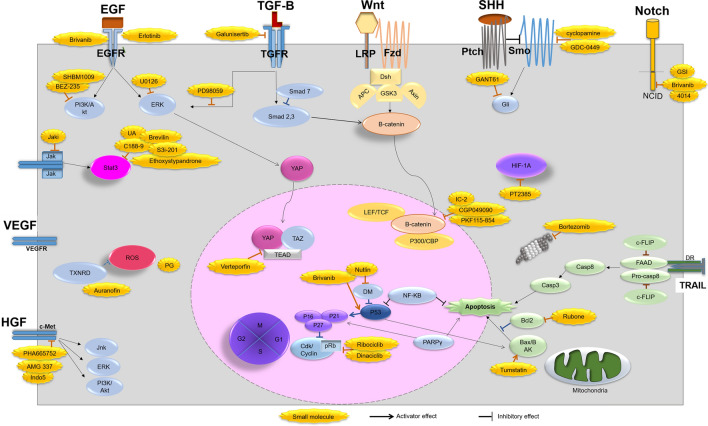
Hepatocellular carcinoma (HCC) is the second leading cause of death due to cancer. Although there are different treatment options, these strategies are not efficient in terms of restricting the tumor cell's proliferation and metastasis. The liver tumor microenvironment contains the non-parenchymal cells with supportive or inhibitory effects on the cancerous phenotype of HCC. Several signaling pathways are dis-regulated in HCC and cause uncontrolled cell propagation, metastasis, and recurrence of liver carcinoma cells. Recent studies have established new approaches for the prevention and treatment of HCC using small molecules. Small molecules are compounds with a low molecular weight that usually inhibit the specific targets in signal transduction pathways. These components can induce cell cycle arrest, apoptosis, block metastasis, and tumor growth. Devising strategies for simultaneously targeting HCC and the non-parenchymal population of the tumor could lead to more relevant research outcomes. These strategies may open new avenues for the treatment of HCC with minimal cytotoxic effects on healthy cells. This study provides the latest findings on critical signaling pathways governing HCC behavior and using small molecules in the control of HCC both in vitro and in vivo models.
肝细胞癌(HCC)是癌症导致死亡的第二大主要原因。尽管有不同的治疗选择,但这些策略在限制肿瘤细胞增殖和转移方面并不有效。肝脏肿瘤微环境包含对HCC癌性表型具有支持或抑制作用的非实质细胞。HCC中几种信号通路失调,导致肝癌细胞不受控制地增殖、转移和复发。最近的研究建立了使用小分子预防和治疗HCC的新方法。小分子是分子量低的化合物,通常抑制信号转导通路中的特定靶点。这些成分可诱导细胞周期停滞、凋亡、阻断转移和肿瘤生长。设计同时靶向HCC和肿瘤非实质细胞群的策略可能会带来更相关的研究成果。这些策略可能为治疗HCC开辟新途径,同时对健康细胞的细胞毒性作用最小。本研究提供了关于控制HCC行为的关键信号通路以及在体外和体内模型中使用小分子控制HCC的最新研究结果。