Yin Fugui, Yu Hai, Lepp Dion, Shi Xuejiang, Yang Xiaojian, Hu Jielun, Leeson Steve, Yang Chengbo, Nie Shaoping, Hou Yongqing, Gong Joshua
Guelph Research and Development Centre, Agriculture and Agri-Food Canada, Guelph, Ontario, Canada.
Next Generation Sequencing Platforms, Clinical Genomics Centre, the UHN/MSH Gene Profiling Facility, Toronto, Ontario, Canada.
PLoS One. 2016 Aug 10;11(8):e0160751. doi: 10.1371/journal.pone.0160751. eCollection 2016.
BACKGROUND & AIMS: Butyrate has been shown to potently regulate energy expenditure and lipid metabolism in animals, yet the underlying mechanisms remain to be fully understood. The aim of this study was to investigate the molecular mechanisms of butyrate (in the form of butyrate glycerides, BG)-induced lipid metabolism at the level of gene expression in the jejunum and liver of broilers.
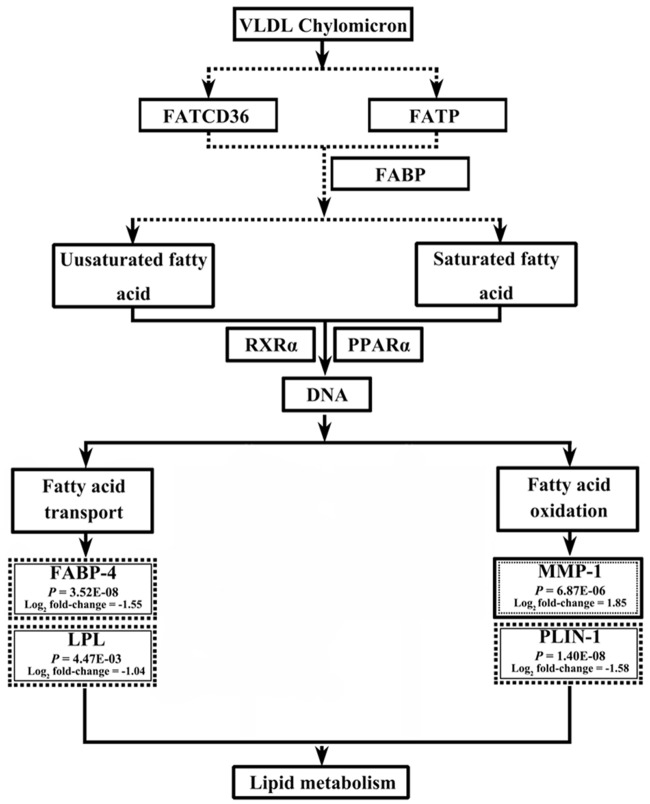
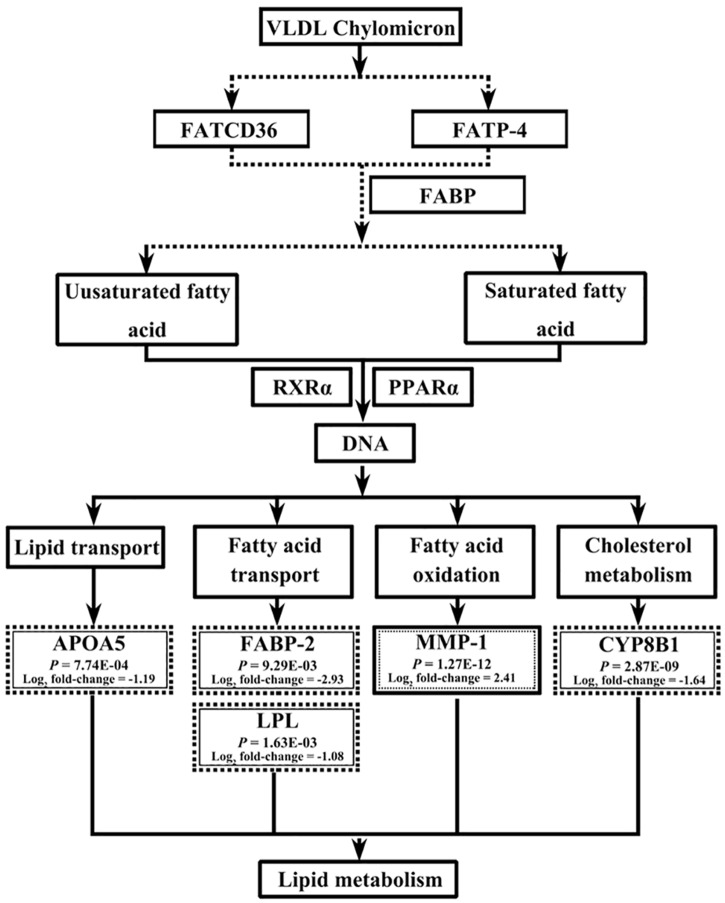
METHODOLOGY/PRINCIPAL FINDINGS: Two animal experiments were included in this study. In Experiment 1, two hundred and forty male broiler chickens were equally allocated into two groups: 1) basal diet (BD), 2) BG diets (BD + BG). Growth performance was compared between treatments for the 41-day trial. In Experiment 2, forty male broiler chickens were equally allocated into two groups. The general experimental design, group and management were the same as described in Experiment 1 except for reduced bird numbers and 21-day duration of the trial. Growth performance, abdominal fat deposition, serum lipid profiles as well as serum and tissue concentrations of key enzymes involved in lipid metabolism were compared between treatments. RNA-seq was employed to identify both differentially expressed genes (DEGs) and treatment specifically expressed genes (TSEGs). Functional clustering of DEGs and TSEGs and signaling pathways associated with lipid metabolism were identified using Ingenuity Pathways Analysis (IPA) and DAVID Bioinformatics Resources 6.7 (DAVID-BR). Quantitative PCR (qPCR) assays were subsequently conducted to further examine the expression of genes in the peroxisome proliferator-activated receptors (PPAR) signaling pathway identified by DAVID-BR. Dietary BG intervention significantly reduced abdominal fat ratio (abdominal fat weight/final body weight) in broilers. The decreased fat deposition in BG-fed chickens was in accordance with serum lipid profiles as well as the level of lipid metabolism-related enzymes in the serum, abdominal adipose, jejunum and liver. RNA-seq analysis indicated that dietary BG intervention induced 79 and 205 characterized DEGs in the jejunum and liver, respectively. In addition, 255 and 165 TSEGs were detected in the liver and jejunum of BG-fed group, while 162 and 211 TSEGs genes were observed in the liver and jejunum of BD-fed birds, respectively. Bioinformatic analysis with both IPA and DAVID-BR further revealed a significant enrichment of DEGs and TSEGs in the biological processes for reducing the synthesis, storage, transportation and secretion of lipids in the jejunum, while those in the liver were for enhancing the oxidation of ingested lipids and fatty acids. In particular, transcriptional regulators of THRSP and EGR-1 as well as several DEGs involved in the PPAR-α signaling pathway were significantly induced by dietary BG intervention for lipid catabolism.
Our results demonstrate that BG reduces body fat deposition via regulation of gene expression, which is involved in the biological events relating to the reduction of synthesis, storage, transportation and secretion, and improvement of oxidation of lipids and fatty acids.
丁酸已被证明能有效调节动物的能量消耗和脂质代谢,但其潜在机制仍有待充分了解。本研究旨在探讨丁酸甘油酯(BG)诱导肉鸡空肠和肝脏中脂质代谢的基因表达水平的分子机制。
方法/主要发现:本研究包括两个动物实验。在实验1中,240只雄性肉鸡被平均分为两组:1)基础日粮(BD)组,2)BG日粮组(BD + BG)。在41天的试验期内比较各处理组的生长性能。在实验2中,40只雄性肉鸡被平均分为两组。除鸡数量减少和试验期为21天外,一般实验设计、分组和管理与实验1相同。比较各处理组的生长性能、腹部脂肪沉积、血清脂质谱以及参与脂质代谢的关键酶的血清和组织浓度。采用RNA测序(RNA-seq)鉴定差异表达基因(DEG)和处理特异性表达基因(TSEG)。使用Ingenuity Pathways Analysis(IPA)和DAVID生物信息学资源6.7(DAVID-BR)对DEG和TSEG进行功能聚类,并鉴定与脂质代谢相关的信号通路。随后进行定量PCR(qPCR)分析,以进一步检测DAVID-BR鉴定的过氧化物酶体增殖物激活受体(PPAR)信号通路中基因的表达。日粮BG干预显著降低了肉鸡的腹部脂肪率(腹部脂肪重量/最终体重)。BG饲喂鸡的脂肪沉积减少与血清脂质谱以及血清、腹部脂肪、空肠和肝脏中脂质代谢相关酶的水平一致。RNA-seq分析表明,日粮BG干预分别在空肠和肝脏中诱导了79个和205个特征性DEG。此外,在BG饲喂组的肝脏和空肠中分别检测到255个和165个TSEG,而在BD饲喂组的肝脏和空肠中分别观察到162个和211个TSEG基因。使用IPA和DAVID-BR进行的生物信息学分析进一步揭示,空肠中DEG和TSEG在减少脂质合成、储存、运输和分泌的生物学过程中显著富集,而肝脏中的DEG和TSEG则在增强摄入脂质和脂肪酸的氧化方面显著富集。特别是,日粮BG干预显著诱导了参与脂质分解代谢的THRSP和EGR-1转录调节因子以及PPAR-α信号通路中的几个DEG。
我们的结果表明,BG通过调节基因表达减少体脂沉积,这涉及到与减少脂质合成、储存、运输和分泌以及改善脂质和脂肪酸氧化相关的生物学事件。