Fuangrod Todsaporn, Greer Peter B, Woodruff Henry C, Simpson John, Bhatia Shashank, Zwan Benjamin, vanBeek Timothy A, McCurdy Boyd M C, Middleton Richard H
Faculty of Engineering and Built Environment, School of Electrical Engineering and Computer Science, University of Newcastle, Newcastle, NSW, Australia.
Faculty of Science and IT, School of Mathematical and Physical Sciences, The University of Newcastle, Newcastle, NSW, Australia.
Radiat Oncol. 2016 Aug 12;11(1):106. doi: 10.1186/s13014-016-0682-y.
The aim of this study is to investigate the performance and limitations of a real-time transit electronic portal imaging device (EPID) dosimetry system for error detection during dynamic intensity modulated radiation therapy (IMRT) treatment delivery. Sites studied are prostate, head and neck (HN), and rectal cancer treatments.
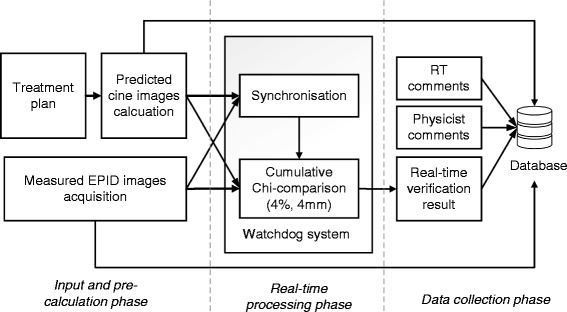
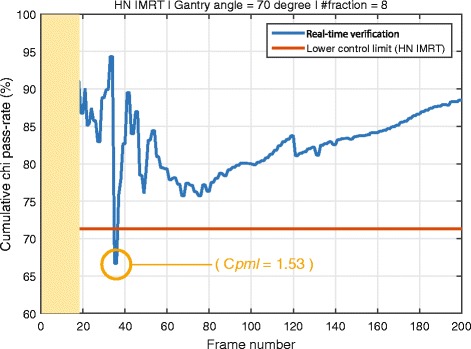
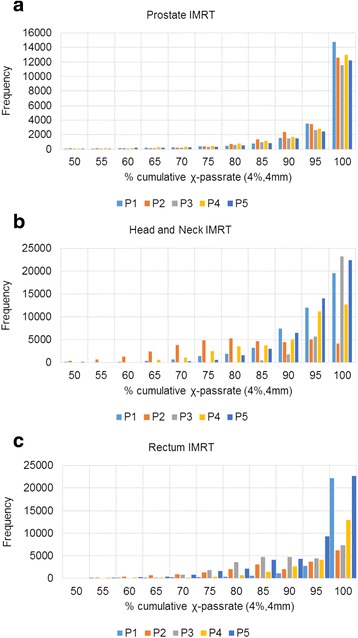
The system compares measured cumulative transit EPID image frames with predicted cumulative image frames in real-time during treatment using a χ comparison with 4 %, 4 mm criteria. The treatment site-specific thresholds (prostate, HN and rectum IMRT) were determined using initial data collected from 137 patients (274 measured treatment fractions) and a statistical process control methodology. These thresholds were then applied to data from 15 selected patients including 5 prostate, 5 HN, and 5 rectum IMRT treatments for system evaluation and classification of error sources.
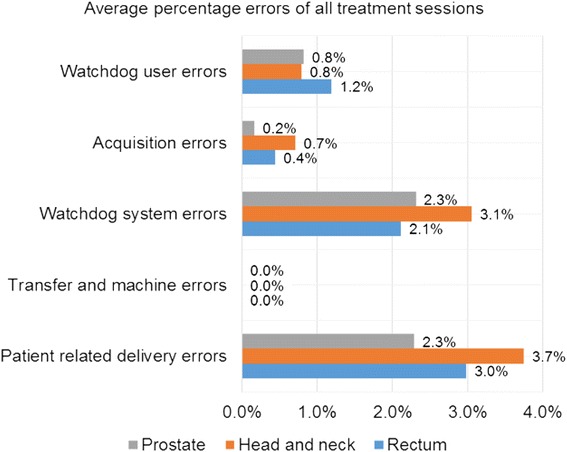
Clinical demonstration of real-time transit EPID dosimetry in IMRT was presented. For error simulation, the system could detect gross errors (i.e. wrong patient, wrong plan, wrong gantry angle) immediately after EPID stabilisation; 2 seconds after the start of treatment. The average rate of error detection was 7.0 % (prostate = 5.6 %, HN= 8.7 % and rectum = 6.7 %). The detected errors were classified as either clinical in origin (e.g. patient anatomical changes), or non-clinical in origin (e.g. detection system errors). Classified errors were 3.2 % clinical and 3.9 % non-clinical.
An EPID-based real-time error detection method for treatment verification during dynamic IMRT has been developed and tested for its performance and limitations. The system is able to detect gross errors in real-time, however improvement in system robustness is required to reduce the non-clinical sources of error detection.
本研究旨在探讨实时传输电子射野影像装置(EPID)剂量测定系统在动态调强放射治疗(IMRT)过程中进行误差检测的性能及局限性。研究部位包括前列腺癌、头颈部(HN)癌和直肠癌的治疗。
该系统在治疗过程中,使用χ²比较法(4%,4毫米标准)实时将测量的累积传输EPID图像帧与预测的累积图像帧进行比较。利用从137例患者(274个测量治疗分次)收集的初始数据和统计过程控制方法确定特定治疗部位的阈值(前列腺癌、HN癌和直肠癌IMRT)。然后将这些阈值应用于15例选定患者的数据,包括5例前列腺癌、5例HN癌和5例直肠癌IMRT治疗,以评估系统并对误差来源进行分类。
展示了IMRT中实时传输EPID剂量测定的临床验证。对于误差模拟,系统在EPID稳定后(治疗开始后2秒)能够立即检测到严重误差(即患者错误、计划错误、机架角度错误)。误差检测的平均率为7.0%(前列腺癌=5.6%,HN癌=8.7%,直肠癌=6.7%)。检测到的误差分为临床来源(如患者解剖结构变化)或非临床来源(如检测系统误差)。分类后的误差中临床来源的占3.2%,非临床来源的占3.9%。
已开发并测试了一种基于EPID的实时误差检测方法,用于动态IMRT治疗验证的性能及局限性。该系统能够实时检测严重误差,然而需要提高系统的稳健性以减少误差检测的非临床来源。