Roddis Jennifer K, Holloway Immy, Bond Carol, Galvin Kathleen T
Faculty of Health and Social Sciences at Bournemouth University, Bournemouth, UK;
Faculty of Health and Social Sciences at Bournemouth University, Bournemouth, UK.
Int J Qual Stud Health Well-being. 2016 Aug 16;11:31530. doi: 10.3402/qhw.v11.31530. eCollection 2016.
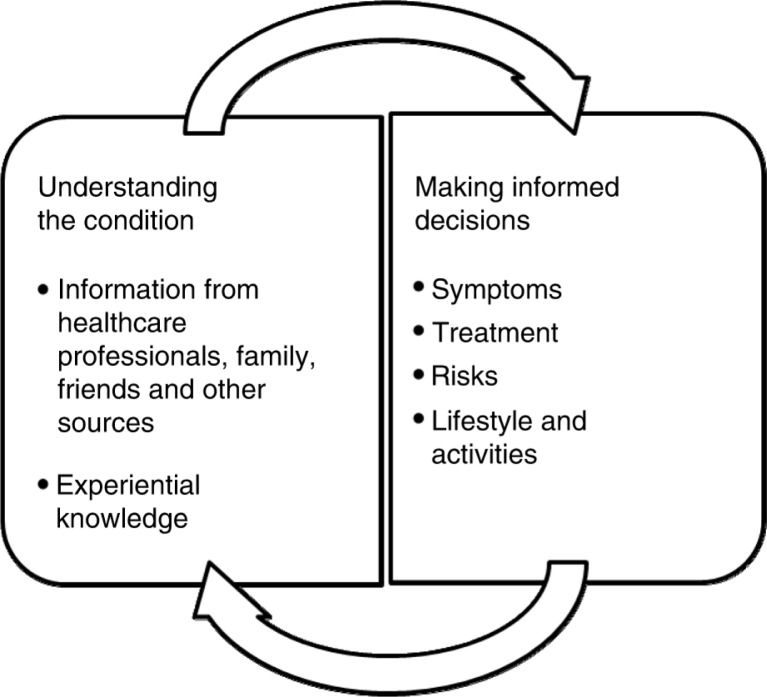
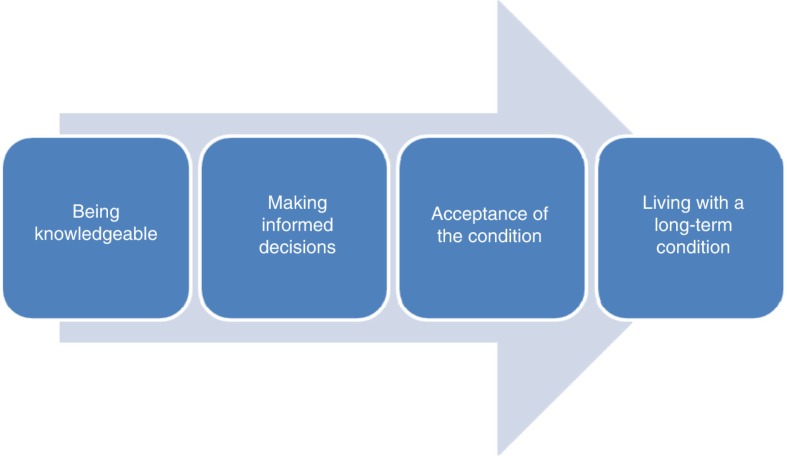
A range of literature has explored the experience of living with a long-term condition (LTC), and frequently treats such experiences and conditions as problematic. In contrast, other research has demonstrated that it may be possible to adapt and achieve well-being, even when living with such a condition. This tends to focus on meaning and the qualitative experience of living with an LTC, and offers alternative perspectives, often of the same or similar conditions. As a result of these conflicting views, this study chose to consider two conditions which, though they may lead to life-threatening illness on occasion, do not appear to impact significantly the lives of all those affected on a daily basis. The aim of this research was to explore and explain how people make sense of two long-term, potentially life-threatening health conditions, namely, thrombophilia and asthma. In doing so, it specifically considered the contribution made by information about the condition. A constructivist grounded theory approach was adopted; this enabled the generation of a theory regarding how people make sense of their LTC, whilst acknowledging the social circumstances in which this was situated. Semi-structured interviews were conducted with 16 participants who had given consent to take part in the research. The findings demonstrate that participants undergo a two-stage process-gaining knowledge and living with a long-term condition. The theory based on these findings indicates that those who are knowledgeable about their condition, making informed decisions in relation to it, and accept their condition are able to live with it, whilst those who do not accept their condition do not fully adapt to it or integrate it into their lives.
一系列文献探讨了患有长期疾病(LTC)的经历,并常常将这些经历和疾病视为问题。相比之下,其他研究表明,即使患有这种疾病,也有可能适应并实现幸福。这往往侧重于意义以及患有长期疾病的定性体验,并提供了不同的观点,通常是关于相同或相似疾病的。由于这些相互矛盾的观点,本研究选择考虑两种疾病,这两种疾病虽然有时可能导致危及生命的疾病,但似乎不会对所有受影响者的日常生活产生重大影响。本研究的目的是探索并解释人们如何理解两种长期的、潜在危及生命的健康状况,即血栓形成倾向和哮喘。在此过程中,特别考虑了有关疾病的信息所起的作用。采用了建构主义扎根理论方法;这使得能够生成一种关于人们如何理解其长期疾病的理论,同时承认这一过程所处的社会环境。对16名同意参与研究的参与者进行了半结构化访谈。研究结果表明,参与者经历了一个两阶段的过程——获取知识和与长期疾病共存。基于这些发现的理论表明,那些了解自己的病情、就病情做出明智决定并接受自己病情的人能够与之共存,而那些不接受自己病情的人则不能完全适应病情或将其融入自己的生活。