Tse Gary, Yan Bryan P, Chan Yin W F, Tian Xiao Yu, Huang Yu
Li Ka Shing Faculty of Medicine, School of Biomedical Sciences, University of Hong KongHong Kong, China; Department of Medicine and Therapeutics, Faculty of Medicine, Chinese University of Hong KongHong Kong, China.
Department of Medicine and Therapeutics, Faculty of Medicine, Chinese University of Hong KongHong Kong, China; Department of Epidemiology and Preventive Medicine, Monash UniversityMelbourne, VIC, Australia.
Front Physiol. 2016 Aug 3;7:313. doi: 10.3389/fphys.2016.00313. eCollection 2016.
Cardiac arrhythmias represent a significant problem globally, leading to cerebrovascular accidents, myocardial infarction, and sudden cardiac death. There is increasing evidence to suggest that increased oxidative stress from reactive oxygen species (ROS), which is elevated in conditions such as diabetes and hypertension, can lead to arrhythmogenesis.
A literature review was undertaken to screen for articles that investigated the effects of ROS on cardiac ion channel function, remodeling and arrhythmogenesis.
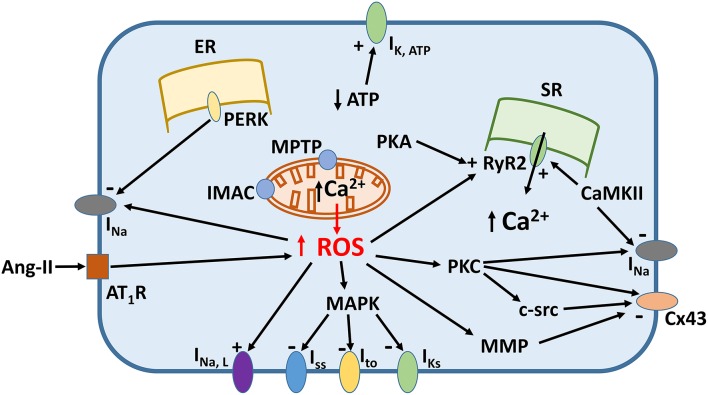
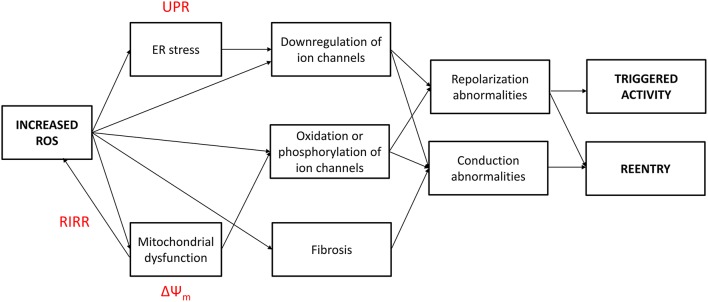
Prolonged endoplasmic reticulum stress is observed in heart failure, leading to increased production of ROS. Mitochondrial ROS, which is elevated in diabetes and hypertension, can stimulate its own production in a positive feedback loop, termed ROS-induced ROS release. Together with activation of mitochondrial inner membrane anion channels, it leads to mitochondrial depolarization. Abnormal function of these organelles can then activate downstream signaling pathways, ultimately culminating in altered function or expression of cardiac ion channels responsible for generating the cardiac action potential (AP). Vascular and cardiac endothelial cells become dysfunctional, leading to altered paracrine signaling to influence the electrophysiology of adjacent cardiomyocytes. All of these changes can in turn produce abnormalities in AP repolarization or conduction, thereby increasing likelihood of triggered activity and reentry.
ROS plays a significant role in producing arrhythmic substrate. Therapeutic strategies targeting upstream events include production of a strong reducing environment or the use of pharmacological agents that target organelle-specific proteins and ion channels. These may relieve oxidative stress and in turn prevent arrhythmic complications in patients with diabetes, hypertension, and heart failure.
心律失常是全球范围内的一个重大问题,可导致脑血管意外、心肌梗死和心源性猝死。越来越多的证据表明,活性氧(ROS)产生的氧化应激增加,在糖尿病和高血压等疾病中会升高,可导致心律失常的发生。
进行文献综述,以筛选研究ROS对心脏离子通道功能、重塑和心律失常发生影响的文章。
在心力衰竭中观察到内质网应激延长,导致ROS产生增加。糖尿病和高血压中升高的线粒体ROS可通过一个称为ROS诱导的ROS释放的正反馈环刺激其自身产生。连同线粒体内膜阴离子通道的激活,它导致线粒体去极化。这些细胞器的异常功能随后可激活下游信号通路,最终导致负责产生心脏动作电位(AP)的心脏离子通道功能或表达改变。血管和心脏内皮细胞功能失调,导致旁分泌信号改变,影响相邻心肌细胞的电生理。所有这些变化反过来又会导致AP复极化或传导异常,从而增加触发活动和折返的可能性。
ROS在产生心律失常基质中起重要作用。针对上游事件的治疗策略包括产生强还原环境或使用针对细胞器特异性蛋白质和离子通道的药物。这些可能减轻氧化应激,进而预防糖尿病、高血压和心力衰竭患者的心律失常并发症。