
通过缺失多种痘苗病毒免疫调节剂增加了衰减但降低了免疫原性。
Increased attenuation but decreased immunogenicity by deletion of multiple vaccinia virus immunomodulators.
作者信息
Sumner Rebecca P, Ren Hongwei, Ferguson Brian J, Smith Geoffrey L
机构信息
Department of Pathology, University of Cambridge, Tennis Court Road, Cambridge CB2 1QP, UK.
Department of Pathology, University of Cambridge, Tennis Court Road, Cambridge CB2 1QP, UK.
出版信息
Vaccine. 2016 Sep 14;34(40):4827-34. doi: 10.1016/j.vaccine.2016.08.002. Epub 2016 Aug 17.
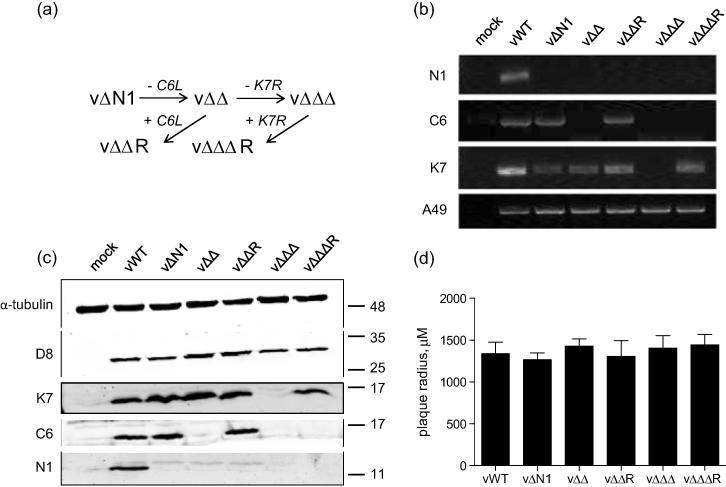
Vaccinia virus (VACV)-derived vectors are popular candidates for vaccination against diseases such as HIV-1, malaria and tuberculosis. However, their genomes encode a multitude of proteins with immunomodulatory functions, several of which reduce the immunogenicity of these vectors. Hitherto only limited studies have investigated whether the removal of these immunomodulatory genes in combination can increase vaccine efficacy further. To this end we constructed viruses based on VACV strain Western Reserve (WR) lacking up to three intracellular innate immunomodulators (N1, C6 and K7). These genes were selected because the encoded proteins had known functions in innate immunity and the deletion of each gene individually had caused a decrease in virus virulence in the murine intranasal and intradermal models of infection and an increase in immunogenicity. Data presented here demonstrate that deletion of two, or three of these genes in combination attenuated the virus further in an incremental manner. However, when vaccinated mice were challenged with VACV WR the double and triple gene deletion viruses provided weaker protection against challenge. This was accompanied by inferior memory CD8(+) T cell responses and lower neutralising antibody titres. This study indicates that, at least for the three genes studied in the context of VACV WR, the single gene deletion viruses are the best vaccine vectors, and that increased attenuation induced by deletion of additional genes decreased immunogenicity. These data highlight the fine balance and complex relationship between viral attenuation and immunogenicity. Given that the proteins encoded by the genes examined in this study are known to affect specific aspects of innate immunity, the set of viruses constructed here are interesting tools to probe the role of the innate immune response in influencing immune memory and vaccine efficacy.
痘苗病毒(VACV)衍生载体是用于预防诸如HIV-1、疟疾和结核病等疾病疫苗接种的热门候选物。然而,它们的基因组编码了多种具有免疫调节功能的蛋白质,其中几种会降低这些载体的免疫原性。迄今为止,仅有有限的研究调查了联合去除这些免疫调节基因是否能进一步提高疫苗效力。为此,我们构建了基于痘苗病毒西储株(WR)的病毒,这些病毒缺失多达三种细胞内固有免疫调节剂(N1、C6和K7)。选择这些基因是因为其编码的蛋白质在固有免疫中具有已知功能,并且单独缺失每个基因都会导致在小鼠鼻内和皮内感染模型中病毒毒力下降以及免疫原性增加。此处呈现的数据表明,联合缺失其中两个或三个基因会以递增方式进一步减弱病毒。然而,当用痘苗病毒WR攻击接种疫苗的小鼠时,双基因和三基因缺失病毒提供的针对攻击的保护较弱。这伴随着较差的记忆性CD8(+) T细胞反应和较低的中和抗体滴度。本研究表明,至少对于在痘苗病毒WR背景下研究的这三个基因而言,单基因缺失病毒是最佳的疫苗载体,并且额外基因缺失诱导的增强的减毒作用降低了免疫原性。这些数据突出了病毒减毒与免疫原性之间的微妙平衡和复杂关系。鉴于本研究中所检测基因编码的蛋白质已知会影响固有免疫的特定方面,此处构建的这组病毒是探究固有免疫反应在影响免疫记忆和疫苗效力中作用的有趣工具。



 Zotero 插件