Aper Stijn J A, Dierickx Pieterjan, Merkx Maarten
Laboratory of Chemical Biology and Institute for Complex Molecular Systems (ICMS), Department of Biomedical Engineering, Eindhoven University of Technology , P.O. Box 513, 5600 MB Eindhoven, The Netherlands.
Hubrecht Institute-KNAW and University Medical Center Utrecht , Utrecht, The Netherlands.
ACS Chem Biol. 2016 Oct 21;11(10):2854-2864. doi: 10.1021/acschembio.6b00453. Epub 2016 Sep 1.
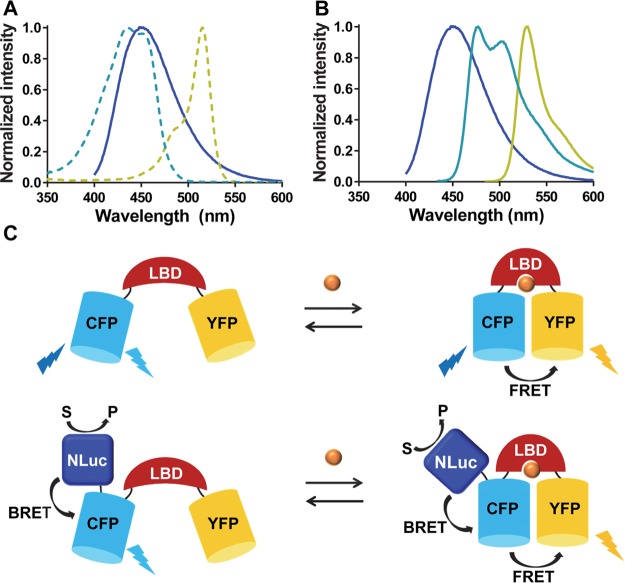
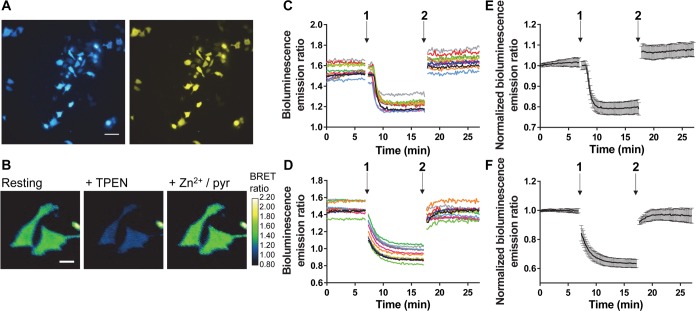
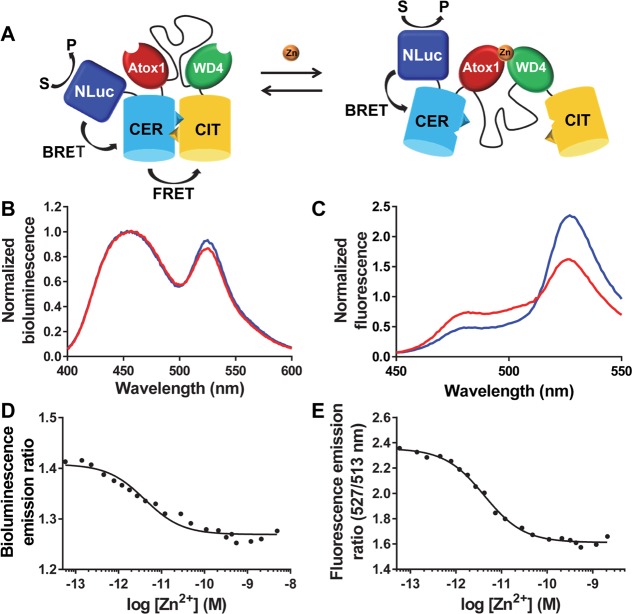
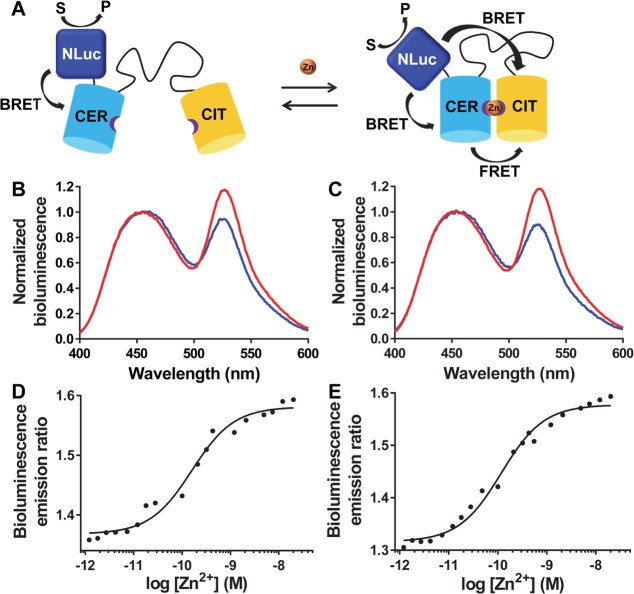
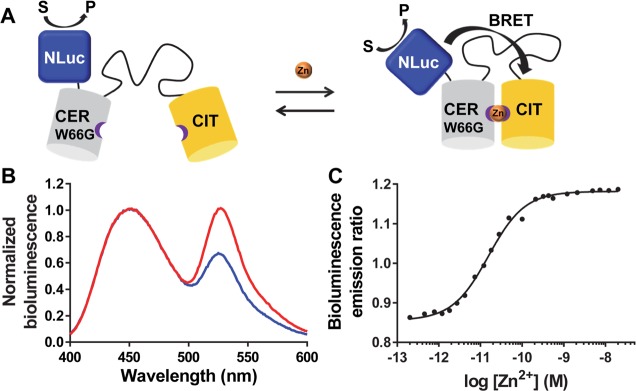
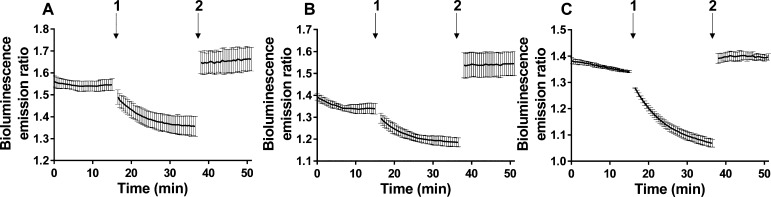
Genetically encoded FRET-based sensor proteins have significantly contributed to our current understanding of the intracellular functions of Zn. However, the external excitation required for these fluorescent sensors can give rise to photobleaching and phototoxicity during long-term imaging, limits applications that suffer from autofluorescence and light scattering, and is not compatible with light-sensitive cells. For these applications, sensor proteins based on Bioluminescence Resonance Energy Transfer (BRET) would provide an attractive alternative. In this work, we used the bright and stable luciferase NanoLuc to create the first genetically encoded BRET sensors for measuring intracellular Zn. Using a new sensor approach, the NanoLuc domain was fused to the Cerulean donor domain of two previously developed FRET sensors, eCALWY and eZinCh-2. In addition to preserving the excellent Zn affinity and specificity of their predecessors, these newly developed sensors enable both BRET- and FRET-based detection. While the dynamic range of the BRET signal for the eCALWY-based BLCALWY-1 sensor was limited by the presence of two competing BRET pathways, BRET/FRET sensors based on the eZinCh-2 scaffold (BLZinCh-1 and -2) yielded robust 25-30% changes in BRET ratio. In addition, introduction of a chromophore-silencing mutation resulted in a BRET-only sensor (BLZinCh-3) with increased BRET response (50%) and an unexpected 10-fold increase in Zn affinity. The combination of robust ratiometric response, physiologically relevant Zn affinities, and stable and bright luminescence signal offered by the BLZinCh sensors allowed monitoring of intracellular Zn in plate-based assays as well as intracellular BRET-based imaging in single living cells in real time.
基于基因编码的荧光共振能量转移(FRET)的传感器蛋白极大地促进了我们目前对锌细胞内功能的理解。然而,这些荧光传感器所需的外部激发在长期成像过程中会导致光漂白和光毒性,限制了受自发荧光和光散射影响的应用,并且与光敏感细胞不兼容。对于这些应用,基于生物发光共振能量转移(BRET)的传感器蛋白将提供一个有吸引力的替代方案。在这项工作中,我们使用明亮且稳定的荧光素酶NanoLuc创建了首个用于测量细胞内锌的基因编码BRET传感器。采用一种新的传感器方法,将NanoLuc结构域与之前开发的两种FRET传感器eCALWY和eZinCh-2的天蓝蛋白供体结构域融合。除了保留其前身出色的锌亲和力和特异性外,这些新开发的传感器还能够进行基于BRET和FRET的检测。虽然基于eCALWY的BLCALWY-1传感器的BRET信号动态范围受到两条竞争性BRET途径的限制,但基于eZinCh-2支架的BRET/FRET传感器(BLZinCh-1和-2)在BRET比率上产生了25% - 30%的显著变化。此外,引入发色团沉默突变产生了一种仅基于BRET的传感器(BLZinCh-3),其BRET响应增加(50%),并且锌亲和力意外增加了10倍。BLZinCh传感器提供的强大比率响应、生理相关的锌亲和力以及稳定且明亮的发光信号,使得在基于平板的测定中能够监测细胞内锌,同时也能够在单个活细胞中实时进行基于细胞内BRET的成像。