den Hamer Anniek, Dierickx Pieterjan, Arts Remco, de Vries Joost S P M, Brunsveld Luc, Merkx Maarten
Laboratory of Chemical Biology and Institute for Complex Molecular Systems, Department of Biomedical Engineering, Eindhoven University of Technology, Den Dolech 2, 5612 AZ Eindhoven, The Netherlands.
Hubrecht Institute-KNAW and University Medical Center Utrecht, 3584 CT Utrecht, The Netherlands.
ACS Sens. 2017 Jun 23;2(6):729-734. doi: 10.1021/acssensors.7b00239. Epub 2017 May 31.
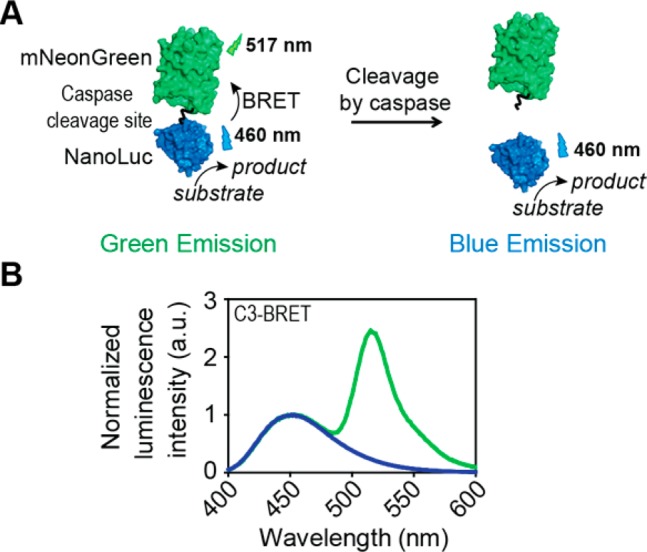
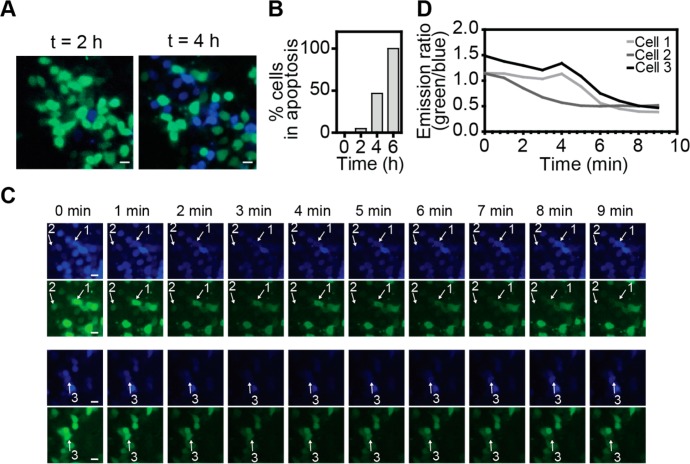
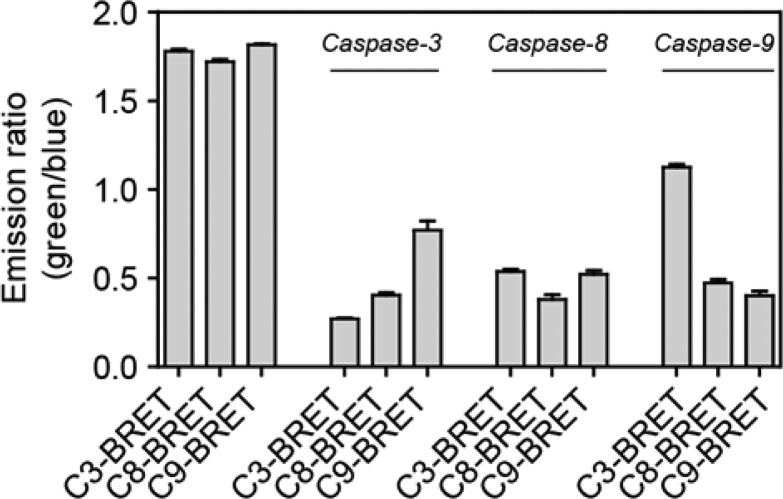
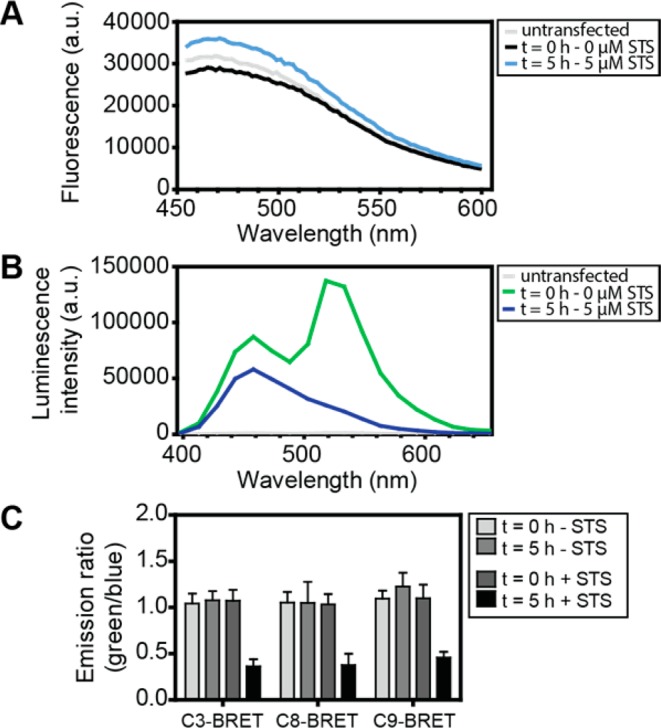
FRET-based caspase activity probes have become important tools to monitor apoptotic cell signaling. However, their dependence on external illumination is incompatible with light sensitive cells and hampers applications that suffer from autofluorescence and light scattering. Here we report the development of three caspase sensor proteins based on Bioluminescence Resonance Energy Transfer (BRET) that retain the advantages of genetically encoded, ratiometric optical probes but do not require external illumination. These sensors consist of the bright and stable luciferase NanoLuc and the fluorescent protein mNeonGreen, fused together via a linker containing a recognition site for caspase-3, -8, or -9. characterization showed that each caspase sensor displayed a robust 10-fold decrease in BRET ratio upon linker cleavage, with modest caspase specificity. Importantly, whereas scattering and background fluorescence precluded FRET-based detection of intracellular caspase activity in plate-reader assays, such measurements could be easily performed using our caspase BRET sensors in a high throughput format. The brightness of the BRET sensors also enabled long-term single-cell imaging, allowing BRET-based recording of cell heterogeneity in caspase activity in a heterogenic cell population.
基于荧光共振能量转移(FRET)的半胱天冬酶活性探针已成为监测凋亡细胞信号传导的重要工具。然而,它们对外部光照的依赖与光敏感细胞不兼容,并阻碍了受自发荧光和光散射影响的应用。在此,我们报告了基于生物发光共振能量转移(BRET)开发的三种半胱天冬酶传感器蛋白,它们保留了基因编码的比率光学探针的优点,但不需要外部光照。这些传感器由明亮且稳定的荧光素酶NanoLuc和荧光蛋白mNeonGreen组成,通过含有半胱天冬酶-3、-8或-9识别位点的接头融合在一起。表征表明,每个半胱天冬酶传感器在接头切割后BRET比率均出现强劲的10倍下降,半胱天冬酶特异性适中。重要的是,虽然散射和背景荧光排除了在酶标仪检测中基于FRET检测细胞内半胱天冬酶活性的可能性,但使用我们的半胱天冬酶BRET传感器可以很容易地以高通量形式进行此类测量。BRET传感器的亮度还实现了长期单细胞成像,允许基于BRET记录异质细胞群体中半胱天冬酶活性的细胞异质性。