Ortiz-Fernández Lourdes, Carmona Francisco-David, Montes-Cano Marco-Antonio, García-Lozano José-Raúl, Conde-Jaldón Marta, Ortego-Centeno Norberto, Castillo María Jesús, Espinosa Gerard, Graña-Gil Genaro, Sánchez-Bursón Juan, Juliá María Rosa, Solans Roser, Blanco Ricardo, Barnosi-Marín Ana-Celia, Gómez de la Torre Ricardo, Fanlo Patricia, Rodríguez-Carballeira Mónica, Rodríguez-Rodríguez Luis, Camps Teresa, Castañeda Santos, Alegre-Sancho Juan-Jose, Martín Javier, González-Escribano María Francisca
Department of Immunology, Hospital Universitario Virgen del Rocío (IBiS, CSIC, US), Sevilla, 41013, Spain.
Instituto de Parasitología y Biomedicina "López-Neyra", CSIC, PTS Granada, Granada, 18016, Spain.
PLoS One. 2016 Aug 22;11(8):e0161305. doi: 10.1371/journal.pone.0161305. eCollection 2016.
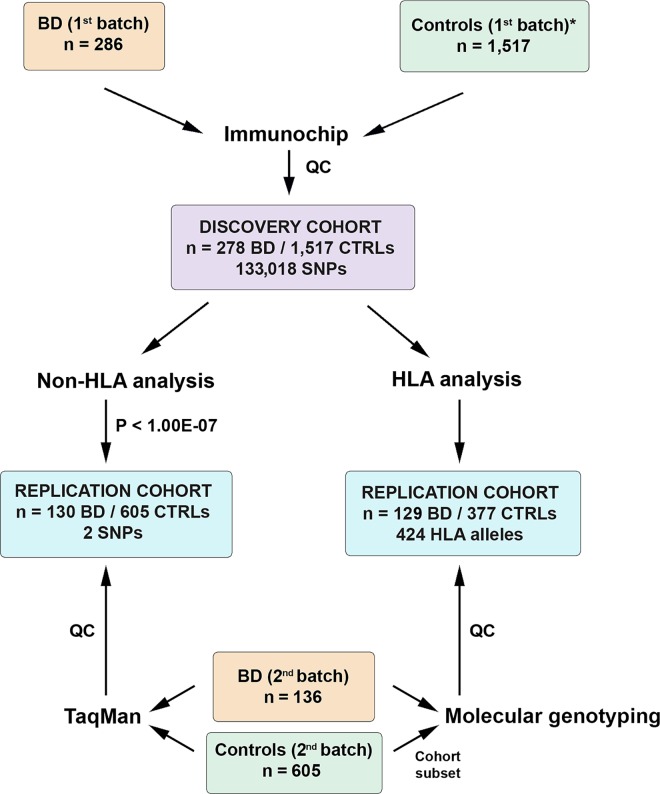
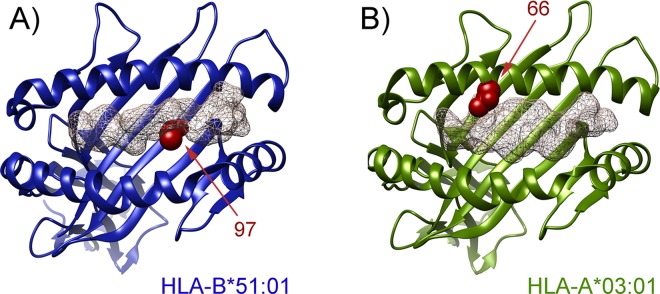
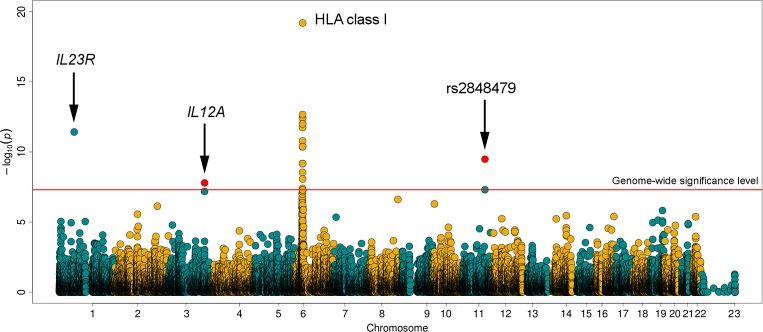
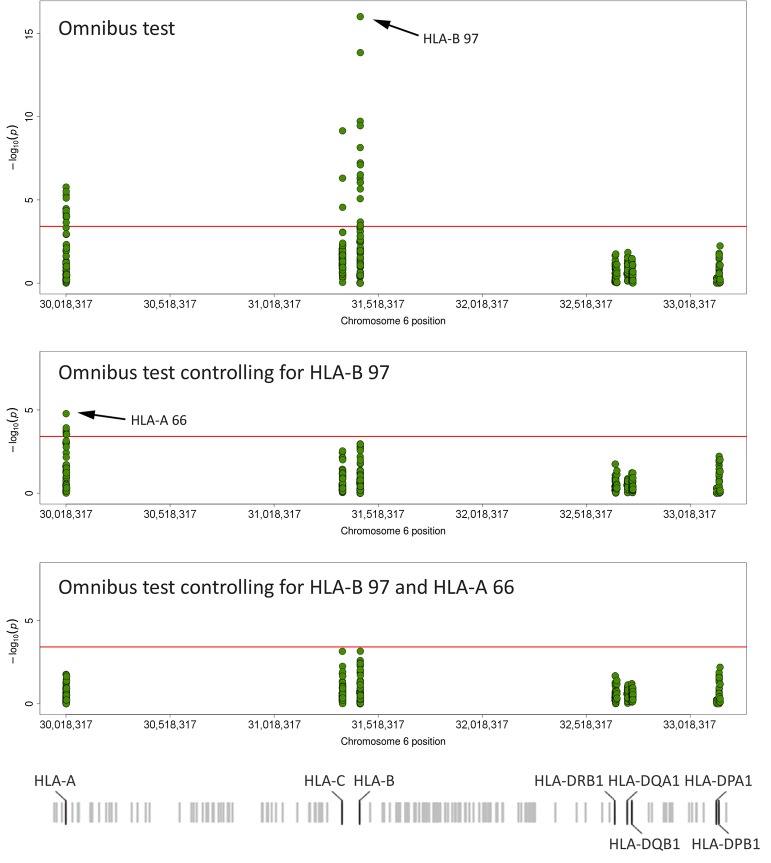
Behcet's disease (BD) is an immuno-mediated vasculitis in which knowledge of its etiology and genetic basis is limited. To improve the current knowledge, a genetic analysis performed with the Immunochip platform was carried out in a population from Spain. A discovery cohort comprising 278 BD cases and 1,517 unaffected controls were genotyped using the Immunochip platform. The validation step was performed on an independent replication cohort composed of 130 BD cases and 600 additional controls. The strongest association signals were observed in the HLA class I region, being HLA-B51 the highest peak (overall P = 6.82E-32, OR = 3.82). A step-wise conditional logistic regression with classical alleles identified HLA-B57 and HLA-A03 as additional independent markers. The amino acid model that best explained the association, includes the position 97 of the HLA-B molecule and the position 66 of the HLA-A. Among the non-HLA loci, the most significant in the discovery analysis were: IL23R (rs10889664: P = 3.81E-12, OR = 2.00), the JRKL/CNTN5 region (rs2848479: P = 5.00E-08, OR = 1.68) and IL12A (rs1874886: P = 6.67E-08, OR = 1.72), which were confirmed in the validation phase (JRKL/CNTN5 rs2848479: P = 3.29E-10, OR = 1.66; IL12A rs1874886: P = 1.62E-08, OR = 1.61). Our results confirm HLA-B51 as a primary-association marker in predisposition to BD and suggest additional independent signals within the class I region, specifically in the genes HLA-A and HLA-B. Regarding the non-HLA genes, in addition to IL-23R, previously reported in our population; IL12A, described in other populations, was found to be a BD susceptibility factor also in Spaniards; finally, a new associated locus was found in the JRKL/CNTN5 region.
白塞病(BD)是一种免疫介导的血管炎,目前对其病因和遗传基础的了解有限。为了增进当前的认识,我们在西班牙人群中使用免疫芯片平台进行了基因分析。使用免疫芯片平台对一个由278例BD病例和1517名未受影响的对照组成的发现队列进行了基因分型。验证步骤在一个由130例BD病例和600名额外对照组成的独立重复队列中进行。在HLA I类区域观察到最强的关联信号,其中HLA - B51是最高峰(总体P = 6.82E - 32,OR = 3.82)。通过经典等位基因进行的逐步条件逻辑回归确定HLA - B57和HLA - A03为额外的独立标记。最能解释这种关联的氨基酸模型包括HLA - B分子的第97位和HLA - A的第66位。在非HLA基因座中,发现分析中最显著的是:IL23R(rs10889664:P = 3.81E - 12,OR = 2.00)、JRKL/CNTN5区域(rs2848479:P = 5.00E - 08,OR = 1.68)和IL12A(rs1874886:P = 6.67E - 08,OR = 1.72),这些在验证阶段得到了证实(JRKL/CNTN5 rs2848479:P = 3.29E - 10,OR = 1.66;IL12A rs1874886:P = 1.62E - 08,OR = 1.61)。我们的结果证实HLA - B51是BD易感性的主要关联标记,并提示I类区域内还有其他独立信号,特别是在HLA - A和HLA - B基因中。关于非HLA基因,除了我们人群中先前报道的IL - 23R;在其他人群中描述的IL12A,在西班牙人中也被发现是BD的易感因素;最后,在JRKL/CNTN5区域发现了一个新的关联基因座。